Friday, June 26, 2020

Washington Middle School Flagship Water Explorers: Part Four

Introducing the Watershed Education Network’s Washington Middle School Flagship Water Explorers 2020 

By Deb Fassnacht and Jenna Rolle

Week Four: Marsh Soup


Our fourth week of Water Explorers I was really excited to try out a lesson I had found in a curriculum book in the WEN office: Marsh Soup! The goal of this lesson is to familiarize the students with the marshy area that surrounds Bancroft pond. The marshy areas may not be as classically beautiful or fresh as a flowing stream or an idyllic pond, but they support the bulk of riparian habitat for important plants, animals, and insects. Luckily, this batch of Water Explorers was more than happy to muck around in the marsh, regardless of stinky smells or unappetizing squishing sounds underfoot. 

To make marsh soup (or salad, or casserole, or whatever the students want it to be) each team was given a bowl and instructed to build a meal from the marsh. The teams were then to be scored on two criteria: quantity of ingredients and presentation. Both teams took different approaches. Team one opted for quantity, and ended up with 15 different plants, 6 different types of mud, and ice, stream water, and pond water. Team two created a beautiful presentation of seeds, moss and leaves, and still fit quite a few different ingredients in there.


It was really wonderful to see the whole team of explorers out there hunting for marsh treasures and mucking about in an area of the hydrologic cycle that most people ignore. We returned to Washington covered in mud and still chattering about all the cool stuff we found in the marsh. After a quick apology to the parents for the state of their clothes, I sent the students off for their Spring Break.

Friday, June 19, 2020

Washington Middle School Flagship Water Explorers: Part Three

Introducing the Watershed Education Network’s Washington Middle School Flagship Water Explorers 2020 

By Deb Fassnacht and Jenna Rolle

Week Three: More Cattails and Bugs!

Our numbers were cut in half for the third week of Water Explorers, with two of the team in band practice. But the weather was semi-decent so we packed our clipboards and colored pencils and walked down to Bancroft Pond. After seeing the students’ interest in cattails, I had thought to do a miniature plant lesson. Each student found two plants around Bancroft Pond and sketched them, and wrote down two things that they thought made that plant stand out from the others. We then looked in a Wetland Plant Identification book to try and identify the plants they sketched. Finding the dichotomous key to be a bit over even my head, we ended up looking up the plant names and comparing the page to the sketches. They had done a really awesome job identifying the key features of their plants and what set those apart from the others for easy identification.


Once the plant lesson was finished, we still had another 20 minutes before we had to head back to Washington, so the students had free ‘wander and explore’ time. During this time we encountered a gigantic bug, at least 2 inches long, crawling around on a log in the ice of the pond. Much shrieking and excitement ensued. Once we had safely escorted the bug back to its habitat, we packed our bags up once again and headed back to the school. 

Friday, June 12, 2020

Washington Middle School Flagship Water Explorers: Part Two

Introducing the Watershed Education Network’s Washington Middle School Flagship Water Explorers 2020 

By Deb Fassnacht and Jenna Rolle

Week Two: Meeting all the Water Explorers and Exploring Bancroft Pond

The second week of Water Explorers at Washington Middle School was the first time the troupe of water-lovers was all together. All four 6th graders were able to attend, Deb joined for the first part of the lesson, and I was excited to lead a group outing to Bancroft Pond. After introducing ourselves to each other and setting some ground rules for the program, we grabbed our best outdoorsy shoes, jackets, and gloves and headed down to the pond.

The aim of the first week was to get the students oriented to Bancroft Pond, a beautiful park just down the road from their school, and get a feel for their interests in the water-sphere. To prompt this, I had each student write down two observations and two questions they had after a day of exploring the area. The hope was to use these questions and observations as guides to help plan curriculum. I quickly noticed that what the students seemed most interested in were the cattails, which had recently begun to seed out and could be ripped apart and thrown like confetti. All in all, the students seemed to be incredibly happy to be outside, in spite of cold temperatures, and I was excited to have such an energetic and engaged group.


Friday, June 5, 2020

Washington Middle School Flagship Water Explorers: Part One

Introducing the Watershed Education Network’s Washington Middle School Flagship Water Explorers 2020 

By Deb Fassnacht and Jenna Rolle


In January of 2020, Watershed Education Network’s team reached out to Washington Middle School to see about expanding citizen science with students there. We were encouraged to consider the after school program, Flagship. In the winter, we met with Flagship leader, Kristian Stipe to learn about how we could work with the afterschool program and lead students in grades 6-8 on water observations, explorations, and record change over time as citizen scientists. Lucky for us, Jenna Rolle, a winter volunteer and former hydrologic technician, wanted to join the afterschool explorations. Deb and Jenna kicked off this spring’s program.

Week One: Meeting the Flagship Explorers and heading out to discover Pattee Creek and Bancroft Pond

On the first day, Deb met with a few interested students at the school. We met in the cafeteria room with the big cafeteria tables. All the Flagship programs had a table and sign directing kids to their activities. There were crafts, dungeons and dragons, robotics, and some martial arts. I went for one more trip from my car for art supplies and when I returned, I saw one young girl at our table. I asked if she was there for Water Explorers and she replied with a big smile, “Yes.” Then she quickly blurted out, “I LOVE water” and we both laughed. And I said, “I do too, it is one of my favorite places.” We decided to wait for others before going out the back door for a recess. One student came by and said he would be there next week. 

We played ‘Ga-ga-ball,’ a form of dodge ball in a fenced area where the goal is to bounce the ball twice (saying "ga-ga") trying to hit the other person with the bouncing ball. I was the one trying to avoid the ball. The ball pit was filled with ice, water and mud, so soon we were a bit wet and muddy. Since it was a March day with sun shining and the smell of melted snow was in the air, we both wanted to go explore! We decided to go follow Pattee Creek to Bancroft Pond and do some observing and scouting for the rest of the group the following week. 

Such a beautiful day! We enjoyed the sun, the feel of spring, melting snow and a breeze on our faces. Bancroft Pond was frozen and still, sun and shadows with a few birds overhead. We looked for geese and ducks that would be coming back as the weather warmed. Old snow, feathers, and cattails from the year before were bending near the icy trails. My student explorer checked out the ice along the edge of the pond and in the puddles we came across on the trail…snap, crackle, and crunch. We hurried back to the school so we could be on time. I was impressed that my young explorer wanted to pick up garbage we found along the storm drain and beside the sidewalk as we went. We timed our walk for the following weeks. It took 20 minutes from the door of the school to Bancroft Pond. We knew we could explore and have students back each week.

Wednesday, May 20, 2020

Hellgate Elementary Exploration

October 15, 2019
By Bailey Bartell

Hey everyone! I felt incredibly lucky to go with Deb, the Executive Director of WEN, to the classroom as well as the field on this recent project that we accomplished. The WEN team and about 20 volunteers took the entirety of Hellgate Elementary’s second grade class to the Rocky Mountain Elk Foundation (RMEF) for a field trip. With support from the Hellgate PTA, WEN was able to reach close to 180 students in order to expose them to the river ecosystem. 
While in the classroom, Deb began the lesson connecting the students to the river by thinking about things they already know. We talked about what allows us to know that a river is healthy and what we wonder about rivers. We drew pictures of what a healthy river looks like and we collected some wonderful curiosities from the kids like: how far does the river go? Where does it come from? How do we know if it is clean? How do the bugs get there? In addition to introducing musings about the Clark Fork River, we played games and sang songs to help us learn how to identify a mayfly, stonefly and caddisfly. These were the same aquatic macroinvertebrates that we searched for during our field trip at Grant Creek.

On the mornings of our five field trip days, volunteers arrived to the RMEF early to collect insects from the creek for the students to search for in tubs and identify. I was able to guide the experience for students as they found and sorted these various aquatic macroinvertebrates. The level of excitement that was derived from each insect was contagious. Each time a student found a new insect, they would exclaim and treat it like a prize they won. This reaction came from all the students. It was really fun to watch the students who were hesitant in the beginning become excited and involved in the process of searching through the tubs of cold water, insects and detritus. The energy was palpable and helped to create an engaging and positive learning environment.

In addition to finding macroinvertebrates, the students wandered through the property on their riparian walk. They were introduced to the concept of what makes up a riparian area and the benefits of maintaining the natural spaces next to our water sources. We talked about what animals live there, what plants and space help to create a healthy riparian area and took time to connect to the place. We accomplished this by taking interactive walks around RMEF’s property. We listened to the creek sounds, made observations about the downed trees and tall grasses and became young scientists by drawing in our field journals to document our findings.


We ended our afternoons with an active game, Macroinvertebrate Mayhem, that models what happens to our rivers when heat and sediment are introduced to the cold mountain streams. The students were a caddisfly, stonefly, or mayfly and moved down a cold, clear river. As heat and sediment moved into the river as well, the cold water insects changed to warm water compatible insects. At the end, we discussed how the river goes through yearly cycles and why it is important to maintain healthy conditions of cold, clear rivers as much as possible.

I feel incredibly lucky to have witnessed the relationships built with WEN from introductions to waving goodbye after being told one thing that they learned while being with us.

Wednesday, May 13, 2020

My Stream Team Introduction

My Stream Team Introduction 
October 15, 2019
By Bailey Bartell

These past few weeks I have been part of two different groups who go out to collect data on watersheds with the downstream idea of positive impact. I have been part of two different citizen science Stream Teams collecting data on Rattlesnake Creek.
During my time with Stream Team Level Two, we took two different cross sections of the creek in order to measure the creek bed depth. We did this so in the following years we can measure the changes after the dam is removed upstream. David, Aissa and I waded across the creek and setting up a tape for measurement and using a fancy scope (hand level) in order to get a level reading. It took us a good few hours to do so, all the while slipping and sliding under the grey clouds that rolled around the valley. 

My second experience with Stream Team Level Two involved taking longitudinal profiles of Rattlesnake Creek beginning about 100 feet downstream from the currently existing dam. David, Joe and I were essentially measuring the gradient of the creek by taking measurements every forty feet. This required us to run a measuring line forty feet from each reading that we took, we measured the depth at the bankfull, the wetted edge and the thalweg. The bankfull is where the water would rest if the creek bed were full, the wetted edge is where the water is currently sitting in the bed and the thalweg is where most of the downstream current is going. So we took each of these measurements and one additional backsight, every forty feet down this creek until we got to our original cross sections. It was slow moving, but it was incredibly beautiful and humbling to witness the experimental process of new research.


My third experience with Stream Team was with Level One. This group is a group of young adults that go to Rattlesnake Creek every Sunday in order to take varying sets of data. This past Sunday we went to a spot 100 feet below the dam in order to collect physical (cross-section, pebble count, velocity, and photo points), chemical (temperature, pH, and dissolved oxygen), and bug diversity from the creek. We had eight people and lots of work to accomplish. This time, everyone was stationed in one location with no intention to move. It was so powerful to witness so many people dedicating their free time to citizen science! We rallied on getting things done quickly and sharing responsibilities so we collected all of the data for the day in just around three hours. We were lucky to spend the day in dappled sunshine and a light breeze.


It is really rewarding to be part of a process that is paving the way for citizen science in our country and gain so much experience in the process. It is really easy to sign up to be part of the research. All you have to do is email Aissa Wise who is WEN’s Stream Team Coordinator and come to a training. There will be several trainings over the next season and it is a great way to give back to the community.


Wednesday, December 12, 2018

Living in a Caddisfly Case: Part One

By Cassie Sevigny

The wind carries the sharp, salty smell of dead seaweed, thick and dark, strewn across the grey stones. Most things are grey on the Puget Sound beach – the salted and sundried driftwood above the tide line, the clouds that hang overhead, the seagulls picking at picnic scraps, the puddles of rain… I relish the quiet, contemplative mood required to enjoy this grey but textured landscape. My siblings and I would spend hours collecting logs to build forts to withstand the tides and wind coming off the water, as if we were marooned and in need of shelter. This piece of ocean was my main connection to water for almost a decade. Then I moved to Montana.
Montana is landlocked. There is no ocean, not even a protected piece of one like Puget Sound. Nowhere to stand on a beach and imagine how far out the horizon expands. There were mountains and forest though, so with them as the structure of my new home, I sought out inland waters to nourish it.
The Watershed Education Network found me at a volunteer fair. They teach youth (and adults) about what makes a healthy watershed, at least for Missoula County. A woman named Becca gave me the basics of understanding water chemistry, insects, and measuring physical characteristics. She had bright, peppy eyes, frizzy hair in a perpetual ponytail, and an adoration for bugs.
I wanted peaceful moments to experience and learn about rivers myself before I taught watershed science to local kids, so I joined WEN’s citizen science program called Stream Team. Volunteers went out in the fall and spring to gather data from streams, as if we were doctors conducting check-ups. Each trip consisted of four hours of freezing our hands, checking the sky and our waders for leaks, estimating the river’s depth at full flows, and taking its temperature. I ate up the information, and the snacks packed by Deb, the Director. Like any other animal, I knew these people feeding me would be my friends.

Friday, September 21, 2018

Rattlesnake Creek Discovery

WEN's First Summer Camp: A Reflection


     The 2018 Rattlesnake Creek Discovery Summer Camp, in partnership with the Missoula International School, was a full week of fun, play, and learning. Six children attended Monday-Friday 9 a.m.-3 p.m. On the first day, the Rattlesnake Creek explorers collected macro-invertebrates from two different locations, then learned how to identify and draw these aquatic insects.


    Tuesday was introduction to bug anatomy, and more exploration north of the Pavilion. The explorers ventured off into the riparian area along Rattlesnake Creek and discovered interesting critters. The day ended with a cool down in the creek!

     On day three, we mapped Rattlesnake Creek and created our own maps of Greenough Park. We also measured the velocity of the Creek with our sticks and painted rocks with Pam Ward (our guest instructor from Sussex School). Lastly, we rounded out the day with Bull trout game fun!


    Thursday we did a water cycle game and journaled about being a water drop. Cas Smith (our hydro-geologist guest presenter) taught a lesson on groundwater, which included exploring various wells in Greenough Park. The afternoon concluded with watercolor painting and Lego building.

     On our last day, the children collected sticks as we hiked and explored through Greenough, and then we used those sticks to construct “dreamboats”. Afterwards, we launched our boats down the Creek. Finally, we celebrated this special week-long summer camp with a macro-invertebrate mayhem game, and said farewell to the Rattlesnake Creek.


     As the partner of an ex-river guide, I've heard (and fallen in love with) a phrase that seems to capture the spirit of this camp, "Let's just read and run." Read the river, then run it accordingly. While developing the Rattlesnake Creek Explorations Camp, we built a structured schedule which we followed every morning. I was an afternoon volunteer and witnessed firsthand how the overall mood vacillated in the full-belly, post-lunch afternoon heat. The children would either rally energetically after a quick dip in the creek, or feel lethargic. 
     
     It seemed that they fed off of each other's energy, without any verbal communication. It was so fun to read them, and then help steer the afternoon schedule according to their wants and needs. We had so much fun every afternoon. Whether we were taking a break from the heat and painting rocks inside an MIS classroom, focusing on a groundwater lesson, or playing with spray-bottles at the Greenough playground- this camp was totally kid-centric. It was so fulfilling to help facilitate the creation of positive summer memories for these six, very awesome kids. 


This camp couldn't have happened without the leaders from the Missoula International School and Watershed Education Network: John Walker and Deb Fassnacht. Special thanks to our guest instructors Pam Ward and Cas Smith! Shout-out to our volunteers: Madeline Wilber, Cassie Sevigny, Markus Boyer, and Eli Santos.

I look back on this summer camp fondly, and consider it a huge success. We at WEN are looking forward to Summer 2019, and the possibility of offering more camps like this. 

Thanks for reading, and happy first day of Fall!
Katrina Thorness
Watershed Education Network
Communications Coordinator
802 East Front St.
Missoula, MT. 59802
Ph (406) 541-9287
Check us out on facebook for updates. 

Katrina is a part-time Communications Coordinator who is focusing on becoming a 'Jane of All Trades' in life, and for WEN. She assists with program development, and has worked on projects for YCC, AIS, and School Stream Monitoring. One of Katrina's life goals is to continue nurturing a community of outdoor learning in the region.

Tuesday, August 14, 2018

What Goes into an Experiment? - Sentinel Floating Islands

4/17/18

     I joined Sylvia at Sentinel High School again as her two classes learned about experimental design. They had been given an article the previous session detailing an experiment about the efficacy of floating islands in removing excess nutrients from the water. Broken into groups, the students sifted through the fancy terminology and scientific structure of the article to find the key points to summarize.

     Sylvia had the students write unfamiliar vocabulary words on the board. She addressed the first word off the bat as it pertained to the experiment's first design.

     "Batch mesocosm can be one of those stressful words," Sylvia said. Mesocosm just means medium-sized-world, as the experiment was not on a tiny scale or a large scale. "Batch" referred to the way the researchers included water in the system. They created batches of water that mimicked the composition of natural pond or creek water and held it motionless in containers. This is contrast to the second design, which allowed that water to flow.

     The students described the batch mesocosms as being a box shape with a native macrophyte on the small floating island. Sylvia then explained another vocabulary word. "A microphyte is basically a small plant." Like algae. She compared the prefix to the word "microscope" which the students were familiar with, to make the connection that microscopes help you see tiny things such as microphytes. A macrophyte, then, is an aquatic plant that is large enough to see, like grass. So each little island had a native plant living atop it.


     "Why do you need a control?" Sylvia asked.
     "What's a control?"
     Sylvia explained that one of the batches did not have a floating island or any plants, just a metal sheet to produce the same amount of shade. This plantless batch was the control.
     "So, to compare to the other one," a student said.
     "Why do they have three experimental tanks?" These would be the batches with plants.
     "Alter them to see different effects," a student suggested. Indeed, a researcher would use their experimental tanks in comparison to the control to see which variables produce measurable changes and which do not, or which produce the most change. Sylvia got to a more basic point though, which is that researchers want to make sure their "data is stable." This means that they gather enough data from the experimental batches that they can find a pattern across all of them. This ensures that if, for example, one of the plants is dying, it doesn't determine all of the results. Having extra batches helps make sure the correct variables contribute the desired information.

     Then they moved on to the next design. The flow tanks took place in "a giant shipping container" divided in half lengthwise with water flowing through each side. Here the researchers wanted to know if the rate of water flow mattered, so one side had slow-moving water and the other had fast-moving water. The steel container had a special coating to prevent metal ions from entering the water, since they can be toxic to plants. Each side also had soil at the bottom. Sylvia reminded the students that soil can have nutrients in it, especially when it contained decomposed materials, so the soil imitated natural conditions where the nutrients came from within the system.

     "One of them absorbed more than the other," a student noted.
     "Yes, definitely. Which one?" Sylvia asked.
     "I think it was the high flow," the student answered.
     Sylvia reviewed the previous lesson on the phosphorus and nitrogen cycles. Both of these are nutrients that are important to plant growth, but in large amounts they can lead to the overgrowth of microphytes: algae blooms. The side with high water flow had more of these nutrients removed by the floating island plants, indicating that faster streams are better at preventing algal overgrowth.

     With the design out of the way, Sylvia broke the experiment down into its most basic parts. She guided the students through identifying the dependent and independent variables of each design. The students identified the dependent variables fairly quickly (the presence or absence of a floating island in the batches, and water flow in the flow tanks), but had trouble with the independent variable. Sylvia emphasized that the answer was simple, and the same across both designs, since the researchers were interested in one thing. This was the level of nutrients (phosphorus and nitrogen) in the water, as lower levels mean the floating islands are removing them more effectively.

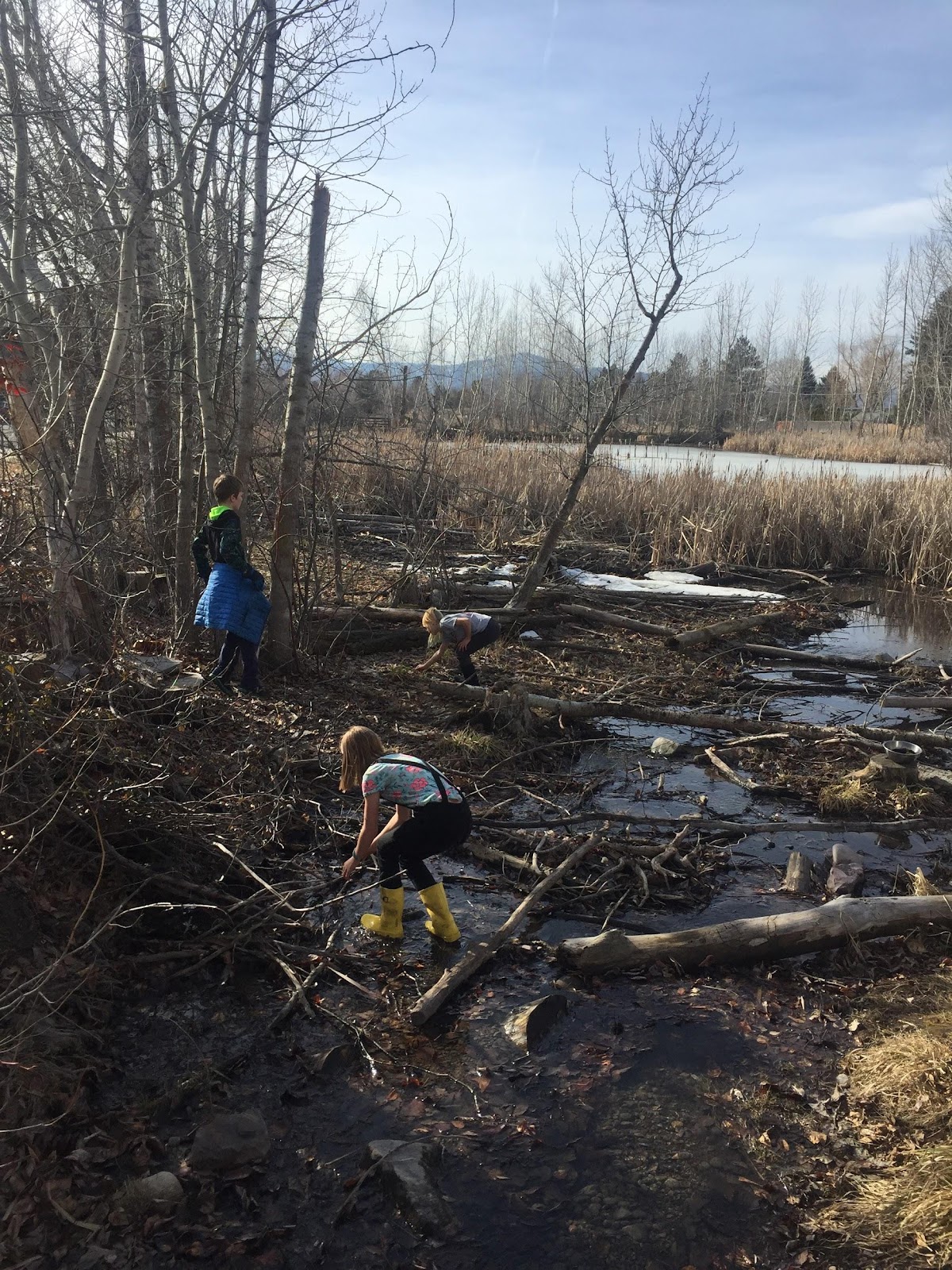
Mini floating island models
     These experiments both took place in a laboratory environment, which is useful because "you can control what happens," as one student said. In other words, there are fewer variables at play because you can choose which ones to include, which then "makes [the data] easier to interpret," as Sylvia said.

     Field experiments have advantages too. "You get all the natural things that could happen right there," another student said, so you don't have to try to replicate all the variables that do exist and interact. If an experiment left some of these variables out, the results might not accurately reflect what would happen in a real ecosystem when one variable changes. This helped the students realize that an effective laboratory experiment should aim to be as much like the natural system as possible.

     Sylvia set the students to work in small groups on a worksheet that asked them to identify other variables that could be important in designing a floating island experiment. I wandered around to guide their thought processes, without giving away any answers.

     Sylvia's repeated use of small groups was intentional, as it can help students develop leadership and social skills through conversation practice. It also helps them consider multiple angles and the ideas of their classmates when dealing with complex issues.

     Many of the students looked sleepy and stayed quiet through most of the lesson, as I remembered I was during my high school mornings, but the answers on their worksheets gave away the connections they were making with the material. Sylvia was thrilled.

-Cassie Sevigny
AmeriCorps Team Member
Media Coordinator
What's in the Water? - Sentinel Floating Islands

2/27/18

     Water composition is pretty important for ensuring a watershed is healthy. That's why Stream Team checks pH levels and turbidity, for example. It's also why Sylvia brought up conductivity, turbidity, and metal content in her wetland health class at Sentinel High School.

     "What is conductivity?" a student asked.
     "Conductivity - how charged the water is, like how many salt ions are in it," Sylvia explained.
     "What does salt do?" came another question.
     "[It] dehydrates animals," like fish, Sylvia said.

     The students thought of ways metal could get into lakes and streams in Montana. Magnesium chloride could come from road salt that washes into drains. But salts aren't the only metal ions that can enter water. Sylvia hinted that many may come as a result of mining exposing materials to surface water. The students thought some more and suggested arsenic, lead, and mercury. All good answers, but most common in Montana, Sylvia said, are zinc and copper. These minerals aren't that bad for humans, but they are unhealthy for plants.

     One way plants are helpful for wetland ecosystems is by holding soil with their roots. If plants start to die from mineral poisoning, their roots no longer protect the dirt from erosion. Water then can pick up bits of that soil, increasing turbidity. Turbidity is the level of suspended particles in the water. If you've ever waded along a beach or shorefront and seen little clouds of dust kick up under your feet, you've seen turbidity in action. That tends to settle back down, though, when the water doesn't move very much, like in a lake. In a river, the current constantly picks up soil particles and carries them downstream, eroding the riverbed and banks. All these dirt particles in the water make it hard for organisms like fish to see and breathe.

     The plants dying has an additional consequence: their decomposition adds to the layer of silt on the bottom, releasing phosphates and nitrates into the water. "Phosphates and nitrates cause algal blooms," Sylvia said, and "silt and the algal blooms cause higher turbidity."


     "Where does phosphorus come from?" Sylvia asked, starting a diagram on the board.
     After a quick look at posters the students had previously made, they said, "decomposing organic matter."
     "Phosphorus is really unique in that it is never ever in the atmosphere," Sylvia said. This means that phosphorus can only enter the water system when it is released by dead organisms and soil. When contaminated plants die off, they release this nutrient, which algae loves. Algae doesn't need to root itself in the soil, but rather "blooms" on the surface where the sun's light reaches. With fewer roots and more algae, the soil can be stirred up even more easily, causing even higher turbidity. Combined with the reduction of oxygen in the water, the increased turbidity makes it harder for any other organisms to continue to survive.

     Adding floating islands to wetland ecosystems allows additional plants to grow on the water's surface to pull phosphates and nitrates out of the water, preventing algal blooms and maintaining or restoring balance.

     Guiding the students through the natural pollutants of wetlands, Sylvia improves their understanding of how natural processes work when in or out of balance. Knowing how these process work provides a foundation for understanding why and how floating islands can restore wetland placed in the Pattee Creek retaining pond down the street. The wetland processes won't be abstract ideas that happen elsewhere, but physical processes that occur in their very own neighborhood. The strategy of using floating islands for restoration also teaches them that taking care of their environment is feasibly in their own hands, and that environmental damage is not a lost cause.

-Cassie Sevigny
AmeriCorps Team Member
Media Coordinator

Tuesday, June 12, 2018

Raised Watershed Wise


I am a Montana native who did much of my growing up in Missoula. I spent summers swimming in the cold waters of the Blackfoot River, learning to fish at the mouth of the Whitefish River, and sometimes even wading through the narrow channels of in-town diversion ditches. I’ve always been drawn to cool, flowing bodies of water. Now that I’m grown, I look back on the relationship I built with Montana’s natural bodies of water and realize how lucky I was to grow up with access to these areas.The fond memories I carry of summers spent playing in and around ephemeral diversion ditches in Missoula speak for the pristine quality of this landscape and the natural resources it offers to its residents. In the sixth grade I was given an assignment to write about my favorite place. I wrote my piece about a diversion ditch near my mother’s apartment. During the spring and much of the summer this ditch filled with clear flowing water. A layer of tiny rainbow pebbles littered the bottom and swaths of water strider insects darted across the water’s surface. Three billowing willow trees grew alongside the ditch and curtained the area off from the rest of the world. When the weather was hot, the dappled shade of the willows and the cool water of the ditch transformed the space into my private refuge.

Stacia in Idaho in 2011
I appreciate that I received an elementary education that valued and supported my curiosity and drive to explore. I attended Hellgate Elementary and Middle School from pre-K until 8th grade, and during those years I participated in several field trips made possible by the Watershed Education Network. Memories of these field trips have stayed with me throughout my life, and I believe they played a significant role in the maturation of my relationship with Montana’s rivers and streams.

Participating in WEN field trips as a child allowed me to grow-up with a well-developed understanding and appreciation of my local watershed ecosystems. I learned about the water’s chemistry, the physical structure and behavior of a river, and the diversity of organisms living beneath the surface. When I entered high school and began traveling beyond the Northwest, I was surprised to find that rivers in other parts of the country hardly resembled those I had grown up knowing. My homesickness for the Clark Fork was especially strong when I visited cities where channelized rivers, corralled by concrete banks, flowed slow and thick with sediment and algae.

Much of my interest and love for streams and rivers can be attributed to a desire to uncover and interact with the many varieties of organisms in and around these areas. At home in Missoula I had memories of fishing stones from the bottom of rivers and turning them over in my hands in search of caddisfly nymphs tucked away in their cases of cemented sand and wood. I had spent every spring for as long as I could remember kneeling at the edges of rivers and creeks in search of nearly invisible fish fry. I hung a poster of native frogs and toads in my bedroom, and bought field guides to help me identify species of garter snakes I found sunning themselves on river banks.

In the spring when I was around nine or ten years old I attended a WEN field trip where we caught and examined macroinvertebrates from the riverbed. Several weeks later I was visiting my grandparents in Whitefish and playing at the edge of the Whitefish River, several yards from the back door of my grandparents’ house. Remembering what I had learned during my WEN field trip, I decided to take my river exploration one step further. I armed myself with a plastic bucket and a pink butterfly net from the dollar store and made my way into the slow moving water of the river. I positioned the netting in front of my toes and shuffled my feet into the stone and silt of the riverbed until yellow-brown sediment clouded the water around me. I lifted my net, hoping to find it teaming with the wriggling bodies of mayfly and stonefly nymphs. A few small stones swung in the netting and I reached in to fish them out. When I grabbed for the stones something hard, sharp, and very much alive, spasmed at my fingertips. Startled, I jerked my hand back and dropped the net into the water. After regaining some composure, reclaimed the net from the water and took another look at the big crawdad flopping inside the pink butterfly net.

Whitefish

Moments such as this one carry a lot of importance for me. As a child I felt I was simply spending my summer vacations at play. Today, I look back on this type of explorative play, and realize how much it has impacted who I am as a person and the things I most value in life. I want to make a conscious effort to continue to engage with local watersheds through recreation, conservation, education, and art. I am excited to have recently reconnected with WEN, an organization which has been a presence in my community for much of my life. WEN facilitates opportunities for volunteers like me to engage with my community and my water resources, and plays a major role in engaging and educating young Missoulians about their watersheds.

Fishing in the Blackfoot

            I believe my love for Missoula and the surrounding landscape harkens back to my earliest roots, for that I thank my teachers, community, and family. After graduating from Hellgate Middle School I went on to attend Big Sky High School and became heavily involved in the school’s science and creative writing programs. I decided to stay loyal to my hometown of Missoula and attended the University of Montana in pursuit of my Bachelor’s degree in wildlife biology. It seems I can’t bring myself to leave Missoula, as I’ve opted to join UM’s creative writing program and will be earning my MFA in creative non-fiction over the next two years. No matter where life takes me next, I know I will always be drawn back to Montana’s Rocky Mountains, the plants and bugs and fish that have been precious to me all my life, and the waters of the Blackfoot, Clark Fork, and Bitterroot Rivers.


Stacia Hill
WEN Volunteer

Tuesday, April 24, 2018

Mussel Detection Technology - Aquatic Invasive Species

     "I imagine you are all really into aquatic invasive species news," Heidi joked. If we were, we would know about the new techniques for detecting mussels. As the only remaining US watershed without them, we are concerned with making sure we stay that way. To do so, we must be vigilant and quick to detect them if they arrive.

     Mussel larvae, also know as veligers, were first detected in the Tiber Reservoir and Canyon Ferry in the fall of 2016. This marked the first time mussels had been found in Montana. Thankfully, these locations are not connected to the Columbia Watershed, so all the lakes and rivers on the Western side of the continental divide are safe, for now.

Related image
Zebra mussel veliger
Source: NOAA Great Lakes Environmental Resource Laboratory

     Detection efforts typically involve examining water samples using microscopy, Heidi said. Dogs are also used to inspect boats, shorelines, and docks, as they're trained to sniff them out. Imagine those police dogs that are used to find bomb residue and drugs, but instead of stationing them at an airport or police station, these dogs get to explore the shores of Montana lakes, seeking out tiny little shelled creatures. The students must've had a similar mental picture, because a few of them laughed. Dogs were deployed in November 2016 and confirmed the presence of mussels in the Tiber Reservoir and Canyon Ferry. US Fish & Wildlife Services has also utilized scuba divers to search for signs of mussels. Using divers brings up silly images of people wandering around underwater looking for something dark in the dark, but it's a lot easier to send people down in scuba gear with flashlights to check underwater features and pipes for mussel colonies than it is to send dogs!

Image result for mussel detection dogs
Mussel inspection dog
Source: Working Dogs for Conservation

     A more recent development in detection technology analyzes environmental DNA, or eDNA. No, this doesn't mean the environment has its own DNA. eDNA is the remnants of DNA left behind by organisms as they shed cells, excrete waste, and rub against other things, like water or rocks. Some form of eDNA detection has been used for several years, but researchers at the Flathead Lake Biological Station have been working on ways to make it work with smaller samples and smaller budgets. This method can help researchers detect mussel presence at all stages of the mussel life cycle. Heidi summarized that in 2016, dogs, divers, and microscopy all found evidence of mussels, but later in 2017, only eDNA did. The question with eDNA, Heidi said, is whether eDNA indicates current presence of mussels if dogs or divers don't find any veligers.

     Since the technology is so new, there aren't standard procedures for how to collect and test eDNA, or how to interpret a positive test result. Perhaps eDNA lingers around after all living veligers and adult mussels are eradicated, or perhaps the DNA breaks down quickly and finding it means mussels are indeed lurking in our waters. As further research is conducted, this method may become more accurate at detecting low populations of mussels, perfect for taking early and quick action.

     Discussing the lengths to which we go to detect mussels helps drive home how important it is to keep them out. It also gives students an idea of how researchers and agencies are approaching the problem, and the creativity of new technology. When I was a young student, "research" sounded like sifting through stacks of papers or doing experiments in stuffy laboratories, but the development of eDNA analysis demonstrates that research attacks real world problems and ultimately tests solutions in the field, too. I think it's important to expose students to the developments in technology and problem solving so they can envision themselves doing the same thing in the future.

-Cassie Sevigny
AmeriCorps Team Member
Media Coordinator
Earth Day fun at Highlander Brewery

     Earth Day with WEN was a busy day. We had staff at MUD's huge annual celebration as well as a smaller event at Highlander Brewery. I elected to lead bug exploration and rock painting at Highlander.

     Highlander has a perfect set-up for WEN to host activities, as Grant Creek runs along the edge of the property, accessible from the outdoor patio space. I got to collect the bugs while Deb and some other volunteers set up the tables. The creek was shallow, but signs posted along the creek warn people to stay out. Currents can be deceiving.


     The kids that were running around the grass became interested in me as soon as they saw me in the water with a net. I shuffled my feet around on a flat patch to reduce the number of times I kicked rocks. Deb also reminded me that stoneflies like to live in the more oxygenated parts, so I collected some from the tiny rapids as well. When our second tub for bugs arrived, I convinced a one-time volunteer who was visiting to collect some bugs too. I passed off the waders and net and instructed him to stand facing downstream, so the water automatically pushes all the stirred up macroinvertebrates and dirt into the net. For a newbie, he had quite a robust sample of bugs in the tub for the kids!


    Kids swarmed the bug tub as soon as I carried it up from the creek and set it on a bench. We even had some parents and older siblings interested! To them I pointed out the differences in gill locations between stoneflies and mayflies, and that these locations influence how each insect swims. We even had a serendipitous moment where a mayfly started to emerge! Deb told the kids what was happening and let them decide what to do to help it along.


Cassie's stonefly
Rocks drying under the table
   I love rock painting, and chose this art activity for Earth Day since WEN hasn't had a rock painting day in a while. I painted a stonefly and a colorful caddisfly case to go with the dragonfly I painted with WEN several years ago. The kids loved this activity too, with several painting more than one rock. We just about ran out of our supply of rocks! I helped the kids write their names on the bottoms of their rocks before they started painting. We had a couple little ones, and two of them held up three fingers when I asked their names.

     "Your name is three?" I checked, and they nodded. "Are you sure?" The kids were very sure, so the parents had to step in to tell me their kid's name. They must have been more used to people asking how old they were!

      Later on while many of the kids returned to their running around the yard, a girl led me to a bug on rock. She asked if the bugs we showed them live in the water. This was a great opportunity to explain that they live in the water while they are young, and when they are older they have wings and live in the air, like the injured bug she found.


      Since I had to take my shoes off to wear the waders in the creek, and I was wearing flip-flops, I took the chance to walk around barefoot as long as the sun was out. Being barefoot helps me feel connected to the Earth, as there is no physical barrier separating me from the ground. The weather was gorgeous, and I felt like I was one of the kids. Even when the weather got shady and I had to put extra layers on, a new set of kids came by to ask if we would still have out bugs and paint out when they were done eating dinner. Having elements of earth (rocks), water (Grant Creek), and life (aquatic macroinvertebrates) available for the kids to explore embodies what Earth Day is all about - respecting the Earth, its ecosystems, and the life that lives on it as well as appreciating it in our own creative human way. This was a fun activity for the volunteers and the patrons of Highlander alike. I look forward to planning an event like this again!

-Cassie Sevigny
AmeriCorps Team Member
Media Coordinator

Tuesday, April 3, 2018

Women in STEM and Women in WEN

     In late February and early March, WEN  partnered with the Girl Scouts to provide after-school STEM lessons for girls at Washington Middle School. WEN provided watershed education that involved watershed enactments, data collection, and interpretation.


     We started with a map of the Columbia Watershed, ours, to orient them. To better explain the components of a watershed, Kyra led them through a simple 3D watershed construction. The girls took soda bottles and egg cartons, among other miscellaneous items, to create their idea of a mountain shape. Kyra helped them place a tarp over this with the folds representing valleys so they could see how water (in the form of rivers and lakes) eventually flows to the lowest point.

     The girls guessed how water would flow down the tarp valleys by placing strings. The strings started on the slopes and ended in the valleys, indicating that they understood water flows to the lowest point. Pointing at each feature, Kyra explained the headwaters, tributaries, and river stem. The girls identified a few areas that would be lakes as well.

     Then we told the girls to be the watershed. Two served as the headwaters, a couple on the sides as tributaries, and one as the Pacific Ocean. Connecting these features were the rest of the girls, serving as the river. As the source of the water, the headwater girls passed beads to their river buddies, with the beads representing one volumetric unit of water flow. Downstream, each girl had a cup with which they transferred the beads. The Pacific Ocean held a small bucket to contain all the incoming "water" from the "Columbia watershed."


     First they simulated low river flow (summer), passing the beads leisurely. For high river flow (spring snowmelt or storms), Kyra instructed the headwaters to pass the beads more quickly. Rainy audio played in the background as beads overwhelmed the girls at intersections of headwaters and tributaries. Beads bounced out of cups, as if the river was flooding.

     Then Kyra modified the game. She gave one headwater and one tributary pieces of trash to pass along with the beads. "It's getting disgusting..." said the girl holding the Pacific Ocean, as the trash collected in her bucket. Notice how only a few parts were polluted, but it polluted everything downstream, Kyra said. Then the girls were given cards with pictures of aquatic invasive species. These included mussels and a weed. These also spread quickly through the watershed, overwhelming the girls. This demonstrated how easily invasive species can colonize an entire watershed from one entry point.


    After each round, the girls did the math to see how many beads, trash pieces, and invasive species ended up in the “ocean” and compared these numbers graphically. The numbers differed drastically depending on the flow of beads.


     What struck me as these activities went on was how interested and participatory these girls were, and that they voluntarily signed up for a STEM after-school program. This indicates that girls are interested in science and math. Either we are catching them at an age before they feel discouraged by STEM, or girls in the community are starting to get the message that STEM is for them too, both of which are good outcomes.

     I felt proud that we were able to provide so many female science role models for them, as we had 4 WEN staff and interns present, including myself. I think it helped that the biology teacher (and WEN board member) who hosted us in her classroom was also a woman, so her classroom was filled with animal artifacts like it was its own natural history museum. On one wall were poster assignments by some of her students, depicting genetics and heredity of dragons. This caught the attention of one girl, who said she couldn't wait to take biology and draw dragons. "Dragons are more fun than peas," the teacher told me.

     All we have to do to make kids - and adults - interested in science and technology is make the content fun and interesting! If that means applying real world concepts to fantasy animals, I'm all for it. I think we did a pretty good job keeping the lesson interesting, even though it was simple. "Who knew counting beads could be so fun?" the Girl Scout coordinator said.

     I also realized how many women work and volunteer for WEN in general – we had 8 women in the office at one time one day! We didn't have to try hard to rally up female volunteers to represent WEN for the girls in the after-school program because WEN is already full of women. Not to mention that WEN was started by a woman - our lovely Director, Deb. I was also proud of Kyra for taking charge of teaching the lesson and organizing the girls, while Natalie, Taylor and I engaged the girls in small conversations about the activities. Teaching was new to her, and while I am also uncomfortable leading lessons, Kyra seemed a natural.

     Exposure to women who already are or have been involved in science helps them realize that such a path is possible, and they can be successful in it. This gives me hope for the future of female-driven science innovation.

-Cassie Sevigny
AmeriCorps Volunteer
Media Coordinator