Showing posts with label Rattlesnake Creek. Show all posts

Monday, March 1, 2021

A Special Place

By Aissa Wise

 Hiking up the trail, backpack full of chocolate and gear, waders and boots tied together and draped over my shoulders. Finding the right configuration of gear placement on my person while hiking to the stream is a skill; sometimes I get it right, sometimes I don’t. How long can I hike with my clunky wade boots smacking my side? Are my waders dragging in the mud? Are my Stream Team volunteers ready to collapse? We round the bend, and the best view of Rattlesnake Creek is before us. A few volunteers mimic my awestruck gasp. I’ve seen this view a thousand times, but it never gets old. In fact, it looks different every time. Today, the Red Osier Dogwood that frames the creek is the color of ripe raspberry. We set our gear down for a deep breath of fresh autumn air and bask in the presence of the creek. A special place. I point out an American Dipper (Cinclus mexicanus) to the volunteers, a sweet little dark grey bird doing her famous dipper dance on a moss covered boulder in search of insects under the water. 

I continue down the trail to the creek, gear and volunteers in tow. I lead them to a special spot I particularly love to share. This place is off the beaten path, set apart from the daily Missoula recreators hiking and biking the Rattlesnake Creek trail system. A special place. The far side of the creek is framed by a large cliff, elegantly curved from years of the creek rushing by. We share our side with creek loving alders (Alnus incana), cottonwoods (Populus trichocarpa), red osier dogwood (Cornus stolonifera), willows (Salix bebbiana), serviceberry (Amelanchier alnifolia), and mountain ash trees (Sorbus americana). Before we set up, I share with my volunteers that we are on sacred ground of the Salish, Pend d'Oreille, & Kootenai Native American People and we honor the path they have always shown us in caring for the environment. I am sure to thank my volunteers for honoring this special place. 


Waders on and safety talk finished, the volunteers split into three groups. Each group will monitor three different water quality parameters; biological, chemical and physical properties of the creek. Group one will collect and count aquatic macroinvertebrates (insects) which are incredible bioindicators (living organisms that give us an idea of the health of an ecosystem). Group two will collect water samples to measure temperature, pH and dissolved oxygen. The last group will measure the creek from bank to bank, describe rocks and cobbles and measure stream flow to get an idea of the physical shape of the creek. We will continue to collect this data for many years in hopes that it will help us, and others, to better understand how the creek is changing over time due to climate change and an increase of human pressure. In turn, this data will allow for better decisions to be made for the health of Rattlesnake Creek, the fish and insects that swim in it, the American Dippers that dance along it, and all of the plants that rely on it. This is a special place. 

Monday, November 16, 2020

My Summer as a Writer in Residence at Rattlesnake Creek Dam


By Cassie Sevigny


A glint of white, a shine of running water ahead. The water is seeping in from the corner of the drained reservoir, opposite the headgates, already braiding through the ditches left by the trucks. The new trickle of stream already washes away the drying, damp, and cracking clay below my feet, the clear water flaunting the muted rainbow of glacial stones. These revealed rivulets of rainbow rocks are their own kind of slow, mini excavation alongside the deconstruction of the dam.


This is a note I wrote while exploring the drained Rattlesnake Creek reservoir as an artist in residence for Trout Unlimited. I was finishing my Master’s in Economics at University of Montana (UM) when I found Open AIR Montana’s artist residency program. Eager to work on a creative project after plunging into statistical econometric analysis, I applied. My excitement heightened upon seeing Rattlesnake Creek dam as a site option because of my prior experience in the creek with the Watershed Education Network (WEN) as a college student. I have participated in citizen science with WEN’s Stream Team and taught local students about river science on WEN field trips. The citizen-led efforts and success of initiating the defunct dam's removal inspired me on a civic level. I was not part of the initial process to approve the removal of the dam, so this was my chance to be involved! 


Since so much of my writing depends on what I see and feel, I did not know exactly where my writing would take me with this project. I wanted to express the importance of this body of water to Missoulians and beyond, the science behind the effects of dams on river ecology, the politics and history of its installation, abandonment, and removal, and the sheer subjective experience of this human-environment interaction. During the residency I spent many days hiking up to the dam overlook, or to the site itself when the construction workers had the day off. I wandered around, connecting pieces of historical and ecological information with aspects of the site itself.


To inform myself, I attended public talks, tours, and virtual lectures by Rob Roberts and Ladd Knotek. I read about bull trout and the importance of the Rattlesnake Creek to local native societies. I helped dig out items from a garbage-and-dirt heap when a local historian came to inspect its trash and treasure. I took pictures of the plants I found along the creek and learned about them with the iNaturalist app. I reviewed the plan for the dam’s deconstruction, and the reconstruction of a semblance of what the original creek might’ve looked like. And of course I ran into WEN staff members along the trail examining the dam removal’s progress.


WEN gave me experience in applied science outdoors with a local stream that connected me to my Montana environment in the first place. Trout Unlimited and Open AIR Montana gave me just the opportunity I needed and desired to explore creative writing and my relationship with an ecosystem that has a soft spot in my heart. 


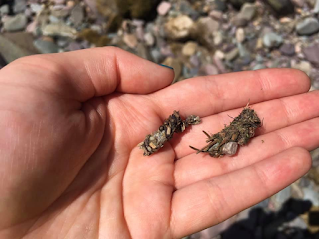
woody caddisfly cases in open hand

Wednesday, November 4, 2020

Cassie's First Bear!

 By Cassie Sevigny


One Tuesday I dropped in on Level 2 Stream Team. I had to go to the bridge crossing Rattlesnake Creek but not cross it myself. Instead I stayed left, barely found the narrow overgrown trail along the bank, and followed it upstream. “Don’t forget to make noise to alert bears since you’re walking alone,” Deb had warned me. Aissa found me before I’d gotten far and showed me to the site.


I stood on mossy rocks and watched Aissa, Stephie, Reyna, and Joe wrangling insect samples from a special collecting net into a jar. It was a process that required all four sets of hands. Out of the corner of my eye I saw a dark figure leaning over a fallen branch in the woods across the stream. Weird spot for someone to be wandering, I briefly thought, but people are weird. A few minutes later I saw the black shape stretch up, and up, and up into a tree. It was no person. I couldn’t even form words in my excitement and surprise. I just pointed. “A bear!” Aissa told everyone. “It’s eating berries from the mountain ash.” 


The bear lounged for a while, ignoring us. Or perhaps not noticing us, for ten minutes later it lumbered toward the creek and suddenly stopped. There were people in the creek! I wondered if it had intended to come down for a drink or a splash. Likely bears do not usually encounter people in their creek so far upstream, away from main trail access. The bear paused for a bit, contemplating what to do, and eventually retreated into the woods. I wondered if it was going to find another spot.


Deb arrived later with Joe Glassy, WEN board member, who she ran into on the trail. I find this a common occurrence with Deb, who seems to know everyone. Joe had brought his dog Lucy and his camera. How unfortunate he had missed the chance to photograph the bear! But as we talked and the team returned to collecting the fatal insect sample, the bear re-emerged from the trees a ways upstream! It lay down at the edge of the water. If not for the slight movement, it could’ve been mistake for a large black boulder among the rocks. 


I’ve lived in Missoula six years now and seen plenty of deer, birds, insects and squirrels. I know bears frequent the Rattlesnake, and I’ve even been at Greenough during reports of bears in the creek. But this was the first one I’ve seen. I felt part elation and part realization that I couldn’t remember how you were supposed to respond to a bear’s presence. Stream Team had bear spray of course, and we didn’t need to use it. But the fact that I was in the bear’s territory and came face to face with one reminded me how wild the land is, and how easily we can ignore that when we build houses and ranches and roads and trails and bring our urban selves so close to the edge of a wilderness.


Tuesday, November 3, 2020

Resplendent Stream Team

By Cassie Sevigny

Returning to WEN as a staff member has felt a bit like a homecoming. Stream Team days pull me out of my apartment isolation and into the woods, resplendent with yellow and red leaves and striped with tree trunks among the dry blond underbrush. I see Rattlesnake creek, which is not cutting through the forest but embedded as part of it, and I realize sometimes we forget about things that make us happy.

The cool fall weather indicates Stream Team season is ending, so I’ve been lucky to go out several times in the past few weeks. One trip brought me to a location between Greenough and the dam site that I had not been to before. A family was leaving the area around the tilted narrow stone table and bench when we arrived. Upon the table we spread out our gear around a little fall fairy house someone had made. Red berries perched in the shelves of pinecones, and leaves and pine needles stuck out like flags from a mossy wood-and-bark house. That day ended with wine and a light plum cake made with Deb’s recipe and Aissa’s plums. The immediate feeling of being among family and working to a common goal makes me happy.


I also helped with a special Stream Team day with University of Montana’s Water Policy class, taught by Ada Montague, this time at a familiar site by the Duncan trailhead bridge. Clouds clung thickly to the sky and the thin conifers swung about in the wind. It was hard to find insects in our tubs with all the leaves and other fall debris. They needed someone “solid on bugs” to teach the volunteers what to look for and how to identify the insects we were counting. I wasn’t sure how much I would remember but trusted in my ability to recognize and relearn. Turns out even after a few years’ absence from leading any stations, I still know my aquatic insects! Pointing out the tiny wiggling ones reminded me of when I was a new volunteer, delightedly soaking up every bit of Al’s professional expertise that I could. 

Working with WEN has taught me to take the lead with whatever they throw at me. I’ve also been reminded that I have plenty of skills and knowledge from years of working with WEN. That expertise makes me comfortable teaching and leading stations, even if I’m initially hesitant, so that others can learn the excitement of their watersheds too.


Friday, September 21, 2018

Rattlesnake Creek Discovery

WEN's First Summer Camp: A Reflection


     The 2018 Rattlesnake Creek Discovery Summer Camp, in partnership with the Missoula International School, was a full week of fun, play, and learning. Six children attended Monday-Friday 9 a.m.-3 p.m. On the first day, the Rattlesnake Creek explorers collected macro-invertebrates from two different locations, then learned how to identify and draw these aquatic insects.


    Tuesday was introduction to bug anatomy, and more exploration north of the Pavilion. The explorers ventured off into the riparian area along Rattlesnake Creek and discovered interesting critters. The day ended with a cool down in the creek!

     On day three, we mapped Rattlesnake Creek and created our own maps of Greenough Park. We also measured the velocity of the Creek with our sticks and painted rocks with Pam Ward (our guest instructor from Sussex School). Lastly, we rounded out the day with Bull trout game fun!


    Thursday we did a water cycle game and journaled about being a water drop. Cas Smith (our hydro-geologist guest presenter) taught a lesson on groundwater, which included exploring various wells in Greenough Park. The afternoon concluded with watercolor painting and Lego building.

     On our last day, the children collected sticks as we hiked and explored through Greenough, and then we used those sticks to construct “dreamboats”. Afterwards, we launched our boats down the Creek. Finally, we celebrated this special week-long summer camp with a macro-invertebrate mayhem game, and said farewell to the Rattlesnake Creek.


     As the partner of an ex-river guide, I've heard (and fallen in love with) a phrase that seems to capture the spirit of this camp, "Let's just read and run." Read the river, then run it accordingly. While developing the Rattlesnake Creek Explorations Camp, we built a structured schedule which we followed every morning. I was an afternoon volunteer and witnessed firsthand how the overall mood vacillated in the full-belly, post-lunch afternoon heat. The children would either rally energetically after a quick dip in the creek, or feel lethargic. 
     
     It seemed that they fed off of each other's energy, without any verbal communication. It was so fun to read them, and then help steer the afternoon schedule according to their wants and needs. We had so much fun every afternoon. Whether we were taking a break from the heat and painting rocks inside an MIS classroom, focusing on a groundwater lesson, or playing with spray-bottles at the Greenough playground- this camp was totally kid-centric. It was so fulfilling to help facilitate the creation of positive summer memories for these six, very awesome kids. 


This camp couldn't have happened without the leaders from the Missoula International School and Watershed Education Network: John Walker and Deb Fassnacht. Special thanks to our guest instructors Pam Ward and Cas Smith! Shout-out to our volunteers: Madeline Wilber, Cassie Sevigny, Markus Boyer, and Eli Santos.

I look back on this summer camp fondly, and consider it a huge success. We at WEN are looking forward to Summer 2019, and the possibility of offering more camps like this. 

Thanks for reading, and happy first day of Fall!
Katrina Thorness
Watershed Education Network
Communications Coordinator
802 East Front St.
Missoula, MT. 59802
Ph (406) 541-9287
Check us out on facebook for updates. 

Katrina is a part-time Communications Coordinator who is focusing on becoming a 'Jane of All Trades' in life, and for WEN. She assists with program development, and has worked on projects for YCC, AIS, and School Stream Monitoring. One of Katrina's life goals is to continue nurturing a community of outdoor learning in the region.

Wednesday, March 18, 2015

Chief Charlo Get Excited at Rattlesnake Creek

With our gear carefully situated, listening to the quiet of the Rattlesnake Creek, we awaited the students of Chief Charlo Elementary. The school bus entered the parking lot of Greenough Park and the 5th graders rambled out, talking excitedly among themselves. The volunteers' anticipation mounted as the teacher, Kevin Cashman, lead the students across the bridge of the creek towards the workstations. And with a rush of joy and squeals of delight the kids were upon us, eager to dive into the world of macro-invertebrates. 

First, a little context. To conduct a biological assessment of the Rattlesnake Creek, 300 macro-invertebrates are gathered to determine if a stream is polluted. Macro-invertebrates are animals that do not have backbones, but are visible to the naked eye. Certain macro-invertebrates are sensitive to pollution in the streams, such as mayfly and stonefly nymphs, and their presence or absence can indicate the overall health of a stream. The Watershed Education Network collects this data to keep community members aware of the quality of the water, and to empower students to understand the importance of our watershed.

The students rushed over to the tables, bubbling with enthusiasm as Mr. Cashman directed the kids into their groups. "Tanagers, and Western Meadowlarks will go into the creek! The Clark's Nutcrackers and the Pileated Wodpeckers will collect the bugs!" And with that the 5th graders scrambled about to their respective stations.

The Tanagers, about six kids, pulled on waders and armed themselves with nets, then went to the waters edge where I told them about the crab walk. "First thing is safety", I call out, "and to be safe in the creek we will be doing the crab walk whenever we are walking in it". With exaggerated movements, I demonstrate the crab walk, where you walk sideways down the river so as to avoid slipping. The kids head into the water and I take them down to riffles where the macro-invertebrates hang out. Three of the 5th graders eagerly hold the nets, while three others stand a few feet in front and start the shimmy. The shimmying disrupts the insects, and are directed by the current of the creek into the awaiting nets. Giggles echo out of the cool afternoon as the kids trade places, the former getting ready to shimmy, and the latter taking the nets. With the nets full of bugs and debris, the Tanagers head up to tubs full of water waiting on the bank where the nets are upended. With the task of netting the bugs finished, the children take the waders off and get ready to start collecting the macro-invertebrates.

Spoons and ice cube trays have taken the place of nets and waders, as I tell the 5th graders to search for the bugs like a stork, calm and unhurried. The Tanagers set about with quite a many "oohs" and "ahs" as the macro-invertebrates that they worked so hard to collect flit about the tub, diving for the leaves and other debris. With steady hands, the kids dip the spoons in, carefully uncovering and lifting the bugs out of the tubs and into the ice cube trays. "One macro-invertebrate per cube", I tell the Tanagers, as spoons laden with treasures appear out of the tub. Once a few fine specimens are found I take out the dichotomous key, an identification tool that consist of a series of choices that lead the user to the correct name and picture of an the macro-invertebrates that we are searching for. First, we look to see if the creatures have shells or not. "No shells!", the kids cry out. Second, we look to whether legs are involved with our little friends. "Legs!", the 5th graders say, and we continue down the key to the majority of the macro-invertebrates found in the stream being mayfly nymphs. After the Tanagers enthusiastically identify the creatures they are set free back into the Rattlesnake Creek.

Today was an exciting day for me. Experiencing the joy and vigor that a child greets its world with is uplifting to say the least. Moments of a persons existence are made when introduced early to the wonders of life. I feel very proud to hopefully be a part of something so significant. Being shown the beauty and life thriving silently in the river can be sometimes all it takes for a person to become acquainted with a sense of wonder that quietly guides them through life. Perhaps this placement of wonder actually took place, or perhaps a group of 25 children just had an absolute blast. Either one I will take. One thing for sure is that I look forward to more outdoor adventures with the Watershed Education Network, where we teach kids of the unseen world bustling in our streams.

-WEN Volunteer


Thursday, July 22, 2010

Summer Time Stream Team

June 2010

Rain continues to fill the banks of Western Montana’s streams and rivers. Driving from Dixon to Missoula every morning, I am struck by how green everything looks. Balsamroot and Lupin are still blooming in the hills, and the cottonwood and aspen are putting out new growth along the Jocko and Clark Fork Rivers. After an abnormally dry winter, let’s hope all this precipitation cuts the summer fire season short.

As native Montanan who migrated to New York for college, it’s great to be home for the summer. Hiking in the mountains, and seeing wildlife, rivers and wide open spaces again reminds me just how lucky I am to live in our beautiful state. A couple of weeks ago, I started a summer internship here at WEN. I’m excited to join the WEN team, and to learn about river education. Part of my internship this summer will include weekly Stream Team sessions. Every Wednesday from 1:00-4:00 pm, a group of community volunteers and WEN staff will be heading out to monitor the health of our local streams and rivers. The data and information we collect will be added to a National online database.

Despite the rainy weather, Emilie Kohler, Michael Anderson, Michael Canseco, Al Pak and I headed out to a site on Pattee Creek last week for Stream Team orientation. Emilie showed us the proper method for each stream experiment. We measured physical aspects of the stream, such as the stream channel morphology and flow characteristics, and using a tennis ball, we calculated velocity. After taking the physical measurements, I pulled on my waders, and along with Michael A., who splashed into the water in his sandals, collected material from the bottom of the channel in nets. We searched through the stream bottom contents for macroinvertibrate life. Although Pattee creek runs through residential Missoula, it seems to be a fairly healthy stream. We found worms, snails, a large cranefly larvae, and a great number of black fly larvae.

Yesterday, Stream Team drove up to Rattlesnake creek. The water was rushing along its banks at a high velocity, due to all the recent precipitation. The swift current made macroinvertibrate collection difficult. However, after only a small mishap in which a team member’s wader filled up with water, we collected a diverse sample that included over 200 mayfly larvae, an enormous stonefly, several types of caddis, aquatic worms, blackflies, and leaches. It was fascinating to see the mayfly larvae breathe; they have visible abdominal gills that flutter gently along their sides in the water.

Despite the threatening clouds, the rain held off until we finished collecting data. After a satisfying day in the field, Stream team headed back to the 4th street office.