Showing posts with label Stream Team. Show all posts

Monday, March 1, 2021

A Special Place

By Aissa Wise

 Hiking up the trail, backpack full of chocolate and gear, waders and boots tied together and draped over my shoulders. Finding the right configuration of gear placement on my person while hiking to the stream is a skill; sometimes I get it right, sometimes I don’t. How long can I hike with my clunky wade boots smacking my side? Are my waders dragging in the mud? Are my Stream Team volunteers ready to collapse? We round the bend, and the best view of Rattlesnake Creek is before us. A few volunteers mimic my awestruck gasp. I’ve seen this view a thousand times, but it never gets old. In fact, it looks different every time. Today, the Red Osier Dogwood that frames the creek is the color of ripe raspberry. We set our gear down for a deep breath of fresh autumn air and bask in the presence of the creek. A special place. I point out an American Dipper (Cinclus mexicanus) to the volunteers, a sweet little dark grey bird doing her famous dipper dance on a moss covered boulder in search of insects under the water. 

I continue down the trail to the creek, gear and volunteers in tow. I lead them to a special spot I particularly love to share. This place is off the beaten path, set apart from the daily Missoula recreators hiking and biking the Rattlesnake Creek trail system. A special place. The far side of the creek is framed by a large cliff, elegantly curved from years of the creek rushing by. We share our side with creek loving alders (Alnus incana), cottonwoods (Populus trichocarpa), red osier dogwood (Cornus stolonifera), willows (Salix bebbiana), serviceberry (Amelanchier alnifolia), and mountain ash trees (Sorbus americana). Before we set up, I share with my volunteers that we are on sacred ground of the Salish, Pend d'Oreille, & Kootenai Native American People and we honor the path they have always shown us in caring for the environment. I am sure to thank my volunteers for honoring this special place. 


Waders on and safety talk finished, the volunteers split into three groups. Each group will monitor three different water quality parameters; biological, chemical and physical properties of the creek. Group one will collect and count aquatic macroinvertebrates (insects) which are incredible bioindicators (living organisms that give us an idea of the health of an ecosystem). Group two will collect water samples to measure temperature, pH and dissolved oxygen. The last group will measure the creek from bank to bank, describe rocks and cobbles and measure stream flow to get an idea of the physical shape of the creek. We will continue to collect this data for many years in hopes that it will help us, and others, to better understand how the creek is changing over time due to climate change and an increase of human pressure. In turn, this data will allow for better decisions to be made for the health of Rattlesnake Creek, the fish and insects that swim in it, the American Dippers that dance along it, and all of the plants that rely on it. This is a special place. 

Wednesday, November 4, 2020

Cassie's First Bear!

 By Cassie Sevigny


One Tuesday I dropped in on Level 2 Stream Team. I had to go to the bridge crossing Rattlesnake Creek but not cross it myself. Instead I stayed left, barely found the narrow overgrown trail along the bank, and followed it upstream. “Don’t forget to make noise to alert bears since you’re walking alone,” Deb had warned me. Aissa found me before I’d gotten far and showed me to the site.


I stood on mossy rocks and watched Aissa, Stephie, Reyna, and Joe wrangling insect samples from a special collecting net into a jar. It was a process that required all four sets of hands. Out of the corner of my eye I saw a dark figure leaning over a fallen branch in the woods across the stream. Weird spot for someone to be wandering, I briefly thought, but people are weird. A few minutes later I saw the black shape stretch up, and up, and up into a tree. It was no person. I couldn’t even form words in my excitement and surprise. I just pointed. “A bear!” Aissa told everyone. “It’s eating berries from the mountain ash.” 


The bear lounged for a while, ignoring us. Or perhaps not noticing us, for ten minutes later it lumbered toward the creek and suddenly stopped. There were people in the creek! I wondered if it had intended to come down for a drink or a splash. Likely bears do not usually encounter people in their creek so far upstream, away from main trail access. The bear paused for a bit, contemplating what to do, and eventually retreated into the woods. I wondered if it was going to find another spot.


Deb arrived later with Joe Glassy, WEN board member, who she ran into on the trail. I find this a common occurrence with Deb, who seems to know everyone. Joe had brought his dog Lucy and his camera. How unfortunate he had missed the chance to photograph the bear! But as we talked and the team returned to collecting the fatal insect sample, the bear re-emerged from the trees a ways upstream! It lay down at the edge of the water. If not for the slight movement, it could’ve been mistake for a large black boulder among the rocks. 


I’ve lived in Missoula six years now and seen plenty of deer, birds, insects and squirrels. I know bears frequent the Rattlesnake, and I’ve even been at Greenough during reports of bears in the creek. But this was the first one I’ve seen. I felt part elation and part realization that I couldn’t remember how you were supposed to respond to a bear’s presence. Stream Team had bear spray of course, and we didn’t need to use it. But the fact that I was in the bear’s territory and came face to face with one reminded me how wild the land is, and how easily we can ignore that when we build houses and ranches and roads and trails and bring our urban selves so close to the edge of a wilderness.


Tuesday, November 3, 2020

Resplendent Stream Team

By Cassie Sevigny

Returning to WEN as a staff member has felt a bit like a homecoming. Stream Team days pull me out of my apartment isolation and into the woods, resplendent with yellow and red leaves and striped with tree trunks among the dry blond underbrush. I see Rattlesnake creek, which is not cutting through the forest but embedded as part of it, and I realize sometimes we forget about things that make us happy.

The cool fall weather indicates Stream Team season is ending, so I’ve been lucky to go out several times in the past few weeks. One trip brought me to a location between Greenough and the dam site that I had not been to before. A family was leaving the area around the tilted narrow stone table and bench when we arrived. Upon the table we spread out our gear around a little fall fairy house someone had made. Red berries perched in the shelves of pinecones, and leaves and pine needles stuck out like flags from a mossy wood-and-bark house. That day ended with wine and a light plum cake made with Deb’s recipe and Aissa’s plums. The immediate feeling of being among family and working to a common goal makes me happy.


I also helped with a special Stream Team day with University of Montana’s Water Policy class, taught by Ada Montague, this time at a familiar site by the Duncan trailhead bridge. Clouds clung thickly to the sky and the thin conifers swung about in the wind. It was hard to find insects in our tubs with all the leaves and other fall debris. They needed someone “solid on bugs” to teach the volunteers what to look for and how to identify the insects we were counting. I wasn’t sure how much I would remember but trusted in my ability to recognize and relearn. Turns out even after a few years’ absence from leading any stations, I still know my aquatic insects! Pointing out the tiny wiggling ones reminded me of when I was a new volunteer, delightedly soaking up every bit of Al’s professional expertise that I could. 

Working with WEN has taught me to take the lead with whatever they throw at me. I’ve also been reminded that I have plenty of skills and knowledge from years of working with WEN. That expertise makes me comfortable teaching and leading stations, even if I’m initially hesitant, so that others can learn the excitement of their watersheds too.


Wednesday, May 13, 2020

My Stream Team Introduction

My Stream Team Introduction 
October 15, 2019
By Bailey Bartell

These past few weeks I have been part of two different groups who go out to collect data on watersheds with the downstream idea of positive impact. I have been part of two different citizen science Stream Teams collecting data on Rattlesnake Creek.
During my time with Stream Team Level Two, we took two different cross sections of the creek in order to measure the creek bed depth. We did this so in the following years we can measure the changes after the dam is removed upstream. David, Aissa and I waded across the creek and setting up a tape for measurement and using a fancy scope (hand level) in order to get a level reading. It took us a good few hours to do so, all the while slipping and sliding under the grey clouds that rolled around the valley. 

My second experience with Stream Team Level Two involved taking longitudinal profiles of Rattlesnake Creek beginning about 100 feet downstream from the currently existing dam. David, Joe and I were essentially measuring the gradient of the creek by taking measurements every forty feet. This required us to run a measuring line forty feet from each reading that we took, we measured the depth at the bankfull, the wetted edge and the thalweg. The bankfull is where the water would rest if the creek bed were full, the wetted edge is where the water is currently sitting in the bed and the thalweg is where most of the downstream current is going. So we took each of these measurements and one additional backsight, every forty feet down this creek until we got to our original cross sections. It was slow moving, but it was incredibly beautiful and humbling to witness the experimental process of new research.


My third experience with Stream Team was with Level One. This group is a group of young adults that go to Rattlesnake Creek every Sunday in order to take varying sets of data. This past Sunday we went to a spot 100 feet below the dam in order to collect physical (cross-section, pebble count, velocity, and photo points), chemical (temperature, pH, and dissolved oxygen), and bug diversity from the creek. We had eight people and lots of work to accomplish. This time, everyone was stationed in one location with no intention to move. It was so powerful to witness so many people dedicating their free time to citizen science! We rallied on getting things done quickly and sharing responsibilities so we collected all of the data for the day in just around three hours. We were lucky to spend the day in dappled sunshine and a light breeze.


It is really rewarding to be part of a process that is paving the way for citizen science in our country and gain so much experience in the process. It is really easy to sign up to be part of the research. All you have to do is email Aissa Wise who is WEN’s Stream Team Coordinator and come to a training. There will be several trainings over the next season and it is a great way to give back to the community.


Friday, May 8, 2015

Trickles and Sparkles : An April Stream Team Excursion

     Last weekend Becca and three brave volunteers headed out to a stream in Lolo on a chilly, overcast Saturday. Halfway along the drive, cell phone service slipped away, and soon after we turned off the main road, so did the pavement. Becca gritted her teeth and clutched the steering wheel, trying to convince the car to drive steady and straight, rather than slide off in the mud. However, the mud could've been thicker, the grooves in the road deeper, and the pellets of rain harder, and we made it safely to our destination.

      The infrequently used trail to the river led through a patch of woods, full of plants soaking up the remnants of the recent April rainfall. The colors brightened with the moisture. The trail stopped abruptly at the water's edge, and we skirted carefully under some low hanging branches of pine to the small clearing (pictured left) where we set our supplies.

     The small trees stretched their brilliant burgundy new growth out to us, each branchlet tipped with a soft yellow-green bud. The floor was scattered with white trilliums, reminding me of home. (In Washington, 5th grade camp took us to the Olympic Peninsula, where they were everywhere.)
The stream was quite gorgeous, frothy and glittery. I put on the waders I had found in the basement (an adult pair this time, so I wouldn't have to cram into the kid overall-waders! They were patched up in places, but that means the holes were all sealed off, right?)


     While setting up the transect I noticed a gradually cold trickle on the back of my leg. It was just the water rushing past running off with my body heat, I thought at first. The waders don't have much insulation. But the cold feeling persisted, and dominated one leg more than the other... I turned my head for the fifth or sixth time and noticed a large rip down the back of the wader. To my great disappointment, the waders I had put my faith and excitement in had let me down. As long as I faced upstream, the front of my leg would mostly block the current from seeping in until we finished measuring the stream's width. Then I could put on the back-up, slightly-too-big waders I had brought just in case.
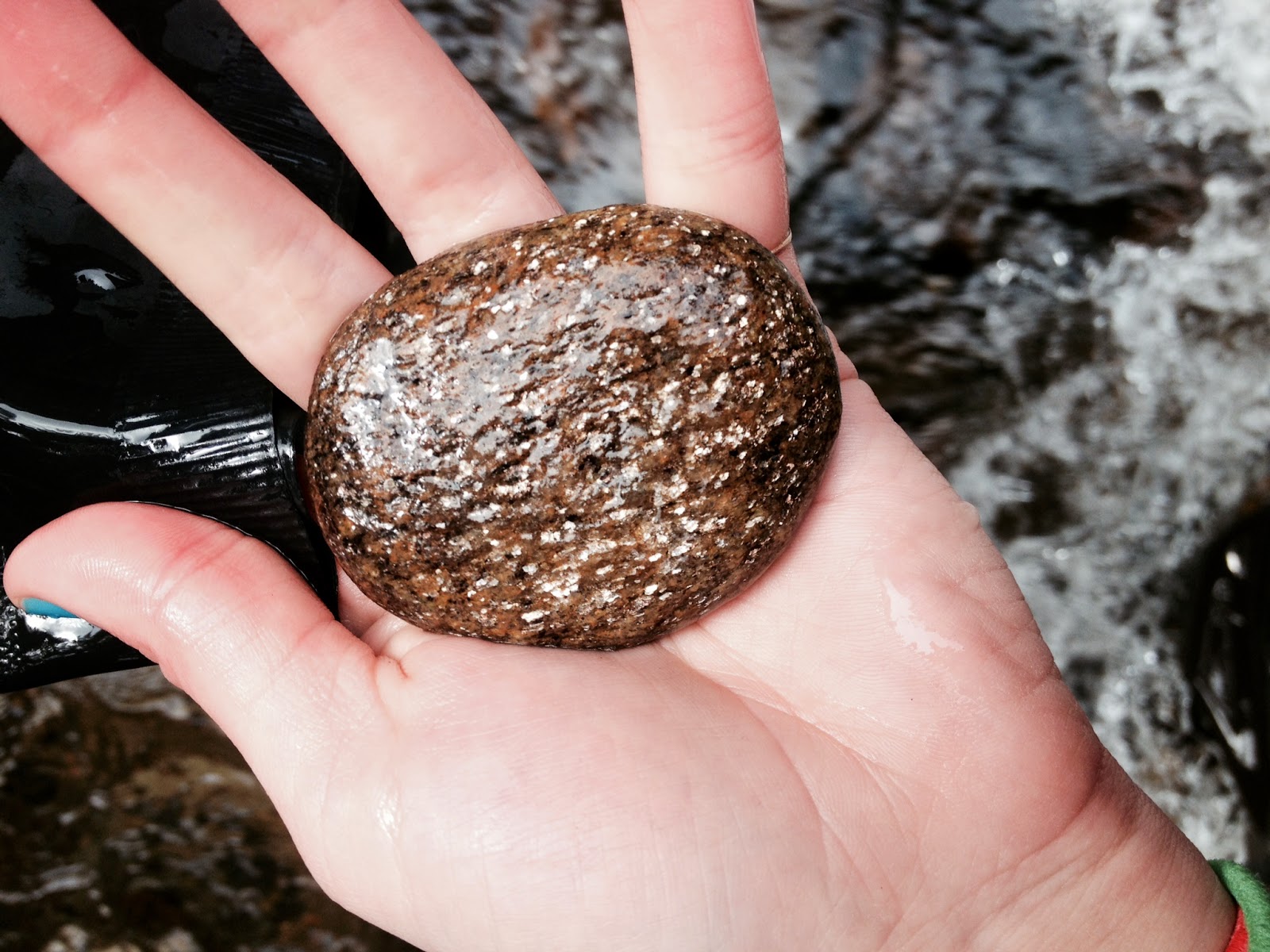
     When Becca and I reached the center of the stream I noticed some strange lights on a boulder resting on the riverbed. They weren't flickering with the current, so it wasn't just sunlight reflecting off the surface of the water. Next to the boulder was a smaller stone, riddled with tinier lights. I made note of the location in my head so I could return later.
    I made it to shore, not too soaked, and only on one leg, and walked over to the pile of waders. I picked one up, and set it aside. It was the left boot and I needed the right boot. I picked up the other one and.... it was a left boot too! Since it was too big for my foot, I decided I could probably wear it on the wrong foot and it wouldn't be too uncomfortable. It would fit, at least, and was better than having a leak. Becca graciously let me borrow her spare wool socks.


    I went back into the river and found the rock I had kept in mind. It did indeed sparkle.


   By this point the next task was pebble count. Becca had brought gloves for us this time, hoping to spare our hands the frozen, numb experience of Stream Teams past. I went to put a pair on and I had the opposite problem as the waders. I had two right hand gloves! The gloves turned out to be ineffective anyway, as the water was deeper than they were long, and just poured in through the top. Also like the waders, the rubber was not very insulating. Becca and Jeremy gave up on the gloves, while I stayed near the shore where it was shallow and only dipped my right hand in to pick up rocks. During this procedure we found that the stream was littered with glittering rocks.


    We concluded the expedition as always, with thermoses of hot water, little cups, and packets of instant hot chocolate. Despite unexpected gear malfunctions, we got the information we came for (plus a little fun), making this another successful, if extra interesting, Stream Team.

-Cassie Sevigny, WEN volunteer

Tuesday, November 4, 2014

Stream Team in Late October

Late fall turns out not to be the most comfortable season to begin one's experience with stream monitoring, but I was determined to finally get my hands wet (and keep my feet dry).

The drive up to the selected stream passed with discussions about ladybugs eating aphids and grizzly bears swarming to eat ladybugs in the mountains. On one side of the car stood thousands of larch trees, green and yellow stripes blanketing the mountainside. Larches, I learned are one of the only deciduous conifers. On the other side, sprinkled in with the evergreens were what appeared to be birch, with dark branches bearing suspended sprays of yellow leaves.
The sky alternated dropping pellets of water and  letting the occasional sunbeam peek through the clouds as we drove.

After a few moments of uncertainty we came upon our section of stream.

       The team unloaded the equipment from the trunk and we tugged on our waders. My waders required a bit more tugging than everyone else's, as I, with my smallish feet, had to use the kid size waders, which happen to come with attached waterproof overalls. My feet fit very comfortably but my legs were slightly too long and my thighs squeezed (very) snugly inside. The difficulty of bending my knees made for some interesting walking strides. Conveniently, however, a pocket was situated on the front where I stowed my camera.

       The bank closest to the roadside was steep, composed of  large black boulders. The strongest current ran along this same bank, forcing us to step into the deepest part of the river, the water trying to pull us along downstream. Resisting the current and carefully treading over the slippery rocks, all three trans-sections were successfully strung across and staked down.
Downstream

Upstream
       Perhaps the easiest measurements to take consisted of measuring the current water and bank-full depths of the stream, as this did not require us to get our hands wet, and slush was not yet falling from the sky. Some hail had formed high in the atmosphere and partially melted before gracing us with its presence. Fortunately the precipitation ceased (for the most part) before the tossing of the grid and counting of "pebbles".

     The grid toss measurement counts the number of patches of fine sediment. We came up with low numbers, as the stream bed was mostly covered in rocks. Plunging our hands into the water to retrieve the grid was our first encounter with the frigidity of the stream, as our waders (and wader-overalls) protected our bodies nicely. In my pairing, grid toss was followed by pebble count, which required hands to be dipped into the water 100 times total to pick up and measure rocks. My partner and I, in sympathy, took turns with this. Our hands quickly flushed red and numbed. We could barely hold the pencil and clipboard, let alone write numbers into a tiny set of boxes. Our results for this measurement came out looking like the scratchings of a child just learning that numbers each have their own shapes. (The warm pocket of my wader-overalls came quite in handy at this point for my hands.) However, this produced some interesting finds.

       Several rocks we picked up had small, squishy, translucent green globules attached to their undersides. Upon investigation (asking Rebecca) my partner and I learned that these were actually a type of algae. While dreading reaching my whole forearm into the deepest section of the stream I saw, sitting in the shallow water over one of the boulders on the bank, what I assumed was a red crayfish. Through the water distortion it appeared to be about three inches. It swam away moments after realizing I had noticed it, just as I was fumbling to get to my camera. (Not being familiar with the area, I looked up what types of crustaceans lived in Montana and found several pictures of crayfish which appeared much like the one I saw, but not anywhere near as red.)


        As we were finishing up our tests and unstaking the trans-sections the sun came out, brightening the larches in the distance. Rebecca pointed out two tall thermoses of hot water, which we poured into mugs and used to warm our hands. The hot water doubled to provide well-deserved hot chocolate for the ride back, which we paired with homemade chocolate chip pumpkin cookies. Talk was lighthearted, about plans for Halloween, and I contemplated that freezing in a stream together with other people creates a sort of camaraderie despite the fact they were strangers just hours before.

-Cassie Sevigny, new WEN volunteer

View on the way back to WEN office.

Thursday, February 23, 2012

Stream Team Unite!!!

This past Monday, President’s day, the stream team headed out to take water samples from Patty Creek. When we arrived at our site destination below the holding pond, we were surprised to find the stream dried up! So we threw our gear back in the car and headed to Rattlesnake Creek. After the gear was set up we were ready to perform chemical experiments to check the oxygen levels of the creek while other stream team members were strapping on their waders and preparing to step into the freezing cold water…brrrr. After about a half hour we had already confirmed the oxygen levels in the creek and were waiting to sort invertebrates into ice cube trays to be counted and recorded. There sure is something special about watching these tiny little bugs swim around in a plastic container. My imagination was set free as I tried to fathom how many of these little critters there are just living in this one small waterway. It’s amazing! Thanks to everyone who made my first stream experience one to remember. 

Katie Thurlby
Volunteer
Watershed Education Network

Tuesday, September 27, 2011

Science In The Name of Fun

Volunteer Coordinator Will Ridlehoover braves the clark fork in the name of science!

Adversity often inspires ingenuity. At least it did with Will and I on the Clark Fork last Sunday.
Our weekly Stream Team outing focused on a section of the river just down-stream from the Madison Street bridge, and as with any wide river, the physical attributes of the Clark Fork presented certain challenges for data collection that had to be overcome.

The Stream Team typically examines three major characteristics of the river. Chemical, biological and physical attributes are measured in order to give us an accurate picture as to the character and health of the river. The physical examination is comprised of factors such as water velocity, bank width, water depth and overall morphology or the "shape" of that river's section. All factors are easy to measure in small streams, but a several hundred foot wide river presents a few challenges of equipment and logistics. Luckily, Will and I were feeling particularly industrious that day, and he had some swimming trunks in his car.

Typically the river's depth and width area easily measured with a depth pole and survey line respectively, but the fast moving and especially deep water combined with the extremely wide section we chose to measure made our typical methods impractical. So with a few handfuls of rocks inside of the nylon bag of a throw rope and the use of a sharpie I fashioned a makeshift depth gauge inspired by my youth on the Mississippi river and the endless reminders of how Samuel Clemens chose his famous pseudonym. In the mean time, Will paddled his way across the river with the aid of an inner-tube to fix a static line to the opposite bank and returned to begin the measurement process. Using the static line to hold his position in the river, Will worked his way across and dropped our makeshift depth gauge every "tube width" (3 foot 2 inches) and sounded off a reading to be recorded on shore. Sixty five readings later, we determined the width to be no less than 205.83 feet across and an average depth of around 3.5 feet.

While this data was useful and important to record for many reasons that any WEN volunteer can explain,  the process of collecting it was important for some reasons you may not expect. Namely, it was hilarious. As Will worked his way slowly across the clark fork, the rest of the team recorded the data and chuckled at the increasingly louder depth reports echoing across the water, and the impressed expressions upon the faces of passers by. We always have fun on Stream Team, but when afforded the opportunity to innovate, be bold, and a little bit silly with like minded folks on the banks of a neighborhood river the experience becomes that much more powerful and rewarding. I can't wait for next week, maybe we'll find a way to build a submarine from Tupperware containers and driftwood.

--
Clinton Begley
OfficeCoordinator
Watershed Education Network


Friday, October 22, 2010

Heading Up the Blackfoot

This past Sunday Stream Team had an amazing afternoon taking data on the Blackfoot River at the Angevine site. While our volunteers, Rob and Pam, started on chemistry, Maria, Steve and myself started setting up to gather stream flow data.  The weather turned out to be a pleasant surprise.  Standing along the Blackfoot, next to the cast of the mountain shadows, the sun lit up the water and made the scenery almost as pleasant as the warmth on my cheeks.  I stood up on a rock to get a better view of the river, watching it curve with the mountain line, and could not have been more happy that I had gone out to do Stream Team that day.

Once we were done measuring stream velocity and dissolved oxygen, we were ready to start collecting insects! As the waders collapsed around the shape of my legs, the water actually felt good, cooling me off from the warm weather.  After a couple of good collections we were ready to start sorting and identifying.  We found numerous stoneflies and caddis.  In fact, many of the stoneflies we found were the biggest I had ever seen, it was very exciting!

The river had a wide variety of insects and many healthy indicator species. The chemical and physical aspects of the stream also were in healthy conditions; we were very satisfied with the day.  Our day was one of the best Stream Teams yet this year, and I highly suggest anyone interested to get involved, because otherwise you'll be missing out on great days such as this one!

Megan Girsch
WEN Autumn 2010 Intern

Monday, October 4, 2010

Adventures with Stream Team

Our Stream Team has an awesome time this past Sunday!  It was a beautiful day for monitoring our local rivers.  This fall, our Stream Team will be monitoring a different river every Sunday afternoon.

Thursday, July 22, 2010

Summer Time Stream Team

June 2010

Rain continues to fill the banks of Western Montana’s streams and rivers. Driving from Dixon to Missoula every morning, I am struck by how green everything looks. Balsamroot and Lupin are still blooming in the hills, and the cottonwood and aspen are putting out new growth along the Jocko and Clark Fork Rivers. After an abnormally dry winter, let’s hope all this precipitation cuts the summer fire season short.

As native Montanan who migrated to New York for college, it’s great to be home for the summer. Hiking in the mountains, and seeing wildlife, rivers and wide open spaces again reminds me just how lucky I am to live in our beautiful state. A couple of weeks ago, I started a summer internship here at WEN. I’m excited to join the WEN team, and to learn about river education. Part of my internship this summer will include weekly Stream Team sessions. Every Wednesday from 1:00-4:00 pm, a group of community volunteers and WEN staff will be heading out to monitor the health of our local streams and rivers. The data and information we collect will be added to a National online database.

Despite the rainy weather, Emilie Kohler, Michael Anderson, Michael Canseco, Al Pak and I headed out to a site on Pattee Creek last week for Stream Team orientation. Emilie showed us the proper method for each stream experiment. We measured physical aspects of the stream, such as the stream channel morphology and flow characteristics, and using a tennis ball, we calculated velocity. After taking the physical measurements, I pulled on my waders, and along with Michael A., who splashed into the water in his sandals, collected material from the bottom of the channel in nets. We searched through the stream bottom contents for macroinvertibrate life. Although Pattee creek runs through residential Missoula, it seems to be a fairly healthy stream. We found worms, snails, a large cranefly larvae, and a great number of black fly larvae.

Yesterday, Stream Team drove up to Rattlesnake creek. The water was rushing along its banks at a high velocity, due to all the recent precipitation. The swift current made macroinvertibrate collection difficult. However, after only a small mishap in which a team member’s wader filled up with water, we collected a diverse sample that included over 200 mayfly larvae, an enormous stonefly, several types of caddis, aquatic worms, blackflies, and leaches. It was fascinating to see the mayfly larvae breathe; they have visible abdominal gills that flutter gently along their sides in the water.

Despite the threatening clouds, the rain held off until we finished collecting data. After a satisfying day in the field, Stream team headed back to the 4th street office.