Showing posts with label Water Monitoring. Show all posts

Friday, May 8, 2015

Trickles and Sparkles : An April Stream Team Excursion

     Last weekend Becca and three brave volunteers headed out to a stream in Lolo on a chilly, overcast Saturday. Halfway along the drive, cell phone service slipped away, and soon after we turned off the main road, so did the pavement. Becca gritted her teeth and clutched the steering wheel, trying to convince the car to drive steady and straight, rather than slide off in the mud. However, the mud could've been thicker, the grooves in the road deeper, and the pellets of rain harder, and we made it safely to our destination.

      The infrequently used trail to the river led through a patch of woods, full of plants soaking up the remnants of the recent April rainfall. The colors brightened with the moisture. The trail stopped abruptly at the water's edge, and we skirted carefully under some low hanging branches of pine to the small clearing (pictured left) where we set our supplies.

     The small trees stretched their brilliant burgundy new growth out to us, each branchlet tipped with a soft yellow-green bud. The floor was scattered with white trilliums, reminding me of home. (In Washington, 5th grade camp took us to the Olympic Peninsula, where they were everywhere.)
The stream was quite gorgeous, frothy and glittery. I put on the waders I had found in the basement (an adult pair this time, so I wouldn't have to cram into the kid overall-waders! They were patched up in places, but that means the holes were all sealed off, right?)


     While setting up the transect I noticed a gradually cold trickle on the back of my leg. It was just the water rushing past running off with my body heat, I thought at first. The waders don't have much insulation. But the cold feeling persisted, and dominated one leg more than the other... I turned my head for the fifth or sixth time and noticed a large rip down the back of the wader. To my great disappointment, the waders I had put my faith and excitement in had let me down. As long as I faced upstream, the front of my leg would mostly block the current from seeping in until we finished measuring the stream's width. Then I could put on the back-up, slightly-too-big waders I had brought just in case.
     When Becca and I reached the center of the stream I noticed some strange lights on a boulder resting on the riverbed. They weren't flickering with the current, so it wasn't just sunlight reflecting off the surface of the water. Next to the boulder was a smaller stone, riddled with tinier lights. I made note of the location in my head so I could return later.
    I made it to shore, not too soaked, and only on one leg, and walked over to the pile of waders. I picked one up, and set it aside. It was the left boot and I needed the right boot. I picked up the other one and.... it was a left boot too! Since it was too big for my foot, I decided I could probably wear it on the wrong foot and it wouldn't be too uncomfortable. It would fit, at least, and was better than having a leak. Becca graciously let me borrow her spare wool socks.


    I went back into the river and found the rock I had kept in mind. It did indeed sparkle.
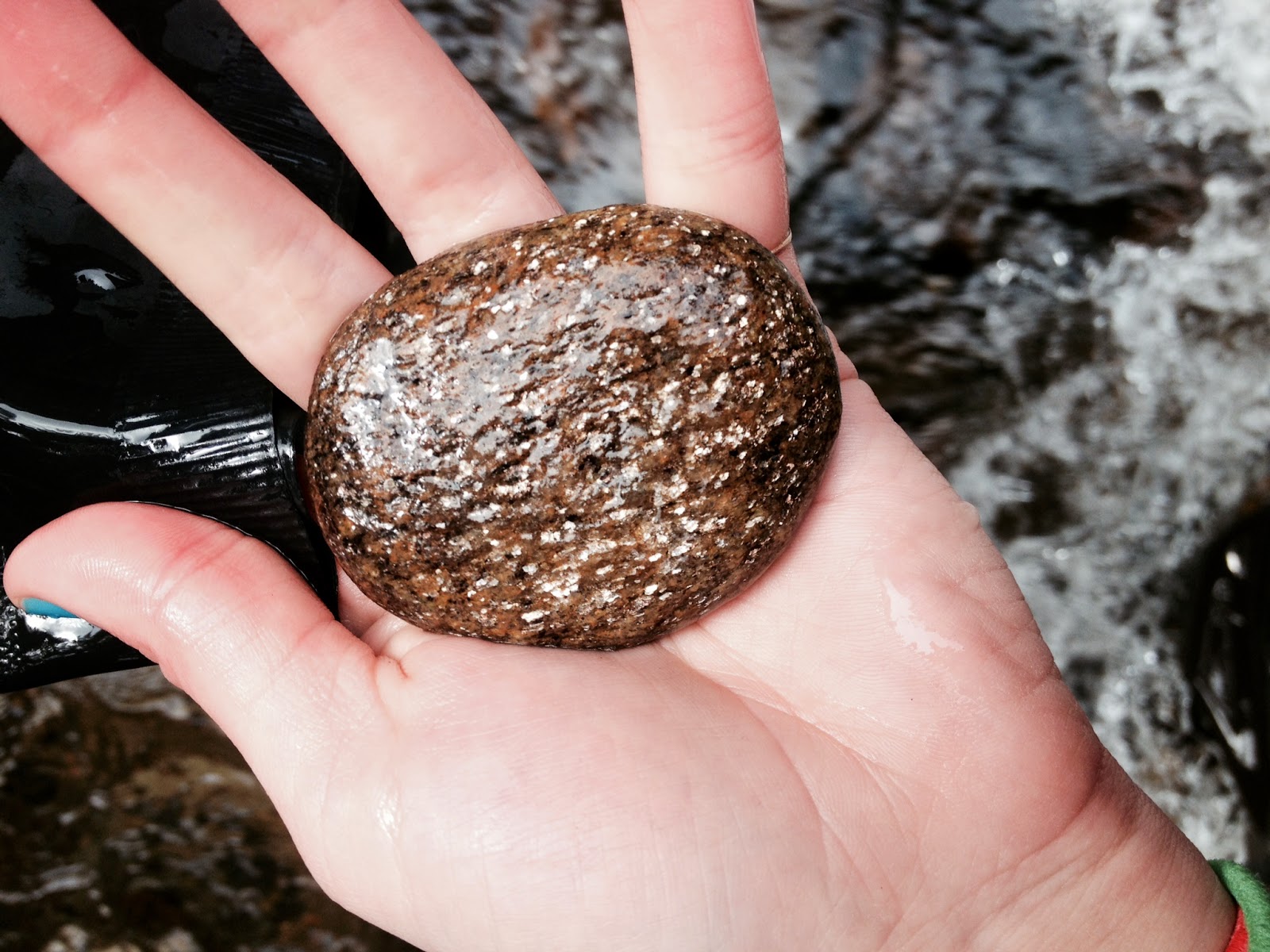

   By this point the next task was pebble count. Becca had brought gloves for us this time, hoping to spare our hands the frozen, numb experience of Stream Teams past. I went to put a pair on and I had the opposite problem as the waders. I had two right hand gloves! The gloves turned out to be ineffective anyway, as the water was deeper than they were long, and just poured in through the top. Also like the waders, the rubber was not very insulating. Becca and Jeremy gave up on the gloves, while I stayed near the shore where it was shallow and only dipped my right hand in to pick up rocks. During this procedure we found that the stream was littered with glittering rocks.


    We concluded the expedition as always, with thermoses of hot water, little cups, and packets of instant hot chocolate. Despite unexpected gear malfunctions, we got the information we came for (plus a little fun), making this another successful, if extra interesting, Stream Team.

-Cassie Sevigny, WEN volunteer

Tuesday, November 4, 2014

Stream Team in Late October

Late fall turns out not to be the most comfortable season to begin one's experience with stream monitoring, but I was determined to finally get my hands wet (and keep my feet dry).

The drive up to the selected stream passed with discussions about ladybugs eating aphids and grizzly bears swarming to eat ladybugs in the mountains. On one side of the car stood thousands of larch trees, green and yellow stripes blanketing the mountainside. Larches, I learned are one of the only deciduous conifers. On the other side, sprinkled in with the evergreens were what appeared to be birch, with dark branches bearing suspended sprays of yellow leaves.
The sky alternated dropping pellets of water and  letting the occasional sunbeam peek through the clouds as we drove.

After a few moments of uncertainty we came upon our section of stream.

       The team unloaded the equipment from the trunk and we tugged on our waders. My waders required a bit more tugging than everyone else's, as I, with my smallish feet, had to use the kid size waders, which happen to come with attached waterproof overalls. My feet fit very comfortably but my legs were slightly too long and my thighs squeezed (very) snugly inside. The difficulty of bending my knees made for some interesting walking strides. Conveniently, however, a pocket was situated on the front where I stowed my camera.

       The bank closest to the roadside was steep, composed of  large black boulders. The strongest current ran along this same bank, forcing us to step into the deepest part of the river, the water trying to pull us along downstream. Resisting the current and carefully treading over the slippery rocks, all three trans-sections were successfully strung across and staked down.
Downstream

Upstream
       Perhaps the easiest measurements to take consisted of measuring the current water and bank-full depths of the stream, as this did not require us to get our hands wet, and slush was not yet falling from the sky. Some hail had formed high in the atmosphere and partially melted before gracing us with its presence. Fortunately the precipitation ceased (for the most part) before the tossing of the grid and counting of "pebbles".

     The grid toss measurement counts the number of patches of fine sediment. We came up with low numbers, as the stream bed was mostly covered in rocks. Plunging our hands into the water to retrieve the grid was our first encounter with the frigidity of the stream, as our waders (and wader-overalls) protected our bodies nicely. In my pairing, grid toss was followed by pebble count, which required hands to be dipped into the water 100 times total to pick up and measure rocks. My partner and I, in sympathy, took turns with this. Our hands quickly flushed red and numbed. We could barely hold the pencil and clipboard, let alone write numbers into a tiny set of boxes. Our results for this measurement came out looking like the scratchings of a child just learning that numbers each have their own shapes. (The warm pocket of my wader-overalls came quite in handy at this point for my hands.) However, this produced some interesting finds.

       Several rocks we picked up had small, squishy, translucent green globules attached to their undersides. Upon investigation (asking Rebecca) my partner and I learned that these were actually a type of algae. While dreading reaching my whole forearm into the deepest section of the stream I saw, sitting in the shallow water over one of the boulders on the bank, what I assumed was a red crayfish. Through the water distortion it appeared to be about three inches. It swam away moments after realizing I had noticed it, just as I was fumbling to get to my camera. (Not being familiar with the area, I looked up what types of crustaceans lived in Montana and found several pictures of crayfish which appeared much like the one I saw, but not anywhere near as red.)


        As we were finishing up our tests and unstaking the trans-sections the sun came out, brightening the larches in the distance. Rebecca pointed out two tall thermoses of hot water, which we poured into mugs and used to warm our hands. The hot water doubled to provide well-deserved hot chocolate for the ride back, which we paired with homemade chocolate chip pumpkin cookies. Talk was lighthearted, about plans for Halloween, and I contemplated that freezing in a stream together with other people creates a sort of camaraderie despite the fact they were strangers just hours before.

-Cassie Sevigny, new WEN volunteer

View on the way back to WEN office.

Friday, October 7, 2011

Swan Field Trip


This last Tuesday, Kitty and I headed up to the Swan Valley in the early morning. We sleepily arrived and set up for the field trip and waited for the kids to arrive. As the students rolled out of the bus, their enthusiasm for the field trip was contagious. This group of students had been going out on our WEN field trips every spring and fall since they were in 3rd grade, and were excited to learn more and build upon what they had already learned in the previous years. At the bug station, students excitedly ran over to me, eyeing the waders already. As we talked about the different kinds of aquatic macroinvertebrates in the river, I was surprised by how much the older students remembered. Finally, the students were able to get into the waders and collect the macroinvertebrates in the river. We found so many mayflys! We also found a couple of ‘mystery bugs’ that the students we able to identify through our dichotomous key. As they proudly told me what each bug was named, I was reminded that no matter how much we think we may know about something, we can always learn something new.

Tuesday, October 5, 2010

Trainings!

At the beginning of every field season, we do a water monitoring training for our new volunteers and community members who want to learn more about their local rivers.  This year we had 24 participants.  Check it out!

Josh shows how to catch bugs to study
 
Dissolved oxygen from the chemistry station
 
Studying bugs