Showing posts with label Cassie Sevigny. Show all posts

Monday, March 15, 2021

Snow Hikes, Snow Spiders, Snow Flies, Oh My!

By Cassie Sevigny

Rounded snow banks along the edges of Bear Creek. Trees cast shadows, and sunlight reveals stones beneath the very clear shallow water.
Bear Creek (Photo by Cassie Sevigny)
I went hiking this weekend with a friend who's moving away from Montana. We drove up to Bear Creek trail, expecting mud and a trail-turned-creek, but spring is not so progressed yet. Instead we found a low-traffic, barely-compressed solid snow trail that was much easier to traverse. The snow lay in heaps on rocks like pillows, hid the true edges of the creek, stuck in frozen puffs to the sides of small trees, and reflected the days brilliant cold sunshine back at us. Good thing I wore sunscreen!

As we walked I noticed little black spiders on the trail. Warming up, perhaps? Despite their dark color against the white, they blended in with all the other natural debris flecking the snow. Only their flicking legs caught my attention. I wondered if these spiders just didn't go dormant for winter, or if the sun was waking them up.

boulders on a hill covered with mounds of snow. Trees at top of hill and a patch of blue sky behind.
Snow pillows (Photo by Cassie Sevigny)

Then in an open snowfield I saw another bug crawling - black and winged, crawling uphill away from the creek. Two tails, wings folded neatly over each other on its back, made me guess it could be a stonefly. One fly is just a curiosity, until my friend said he's seen some earlier. And then there was another. And two more. All crawling uphill, crossing the trail a decent ways away from the creek. Perhaps a hatch? Were these the very winter stoneflies WEN featured on Science Friday?

Winter stoneflies are not very strong fliers and instead walk around on the ice and snow looking for a mate, just like the ones I saw. Their dark color may help them better absorb the heat from the sun when emerging in such cold months, though they also have their own internal antifreeze! 

small winter stonefly on top of snow
Snow fly (Photo by Cassie Sevigny)

I was probably seeing the aptly named "small winter stonefly" (capniidae) since these were smaller and more delicate than most stoneflies I have seen around the Clark Fork in the summer. Missoulian Angler confirms that small winter stoneflies emerge in February and March, and have been found around the Bitterroot River, of which Bear Creek is a tributary. Missoulian Angler also informs me that they have a much cooler name, the "snow fly," which I shall use from now on!

I saw more and more spiders as we hiked too, now that I was looking for any black moving speck in our path. Were the spiders emerging too? Were they looking to eat the stoneflies? My search for information pulled up another blog where someone else wondered the same thing, but for streamside spiders catching insects in their webs. I only saw the spiders. I forgot to photograph the spiders I saw so I cannot identify them precisely, but they were small and black, like many of the spiders active during winter. (Most spiders go dormant to survive the cold.) Maybe they are black for the same reason as their potential prey - to stay warm.

While I found no definitive answer to whether the black snow spiders eat the black snow flies, I was delighted I could reasonably speculate! Working with WEN enabled me to guess that I was seeing some kind of stonefly, and also exposed me to the theoretical existence of winter stoneflies. Finding them in the wild and relating them to the environment I found them in made the cool science facts so much more real, tangible, and relevant to me. Finding small details in a landscape and being able to understand them, or hazard a guess as to their role, also enhances my experience outdoors and makes me feel more connected to the environment than if I saw hikes as "just passing through." Chance encounters with tiny wildlife can mean just as much as the sun shining beautifully between the tall thin  evergreens or the companion you talk to on the way, and I'm glad I had all three.

Sunlight filtering through a stand of tall thin evergreen trees. The shadows leave stripes on the snow in the foreground.
Photo by Cassie Sevigny


Monday, February 8, 2021

Living in a Caddisfly Case: Part Seven

 By Cassie Sevigny

Moving to Montana was my first foray into full-scale independence. Responsible for feeding myself. No family, no friends. When the people and city were unfamiliar, I met the details of Montana’s landscape. The mountains and evergreen forests reminded me of Washington. Montana huckleberries used to feel foreign and wild, a reminder of how far from home I was, but knowing this little sour red huckleberry existed in the place I had left made me feel like a rhizome that had tunneled from the Puget Sound to Missoula, sprouting and growing in a new direction.
Like a caddisfly in a stream or my child self on the beach, I built a home from pieces of the world around me – the mica-rich rocks, swathes of color-changing larch, fire-forged morels and huckleberries, even a red crayfish who eyed me from a stone dropped long ago by a valley-carving glacier. And like caddisflies and huckleberries, I can make my home in both Washington and Montana.

Monday, February 1, 2021

Living in a Caddisfly Case: Part Six

 By Cassie Sevigny

The “Montana huckleberry” isn’t the only variety. There’s another that I found on a visit home, hiking up Wallace Falls with my family. It takes root along streamsides and in rainy forests of western Washington, fanning its leaves over nurse logs, stems tipped with delicate pink berries.
The trail to Wallace Falls starts below buzzing power lines, but as you walk farther into the forest all human noise fades away. Moss and underbrush muffle sound, the rush of the river filtering through the foliage even when you can’t see it. We stopped at a bench near an informational sign. My siblings and I sang the information to each other, creating its story for ourselves in a joyous lingering moment.

My parents identified the red huckleberry plant. Eating one releases a crisp burst of cool tartness, none of the silky blueberry tones that bother me in the Montana variety. I imagined other creatures that met here, birds and chipmunks, all taking a piece for their needs and carrying on. My stepsister could not get enough. Each berry gave a brighter gleeful gleam to her eyes.
“Save some for the bears,” we told her finally. Bears might not come to this particular bush on the trail, but plenty of other bushes in the state park likely see regular bear visitors. In less human-touched areas, bears even fight over huckleberry territory.

Monday, January 25, 2021

Living in a Caddisfly Case: Part Five

 By Cassie Sevigny

Later in 2018 I joined a WEN field trip with students in Ronan, northeast of Missoula. Near Flathead Lake, I added it to my mental map. On the drive we admired the Mission Mountains through thin haze of smoke. Wildfire season had started somewhere. I thought of the trees burning, the morels and foliage that would sprout afterward. We passed through Arlee, where the freeway splits around the town. “Huckleberry pies and shakes!” a sign announced.
“Oh, I love huckleberries,” Deb said. “Have you ever been huckleberry picking?”
“No,” I said. I don’t like huckleberries. They taste too much like blueberries. I don’t like to reveal this in Montana, just as I keep my dislike of seafood quiet when I’m in Seattle.
“We have to pick huckleberries from nature,” Deb continued. “We can’t grow them. No one’s figured out how to farm them yet. People have tried all sorts of things – planting seeds, transplanting bushes from the wild, changing soil chemistry, burning the area first – nothing works.”
One possible reason for this difficulty is that huckleberries can grow via rhizomes, which are underground, root-like stems that extend from the original structure. Sprouts grow off these sideways stems, appearing to be a new plant. Since they aren’t real roots, a cut and transplanted piece of rhizome won’t sprout, disconnected from its main plant body. In addition to proper planting from root or seed, huckleberries require a unique combination of pH, moisture, nutrients and climate provided naturally in mountainous regions prone to wildfires. Once a bush is established, it takes several years to produce the berries. All of these difficulties don’t mean it’s impossible to grow huckleberries commercially someday, but for now they remain wild.
Until then, we must collect all of our huckleberries from the woods, filling buckets like technologically advanced bears. Some people harvest with rakes to reduce the time and tedium. This method gathers more berries faster than handpicking one by one, but the bushes are left damaged.
“I don’t know why anyone would want to damage the bushes, we only have so many and just have to hope they grow back the next year,” Deb complained. She got so caught up in talking about huckleberries, we forgot to stop for shakes.

Monday, January 18, 2021

Living in a Caddisfly Case: Part Four

 By Cassie Sevigny

In the spring of 2018, I heard word of a tree-planting operation in Lolo to reforest a woman’s property affected by fires. How do trees get planted? I wondered. Do we use seeds and hope for sprouts? Wait for saplings to reach several feet before planting them? I needed to return to Lolo to find out how to restore trees to the land that protects the water.
Going alone this time, I realized that Lolo was not in some far away, abstract part of Montana. I only had to point my compass south of Missoula and drive for half an hour. I found the woman’s house hidden from the road by trees. The lawn and trees were green, but as I hiked up the property, the lush undergrowth gave way to black spindly trunks erupting from the tawny ground. Volunteers who arrived before me were balanced on steep slopes among these trunks. Some jammed shovels into dry, rocky soil. The shovelers prepared the way for others who walked along with buckets of baby native trees, less than a foot high, to insert into the holes. The tiny needled fronds of larch and pine stuck out of the ground like decorative feathers.
“My land was hit hard by the fires. I bought up all the saplings available from the restoration companies,” the landowner told me. “So if anyone else wants them, they’ll have to wait ‘til next year.”
On the hillsides I could see many areas with small dabs of white poking out of the ground. These were the mesh grazing guards, stretched over the newly planted treelings like tiny fences to prevent animal nibbling while they were vulnerable. Deer would think any unguarded trees were a buffet planted just for them. The mesh breaks and disintegrates over time. As the tree grows taller and more resilient to grazing, it doesn’t need protection anymore, and the mesh would hinder its growth.
 I collected some of the biodegradable mesh from a pile on the trail and embarked on a scavenger hunt for treelings missing protection. The landowner directed me to a mess of wood bits on a hillside. Logs and branches littered the ground, leaving the sky wide open. Remnants of a slide. A previous group had already planted there, but finding the living wood of exposed treelings among the scattered dead wood was challenging. While the wood debris protected the baby trees from the sun, it hid them from my gaze, too.
Once I was certain I had found all the trees in the woodslide, I moved to the blackened trunks and trees that survived. Here the needles of the treelings stood out against the smooth dirt. I didn’t find very many, but I did find mushrooms. They were brown with vertical wrinkles, shaped like a shriveled nose sniffing the air. Were these the morels I had heard about? I glanced at my charcoal-smudged palms and clothes. Of course. Morels grow in burn sites. The fire stresses the underground organism, called mycelium, triggering mushroom sprouts. Beneath the morels, the soil glinted.
I caught up with the landowner when we finished scouting for missed trees.
“Why are the rocks and dirt sparkly here?” I asked her. Quartz is a crystal common in Washington’s grey granite, but it doesn’t have such gleaming intensity as the Lolo rocks.
“Mica,” she said.
Mica! Why didn’t I think of that?
I felt like a mystery had been answered, a mystery that had driven so much exploration of beauty that I was let down. If I understood the answer, maybe it wasn’t special. Yet, I am delighted to scoop up caddisflies from mulch or watch them cluster on the shore like dropped beads no matter how many times I’ve seen them before, no matter I am not an expert on their lives. I can marvel at a sparkling stream bed or glinting burn site for its beauty, and the sheer shock that such beauty can exist.


Monday, January 11, 2021

Living in a Caddisfly Case: Part Three

 By Cassie Sevigny

We were measuring rocks (and water chemistry, and the width of the river) because Stream Team was tasked with collecting data on how the 2014 Lolo fires affected the watershed. The size of rocks in pebble count matters because it tells us the overall composition of the streambed. Are they mostly large, easy for critters to live under? Or does the river bed consist of small, ground down, powdery material? Fine grain sand contributes to turbidity, or cloudiness.
Turbidity has serious implications for aquatic creatures. Fish and insects breathe the same form of oxygen we do, O2. They pass water over their gills and filter out the oxygen dissolved in it. This oxygen enters the water from the air as the river burbles over rocks and moves through the landscape. After a fire, wind and rain loosen soil that tree roots and foliage previously protected. This loose soil, along with ash particles, washes into the river. These particles dissolve into the spaces between water molecules that would normally hold oxygen. The fish struggle to breathe the suspended soil underwater as we struggle on land to breathe the smoke.
Some insects, like caddisflies, are particularly sensitive to these changes. When picking up rocks for Pebble Count, or wading in a stream, finding caddisfly nymphs clinging to the underneaths of things indicates that the stream is relatively healthy.
When a caddisfly nymph hatches on a streambed, its instincts tell it all the ways a predator could crush its soft body. As a nymph, only its head, thorax, and legs have a protective exoskeleton, while its squishy abdomen stretches out behind it. Some species spin spider-like web-lairs for safety. Some choose to do nothing, content with their river maggot appearance. A few are gem-green, more akin to an aqueous inchworm. My favorite ones are like the hermit crabs of the river world: case-building caddisflies.
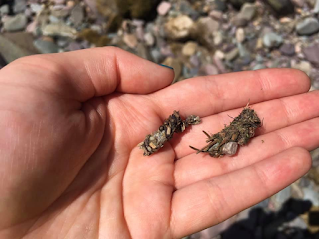
“Look for walking rocks,” I tell kids on WEN field trips, when we have emptied out a net of bugs into a tub of water. A case-building nymph uses its saliva-silk to bind pebbles together around its body. It uses whatever it can find to create its portable house. It might use grains of sand, pebbles of varying size artfully arranged, or perhaps even bits of twigs and stems for a boxy, striped look. Every so often I find lighter toned cases with glimmering rocks, as if the caddisflies were as enraptured with the sparkle as I was. If you don’t have pockets, incorporate the sparkle into your house!
The sparkly cases remind me of the French artist, Hubert Duprat, who kept caddisflies in captivity. He gave them only pearls, gold flakes, and turquoise. Those were the caddisflies of high fashion, crawling around with precious stone adornments.
Once the case is made, only the head and legs stick out, like black eyelashes, so it can crawl around and snag food. The caddisfly eats bits of plant and animal debris that collect on the bottom of the stream, like dust in our houses. Because of the black bodies, you can easily spot the half-inch-long caddisflies in a white tub. It’s the tiny ones that are tricky. That’s when my advice comes in handy. If you are patient enough to let the water settle, only the live insects will move. If you see tiny pebbles or grains of sand moving independently along the bottom, you’ve found a caddisfly!
When the caddisfly is old enough, they grow wings and move out, leaving the case behind. If you find one of these empty cases, you’ll see a tiny air hole on the back end. This tiny air hole is a perfect spot to string up the case on a bracelet or necklace. One WEN volunteer, Al, works at an insect taxonomy lab and brings us leftover cases to do just that.
“Where are these caddisfly cases from?” Deb asked during one of our jewelry-making sessions.
“King County,” Al said.
Seattle is in King County. They were from home.

Monday, January 4, 2021

Living in a Caddisfly Case: Part Two

By Cassie Sevigny

My first trip, we had to leave Missoula to reach our stream site. My mental orientation at this point lacked a compass rose. I biked to the office, crammed myself into Becca's car like another piece of gear, and sat quietly for an hour while we drove off the map into the Wilds of Montana. That is, we went to Lolo.
We lost cell phone service. We passed driveways with signs and side roads without. Rusty pickup trucks guarded the paint-peeling houses. We parked on a dirt shoulder near the day’s assigned stream spot. Popped the trunk, loaded our arms with waders, measuring tools, and clipboards.
Riverside, we untied our shoes, stowed them on the bank, and pulled on the waders. I glanced enviously at the boot-waders the rest of our small team wore. With small feet, my only option were the child-sized, overall-style waders. The waterproofed camo fabric of the legs hugged me so snugly that I had a slight penguin-like waddle. But my waders had pockets.

We had several sets of data to gather, and one of those was called Pebble Count. That sounded pretty boring at first – just gonna start counting pebbles, we’ll be here all day folks. But during Pebble Count we do not actually do any counting of pebbles. We measure rocks.
I reached into the water, hand stinging from the sudden cold, picked up a rock in front of my foot, and pulled a lime green ruler from the pocket of my waders. Daylight reflected off the wet rock. Wait, no, those shimmering striations were embedded in the piece of granite! I tilted the rock back and forth in my hands.
I held the ruler to the rock along its B axis – not its height or length, but width – to find its mediumest measurement.
“50 millimeters!” I yelled to my partner with a clipboard.
I pocketed the rock. When else was I going to find such a glittery rock? I took a step forward deeper into the river. My hand made the polar plunge again to retrieve a second rock. It too, sparkled. Looking up from my Pebble Count, the entire streambed was composed of these sparkle-ridden rocks, a river of treasure flowing through the mountains underneath the crystal clear waters.


Monday, November 16, 2020

My Summer as a Writer in Residence at Rattlesnake Creek Dam


By Cassie Sevigny


A glint of white, a shine of running water ahead. The water is seeping in from the corner of the drained reservoir, opposite the headgates, already braiding through the ditches left by the trucks. The new trickle of stream already washes away the drying, damp, and cracking clay below my feet, the clear water flaunting the muted rainbow of glacial stones. These revealed rivulets of rainbow rocks are their own kind of slow, mini excavation alongside the deconstruction of the dam.


This is a note I wrote while exploring the drained Rattlesnake Creek reservoir as an artist in residence for Trout Unlimited. I was finishing my Master’s in Economics at University of Montana (UM) when I found Open AIR Montana’s artist residency program. Eager to work on a creative project after plunging into statistical econometric analysis, I applied. My excitement heightened upon seeing Rattlesnake Creek dam as a site option because of my prior experience in the creek with the Watershed Education Network (WEN) as a college student. I have participated in citizen science with WEN’s Stream Team and taught local students about river science on WEN field trips. The citizen-led efforts and success of initiating the defunct dam's removal inspired me on a civic level. I was not part of the initial process to approve the removal of the dam, so this was my chance to be involved! 


Since so much of my writing depends on what I see and feel, I did not know exactly where my writing would take me with this project. I wanted to express the importance of this body of water to Missoulians and beyond, the science behind the effects of dams on river ecology, the politics and history of its installation, abandonment, and removal, and the sheer subjective experience of this human-environment interaction. During the residency I spent many days hiking up to the dam overlook, or to the site itself when the construction workers had the day off. I wandered around, connecting pieces of historical and ecological information with aspects of the site itself.


To inform myself, I attended public talks, tours, and virtual lectures by Rob Roberts and Ladd Knotek. I read about bull trout and the importance of the Rattlesnake Creek to local native societies. I helped dig out items from a garbage-and-dirt heap when a local historian came to inspect its trash and treasure. I took pictures of the plants I found along the creek and learned about them with the iNaturalist app. I reviewed the plan for the dam’s deconstruction, and the reconstruction of a semblance of what the original creek might’ve looked like. And of course I ran into WEN staff members along the trail examining the dam removal’s progress.


WEN gave me experience in applied science outdoors with a local stream that connected me to my Montana environment in the first place. Trout Unlimited and Open AIR Montana gave me just the opportunity I needed and desired to explore creative writing and my relationship with an ecosystem that has a soft spot in my heart. 


woody caddisfly cases in open hand

Tuesday, November 3, 2020

Resplendent Stream Team

By Cassie Sevigny

Returning to WEN as a staff member has felt a bit like a homecoming. Stream Team days pull me out of my apartment isolation and into the woods, resplendent with yellow and red leaves and striped with tree trunks among the dry blond underbrush. I see Rattlesnake creek, which is not cutting through the forest but embedded as part of it, and I realize sometimes we forget about things that make us happy.

The cool fall weather indicates Stream Team season is ending, so I’ve been lucky to go out several times in the past few weeks. One trip brought me to a location between Greenough and the dam site that I had not been to before. A family was leaving the area around the tilted narrow stone table and bench when we arrived. Upon the table we spread out our gear around a little fall fairy house someone had made. Red berries perched in the shelves of pinecones, and leaves and pine needles stuck out like flags from a mossy wood-and-bark house. That day ended with wine and a light plum cake made with Deb’s recipe and Aissa’s plums. The immediate feeling of being among family and working to a common goal makes me happy.


I also helped with a special Stream Team day with University of Montana’s Water Policy class, taught by Ada Montague, this time at a familiar site by the Duncan trailhead bridge. Clouds clung thickly to the sky and the thin conifers swung about in the wind. It was hard to find insects in our tubs with all the leaves and other fall debris. They needed someone “solid on bugs” to teach the volunteers what to look for and how to identify the insects we were counting. I wasn’t sure how much I would remember but trusted in my ability to recognize and relearn. Turns out even after a few years’ absence from leading any stations, I still know my aquatic insects! Pointing out the tiny wiggling ones reminded me of when I was a new volunteer, delightedly soaking up every bit of Al’s professional expertise that I could. 

Working with WEN has taught me to take the lead with whatever they throw at me. I’ve also been reminded that I have plenty of skills and knowledge from years of working with WEN. That expertise makes me comfortable teaching and leading stations, even if I’m initially hesitant, so that others can learn the excitement of their watersheds too.


Wednesday, December 12, 2018

Living in a Caddisfly Case: Part One

By Cassie Sevigny

The wind carries the sharp, salty smell of dead seaweed, thick and dark, strewn across the grey stones. Most things are grey on the Puget Sound beach – the salted and sundried driftwood above the tide line, the clouds that hang overhead, the seagulls picking at picnic scraps, the puddles of rain… I relish the quiet, contemplative mood required to enjoy this grey but textured landscape. My siblings and I would spend hours collecting logs to build forts to withstand the tides and wind coming off the water, as if we were marooned and in need of shelter. This piece of ocean was my main connection to water for almost a decade. Then I moved to Montana.
Montana is landlocked. There is no ocean, not even a protected piece of one like Puget Sound. Nowhere to stand on a beach and imagine how far out the horizon expands. There were mountains and forest though, so with them as the structure of my new home, I sought out inland waters to nourish it.
The Watershed Education Network found me at a volunteer fair. They teach youth (and adults) about what makes a healthy watershed, at least for Missoula County. A woman named Becca gave me the basics of understanding water chemistry, insects, and measuring physical characteristics. She had bright, peppy eyes, frizzy hair in a perpetual ponytail, and an adoration for bugs.
I wanted peaceful moments to experience and learn about rivers myself before I taught watershed science to local kids, so I joined WEN’s citizen science program called Stream Team. Volunteers went out in the fall and spring to gather data from streams, as if we were doctors conducting check-ups. Each trip consisted of four hours of freezing our hands, checking the sky and our waders for leaks, estimating the river’s depth at full flows, and taking its temperature. I ate up the information, and the snacks packed by Deb, the Director. Like any other animal, I knew these people feeding me would be my friends.

Friday, September 21, 2018

Rattlesnake Creek Discovery

WEN's First Summer Camp: A Reflection


     The 2018 Rattlesnake Creek Discovery Summer Camp, in partnership with the Missoula International School, was a full week of fun, play, and learning. Six children attended Monday-Friday 9 a.m.-3 p.m. On the first day, the Rattlesnake Creek explorers collected macro-invertebrates from two different locations, then learned how to identify and draw these aquatic insects.


    Tuesday was introduction to bug anatomy, and more exploration north of the Pavilion. The explorers ventured off into the riparian area along Rattlesnake Creek and discovered interesting critters. The day ended with a cool down in the creek!

     On day three, we mapped Rattlesnake Creek and created our own maps of Greenough Park. We also measured the velocity of the Creek with our sticks and painted rocks with Pam Ward (our guest instructor from Sussex School). Lastly, we rounded out the day with Bull trout game fun!


    Thursday we did a water cycle game and journaled about being a water drop. Cas Smith (our hydro-geologist guest presenter) taught a lesson on groundwater, which included exploring various wells in Greenough Park. The afternoon concluded with watercolor painting and Lego building.

     On our last day, the children collected sticks as we hiked and explored through Greenough, and then we used those sticks to construct “dreamboats”. Afterwards, we launched our boats down the Creek. Finally, we celebrated this special week-long summer camp with a macro-invertebrate mayhem game, and said farewell to the Rattlesnake Creek.


     As the partner of an ex-river guide, I've heard (and fallen in love with) a phrase that seems to capture the spirit of this camp, "Let's just read and run." Read the river, then run it accordingly. While developing the Rattlesnake Creek Explorations Camp, we built a structured schedule which we followed every morning. I was an afternoon volunteer and witnessed firsthand how the overall mood vacillated in the full-belly, post-lunch afternoon heat. The children would either rally energetically after a quick dip in the creek, or feel lethargic. 
     
     It seemed that they fed off of each other's energy, without any verbal communication. It was so fun to read them, and then help steer the afternoon schedule according to their wants and needs. We had so much fun every afternoon. Whether we were taking a break from the heat and painting rocks inside an MIS classroom, focusing on a groundwater lesson, or playing with spray-bottles at the Greenough playground- this camp was totally kid-centric. It was so fulfilling to help facilitate the creation of positive summer memories for these six, very awesome kids. 


This camp couldn't have happened without the leaders from the Missoula International School and Watershed Education Network: John Walker and Deb Fassnacht. Special thanks to our guest instructors Pam Ward and Cas Smith! Shout-out to our volunteers: Madeline Wilber, Cassie Sevigny, Markus Boyer, and Eli Santos.

I look back on this summer camp fondly, and consider it a huge success. We at WEN are looking forward to Summer 2019, and the possibility of offering more camps like this. 

Thanks for reading, and happy first day of Fall!
Katrina Thorness
Watershed Education Network
Communications Coordinator
802 East Front St.
Missoula, MT. 59802
Ph (406) 541-9287
Check us out on facebook for updates. 

Katrina is a part-time Communications Coordinator who is focusing on becoming a 'Jane of All Trades' in life, and for WEN. She assists with program development, and has worked on projects for YCC, AIS, and School Stream Monitoring. One of Katrina's life goals is to continue nurturing a community of outdoor learning in the region.

Tuesday, August 14, 2018

What Goes into an Experiment? - Sentinel Floating Islands

4/17/18

     I joined Sylvia at Sentinel High School again as her two classes learned about experimental design. They had been given an article the previous session detailing an experiment about the efficacy of floating islands in removing excess nutrients from the water. Broken into groups, the students sifted through the fancy terminology and scientific structure of the article to find the key points to summarize.

     Sylvia had the students write unfamiliar vocabulary words on the board. She addressed the first word off the bat as it pertained to the experiment's first design.

     "Batch mesocosm can be one of those stressful words," Sylvia said. Mesocosm just means medium-sized-world, as the experiment was not on a tiny scale or a large scale. "Batch" referred to the way the researchers included water in the system. They created batches of water that mimicked the composition of natural pond or creek water and held it motionless in containers. This is contrast to the second design, which allowed that water to flow.

     The students described the batch mesocosms as being a box shape with a native macrophyte on the small floating island. Sylvia then explained another vocabulary word. "A microphyte is basically a small plant." Like algae. She compared the prefix to the word "microscope" which the students were familiar with, to make the connection that microscopes help you see tiny things such as microphytes. A macrophyte, then, is an aquatic plant that is large enough to see, like grass. So each little island had a native plant living atop it.


     "Why do you need a control?" Sylvia asked.
     "What's a control?"
     Sylvia explained that one of the batches did not have a floating island or any plants, just a metal sheet to produce the same amount of shade. This plantless batch was the control.
     "So, to compare to the other one," a student said.
     "Why do they have three experimental tanks?" These would be the batches with plants.
     "Alter them to see different effects," a student suggested. Indeed, a researcher would use their experimental tanks in comparison to the control to see which variables produce measurable changes and which do not, or which produce the most change. Sylvia got to a more basic point though, which is that researchers want to make sure their "data is stable." This means that they gather enough data from the experimental batches that they can find a pattern across all of them. This ensures that if, for example, one of the plants is dying, it doesn't determine all of the results. Having extra batches helps make sure the correct variables contribute the desired information.

     Then they moved on to the next design. The flow tanks took place in "a giant shipping container" divided in half lengthwise with water flowing through each side. Here the researchers wanted to know if the rate of water flow mattered, so one side had slow-moving water and the other had fast-moving water. The steel container had a special coating to prevent metal ions from entering the water, since they can be toxic to plants. Each side also had soil at the bottom. Sylvia reminded the students that soil can have nutrients in it, especially when it contained decomposed materials, so the soil imitated natural conditions where the nutrients came from within the system.

     "One of them absorbed more than the other," a student noted.
     "Yes, definitely. Which one?" Sylvia asked.
     "I think it was the high flow," the student answered.
     Sylvia reviewed the previous lesson on the phosphorus and nitrogen cycles. Both of these are nutrients that are important to plant growth, but in large amounts they can lead to the overgrowth of microphytes: algae blooms. The side with high water flow had more of these nutrients removed by the floating island plants, indicating that faster streams are better at preventing algal overgrowth.

     With the design out of the way, Sylvia broke the experiment down into its most basic parts. She guided the students through identifying the dependent and independent variables of each design. The students identified the dependent variables fairly quickly (the presence or absence of a floating island in the batches, and water flow in the flow tanks), but had trouble with the independent variable. Sylvia emphasized that the answer was simple, and the same across both designs, since the researchers were interested in one thing. This was the level of nutrients (phosphorus and nitrogen) in the water, as lower levels mean the floating islands are removing them more effectively.

Mini floating island models
     These experiments both took place in a laboratory environment, which is useful because "you can control what happens," as one student said. In other words, there are fewer variables at play because you can choose which ones to include, which then "makes [the data] easier to interpret," as Sylvia said.

     Field experiments have advantages too. "You get all the natural things that could happen right there," another student said, so you don't have to try to replicate all the variables that do exist and interact. If an experiment left some of these variables out, the results might not accurately reflect what would happen in a real ecosystem when one variable changes. This helped the students realize that an effective laboratory experiment should aim to be as much like the natural system as possible.

     Sylvia set the students to work in small groups on a worksheet that asked them to identify other variables that could be important in designing a floating island experiment. I wandered around to guide their thought processes, without giving away any answers.

     Sylvia's repeated use of small groups was intentional, as it can help students develop leadership and social skills through conversation practice. It also helps them consider multiple angles and the ideas of their classmates when dealing with complex issues.

     Many of the students looked sleepy and stayed quiet through most of the lesson, as I remembered I was during my high school mornings, but the answers on their worksheets gave away the connections they were making with the material. Sylvia was thrilled.

-Cassie Sevigny
AmeriCorps Team Member
Media Coordinator

What's in the Water? - Sentinel Floating Islands

2/27/18

     Water composition is pretty important for ensuring a watershed is healthy. That's why Stream Team checks pH levels and turbidity, for example. It's also why Sylvia brought up conductivity, turbidity, and metal content in her wetland health class at Sentinel High School.

     "What is conductivity?" a student asked.
     "Conductivity - how charged the water is, like how many salt ions are in it," Sylvia explained.
     "What does salt do?" came another question.
     "[It] dehydrates animals," like fish, Sylvia said.

     The students thought of ways metal could get into lakes and streams in Montana. Magnesium chloride could come from road salt that washes into drains. But salts aren't the only metal ions that can enter water. Sylvia hinted that many may come as a result of mining exposing materials to surface water. The students thought some more and suggested arsenic, lead, and mercury. All good answers, but most common in Montana, Sylvia said, are zinc and copper. These minerals aren't that bad for humans, but they are unhealthy for plants.

     One way plants are helpful for wetland ecosystems is by holding soil with their roots. If plants start to die from mineral poisoning, their roots no longer protect the dirt from erosion. Water then can pick up bits of that soil, increasing turbidity. Turbidity is the level of suspended particles in the water. If you've ever waded along a beach or shorefront and seen little clouds of dust kick up under your feet, you've seen turbidity in action. That tends to settle back down, though, when the water doesn't move very much, like in a lake. In a river, the current constantly picks up soil particles and carries them downstream, eroding the riverbed and banks. All these dirt particles in the water make it hard for organisms like fish to see and breathe.

     The plants dying has an additional consequence: their decomposition adds to the layer of silt on the bottom, releasing phosphates and nitrates into the water. "Phosphates and nitrates cause algal blooms," Sylvia said, and "silt and the algal blooms cause higher turbidity."


     "Where does phosphorus come from?" Sylvia asked, starting a diagram on the board.
     After a quick look at posters the students had previously made, they said, "decomposing organic matter."
     "Phosphorus is really unique in that it is never ever in the atmosphere," Sylvia said. This means that phosphorus can only enter the water system when it is released by dead organisms and soil. When contaminated plants die off, they release this nutrient, which algae loves. Algae doesn't need to root itself in the soil, but rather "blooms" on the surface where the sun's light reaches. With fewer roots and more algae, the soil can be stirred up even more easily, causing even higher turbidity. Combined with the reduction of oxygen in the water, the increased turbidity makes it harder for any other organisms to continue to survive.

     Adding floating islands to wetland ecosystems allows additional plants to grow on the water's surface to pull phosphates and nitrates out of the water, preventing algal blooms and maintaining or restoring balance.

     Guiding the students through the natural pollutants of wetlands, Sylvia improves their understanding of how natural processes work when in or out of balance. Knowing how these process work provides a foundation for understanding why and how floating islands can restore wetland placed in the Pattee Creek retaining pond down the street. The wetland processes won't be abstract ideas that happen elsewhere, but physical processes that occur in their very own neighborhood. The strategy of using floating islands for restoration also teaches them that taking care of their environment is feasibly in their own hands, and that environmental damage is not a lost cause.

-Cassie Sevigny
AmeriCorps Team Member
Media Coordinator

Tuesday, April 24, 2018

Mussel Detection Technology - Aquatic Invasive Species

     "I imagine you are all really into aquatic invasive species news," Heidi joked. If we were, we would know about the new techniques for detecting mussels. As the only remaining US watershed without them, we are concerned with making sure we stay that way. To do so, we must be vigilant and quick to detect them if they arrive.

     Mussel larvae, also know as veligers, were first detected in the Tiber Reservoir and Canyon Ferry in the fall of 2016. This marked the first time mussels had been found in Montana. Thankfully, these locations are not connected to the Columbia Watershed, so all the lakes and rivers on the Western side of the continental divide are safe, for now.

Related image
Zebra mussel veliger
Source: NOAA Great Lakes Environmental Resource Laboratory

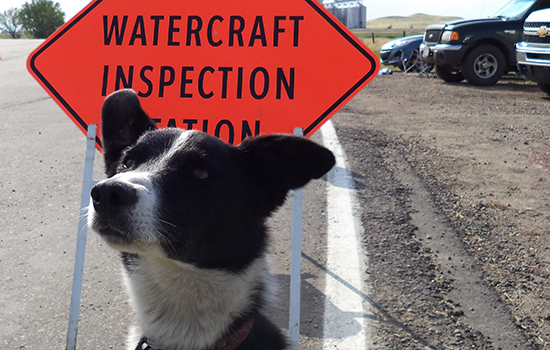
     Detection efforts typically involve examining water samples using microscopy, Heidi said. Dogs are also used to inspect boats, shorelines, and docks, as they're trained to sniff them out. Imagine those police dogs that are used to find bomb residue and drugs, but instead of stationing them at an airport or police station, these dogs get to explore the shores of Montana lakes, seeking out tiny little shelled creatures. The students must've had a similar mental picture, because a few of them laughed. Dogs were deployed in November 2016 and confirmed the presence of mussels in the Tiber Reservoir and Canyon Ferry. US Fish & Wildlife Services has also utilized scuba divers to search for signs of mussels. Using divers brings up silly images of people wandering around underwater looking for something dark in the dark, but it's a lot easier to send people down in scuba gear with flashlights to check underwater features and pipes for mussel colonies than it is to send dogs!

Image result for mussel detection dogs
Mussel inspection dog
Source: Working Dogs for Conservation

     A more recent development in detection technology analyzes environmental DNA, or eDNA. No, this doesn't mean the environment has its own DNA. eDNA is the remnants of DNA left behind by organisms as they shed cells, excrete waste, and rub against other things, like water or rocks. Some form of eDNA detection has been used for several years, but researchers at the Flathead Lake Biological Station have been working on ways to make it work with smaller samples and smaller budgets. This method can help researchers detect mussel presence at all stages of the mussel life cycle. Heidi summarized that in 2016, dogs, divers, and microscopy all found evidence of mussels, but later in 2017, only eDNA did. The question with eDNA, Heidi said, is whether eDNA indicates current presence of mussels if dogs or divers don't find any veligers.

     Since the technology is so new, there aren't standard procedures for how to collect and test eDNA, or how to interpret a positive test result. Perhaps eDNA lingers around after all living veligers and adult mussels are eradicated, or perhaps the DNA breaks down quickly and finding it means mussels are indeed lurking in our waters. As further research is conducted, this method may become more accurate at detecting low populations of mussels, perfect for taking early and quick action.

     Discussing the lengths to which we go to detect mussels helps drive home how important it is to keep them out. It also gives students an idea of how researchers and agencies are approaching the problem, and the creativity of new technology. When I was a young student, "research" sounded like sifting through stacks of papers or doing experiments in stuffy laboratories, but the development of eDNA analysis demonstrates that research attacks real world problems and ultimately tests solutions in the field, too. I think it's important to expose students to the developments in technology and problem solving so they can envision themselves doing the same thing in the future.

-Cassie Sevigny
AmeriCorps Team Member
Media Coordinator

Tuesday, April 3, 2018

Women in STEM and Women in WEN

     In late February and early March, WEN  partnered with the Girl Scouts to provide after-school STEM lessons for girls at Washington Middle School. WEN provided watershed education that involved watershed enactments, data collection, and interpretation.


     We started with a map of the Columbia Watershed, ours, to orient them. To better explain the components of a watershed, Kyra led them through a simple 3D watershed construction. The girls took soda bottles and egg cartons, among other miscellaneous items, to create their idea of a mountain shape. Kyra helped them place a tarp over this with the folds representing valleys so they could see how water (in the form of rivers and lakes) eventually flows to the lowest point.

     The girls guessed how water would flow down the tarp valleys by placing strings. The strings started on the slopes and ended in the valleys, indicating that they understood water flows to the lowest point. Pointing at each feature, Kyra explained the headwaters, tributaries, and river stem. The girls identified a few areas that would be lakes as well.

     Then we told the girls to be the watershed. Two served as the headwaters, a couple on the sides as tributaries, and one as the Pacific Ocean. Connecting these features were the rest of the girls, serving as the river. As the source of the water, the headwater girls passed beads to their river buddies, with the beads representing one volumetric unit of water flow. Downstream, each girl had a cup with which they transferred the beads. The Pacific Ocean held a small bucket to contain all the incoming "water" from the "Columbia watershed."


     First they simulated low river flow (summer), passing the beads leisurely. For high river flow (spring snowmelt or storms), Kyra instructed the headwaters to pass the beads more quickly. Rainy audio played in the background as beads overwhelmed the girls at intersections of headwaters and tributaries. Beads bounced out of cups, as if the river was flooding.

     Then Kyra modified the game. She gave one headwater and one tributary pieces of trash to pass along with the beads. "It's getting disgusting..." said the girl holding the Pacific Ocean, as the trash collected in her bucket. Notice how only a few parts were polluted, but it polluted everything downstream, Kyra said. Then the girls were given cards with pictures of aquatic invasive species. These included mussels and a weed. These also spread quickly through the watershed, overwhelming the girls. This demonstrated how easily invasive species can colonize an entire watershed from one entry point.


    After each round, the girls did the math to see how many beads, trash pieces, and invasive species ended up in the “ocean” and compared these numbers graphically. The numbers differed drastically depending on the flow of beads.


     What struck me as these activities went on was how interested and participatory these girls were, and that they voluntarily signed up for a STEM after-school program. This indicates that girls are interested in science and math. Either we are catching them at an age before they feel discouraged by STEM, or girls in the community are starting to get the message that STEM is for them too, both of which are good outcomes.

     I felt proud that we were able to provide so many female science role models for them, as we had 4 WEN staff and interns present, including myself. I think it helped that the biology teacher (and WEN board member) who hosted us in her classroom was also a woman, so her classroom was filled with animal artifacts like it was its own natural history museum. On one wall were poster assignments by some of her students, depicting genetics and heredity of dragons. This caught the attention of one girl, who said she couldn't wait to take biology and draw dragons. "Dragons are more fun than peas," the teacher told me.

     All we have to do to make kids - and adults - interested in science and technology is make the content fun and interesting! If that means applying real world concepts to fantasy animals, I'm all for it. I think we did a pretty good job keeping the lesson interesting, even though it was simple. "Who knew counting beads could be so fun?" the Girl Scout coordinator said.

     I also realized how many women work and volunteer for WEN in general – we had 8 women in the office at one time one day! We didn't have to try hard to rally up female volunteers to represent WEN for the girls in the after-school program because WEN is already full of women. Not to mention that WEN was started by a woman - our lovely Director, Deb. I was also proud of Kyra for taking charge of teaching the lesson and organizing the girls, while Natalie, Taylor and I engaged the girls in small conversations about the activities. Teaching was new to her, and while I am also uncomfortable leading lessons, Kyra seemed a natural.

     Exposure to women who already are or have been involved in science helps them realize that such a path is possible, and they can be successful in it. This gives me hope for the future of female-driven science innovation.

-Cassie Sevigny
AmeriCorps Volunteer
Media Coordinator

Tuesday, March 13, 2018

Shade and Oxygen - Sentinel Floating Islands

Pattee Creek Retaining Pond in February
     "Cold and short" is what students recalled about their visit to the floating islands in Pattee Creek retaining pond. These students have been studying wetland health in science classes at Sentinel High School through a Floating Islands watershed health curriculum taught by Sylvia Doyle.


     A healthy wetland, defined by the students, depends on vegetation. Plants have roots which "hold the bank in," "slow the current," and "shade the algae, so less grows." The plants need light, of course. There should be animals, whose feces and dead bodies provide fertilizer for the soil. Decomposers must be around to break down the dead plants and animals. The habitat type is important, too: "It's gotta have a rocky bottom for fish to lay their eggs, and for bugs."


     Another key aspect of healthy wetlands is dissolved oxygen.

     "Our fishermen and fisherwomen know dissolved oxygen is important, like for trout. Our fish are cold water species, not just because they need cold water but because it means there's more dissolved oxygen." Colder water can hold more oxygen than warmer water.

     "So it's really good to have shade on water," a student observed.

     I thought of Stream Team expeditions I'd gone on in the past, where I dunked my hands again and again into freezing water. My hands would turn pink and then white, but I knew the cold was necessary for the river's health.

     "When you see a white cap in a river or lake, that means the water is completely saturated, over 100%, so the bubbles can't mix in," Sylvia pointed out. The water already has so much oxygen dissolved that it can't take any more. She was referring to river rapids or waves formed by wind, but the image of ocean waves crashing on the shore sprang to my mind.

     Shade not only cools the water but prevents the overgrowth of algae. Too much algae limits the amount of oxygen that the water can contain, and encourages bacterial growth.

     "Bacteria can turn nitrogen gas into soluble form," Sylvia said. Some amount of nitrogen enters the water from gas exchange with the air, but bacteria facilitate this process. The students knew nitrogen is important for the ecosystem and that it can come from decomposing matter, but too much nitrogen makes it hard for organisms to breathe. This is also why fertilizer in runoff can be a problem for wetlands, as it adds more nitrogen than the system is accustomed to.

     Even though Sylvia only brings her lessons to the class once per month, the students remember many bits and pieces of what wetlands need to stay healthy and work together to put the big picture together.


-Cassie Sevigny
AmeriCorps Team Member
Media Coordinator