Showing posts with label Aquatic Invasive Species. Show all posts

Tuesday, April 24, 2018

Mussel Detection Technology - Aquatic Invasive Species

     "I imagine you are all really into aquatic invasive species news," Heidi joked. If we were, we would know about the new techniques for detecting mussels. As the only remaining US watershed without them, we are concerned with making sure we stay that way. To do so, we must be vigilant and quick to detect them if they arrive.

     Mussel larvae, also know as veligers, were first detected in the Tiber Reservoir and Canyon Ferry in the fall of 2016. This marked the first time mussels had been found in Montana. Thankfully, these locations are not connected to the Columbia Watershed, so all the lakes and rivers on the Western side of the continental divide are safe, for now.

Related image
Zebra mussel veliger
Source: NOAA Great Lakes Environmental Resource Laboratory

     Detection efforts typically involve examining water samples using microscopy, Heidi said. Dogs are also used to inspect boats, shorelines, and docks, as they're trained to sniff them out. Imagine those police dogs that are used to find bomb residue and drugs, but instead of stationing them at an airport or police station, these dogs get to explore the shores of Montana lakes, seeking out tiny little shelled creatures. The students must've had a similar mental picture, because a few of them laughed. Dogs were deployed in November 2016 and confirmed the presence of mussels in the Tiber Reservoir and Canyon Ferry. US Fish & Wildlife Services has also utilized scuba divers to search for signs of mussels. Using divers brings up silly images of people wandering around underwater looking for something dark in the dark, but it's a lot easier to send people down in scuba gear with flashlights to check underwater features and pipes for mussel colonies than it is to send dogs!
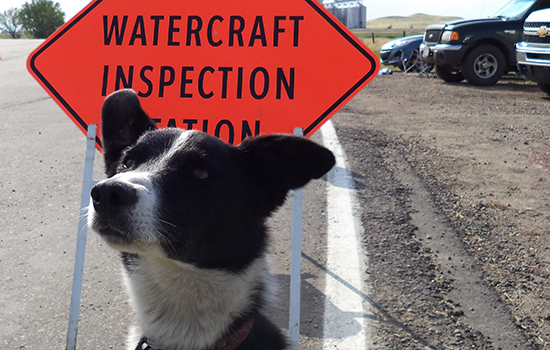
Image result for mussel detection dogs
Mussel inspection dog
Source: Working Dogs for Conservation

     A more recent development in detection technology analyzes environmental DNA, or eDNA. No, this doesn't mean the environment has its own DNA. eDNA is the remnants of DNA left behind by organisms as they shed cells, excrete waste, and rub against other things, like water or rocks. Some form of eDNA detection has been used for several years, but researchers at the Flathead Lake Biological Station have been working on ways to make it work with smaller samples and smaller budgets. This method can help researchers detect mussel presence at all stages of the mussel life cycle. Heidi summarized that in 2016, dogs, divers, and microscopy all found evidence of mussels, but later in 2017, only eDNA did. The question with eDNA, Heidi said, is whether eDNA indicates current presence of mussels if dogs or divers don't find any veligers.

     Since the technology is so new, there aren't standard procedures for how to collect and test eDNA, or how to interpret a positive test result. Perhaps eDNA lingers around after all living veligers and adult mussels are eradicated, or perhaps the DNA breaks down quickly and finding it means mussels are indeed lurking in our waters. As further research is conducted, this method may become more accurate at detecting low populations of mussels, perfect for taking early and quick action.

     Discussing the lengths to which we go to detect mussels helps drive home how important it is to keep them out. It also gives students an idea of how researchers and agencies are approaching the problem, and the creativity of new technology. When I was a young student, "research" sounded like sifting through stacks of papers or doing experiments in stuffy laboratories, but the development of eDNA analysis demonstrates that research attacks real world problems and ultimately tests solutions in the field, too. I think it's important to expose students to the developments in technology and problem solving so they can envision themselves doing the same thing in the future.

-Cassie Sevigny
AmeriCorps Team Member
Media Coordinator

Tuesday, April 3, 2018

Women in STEM and Women in WEN

     In late February and early March, WEN  partnered with the Girl Scouts to provide after-school STEM lessons for girls at Washington Middle School. WEN provided watershed education that involved watershed enactments, data collection, and interpretation.


     We started with a map of the Columbia Watershed, ours, to orient them. To better explain the components of a watershed, Kyra led them through a simple 3D watershed construction. The girls took soda bottles and egg cartons, among other miscellaneous items, to create their idea of a mountain shape. Kyra helped them place a tarp over this with the folds representing valleys so they could see how water (in the form of rivers and lakes) eventually flows to the lowest point.

     The girls guessed how water would flow down the tarp valleys by placing strings. The strings started on the slopes and ended in the valleys, indicating that they understood water flows to the lowest point. Pointing at each feature, Kyra explained the headwaters, tributaries, and river stem. The girls identified a few areas that would be lakes as well.

     Then we told the girls to be the watershed. Two served as the headwaters, a couple on the sides as tributaries, and one as the Pacific Ocean. Connecting these features were the rest of the girls, serving as the river. As the source of the water, the headwater girls passed beads to their river buddies, with the beads representing one volumetric unit of water flow. Downstream, each girl had a cup with which they transferred the beads. The Pacific Ocean held a small bucket to contain all the incoming "water" from the "Columbia watershed."


     First they simulated low river flow (summer), passing the beads leisurely. For high river flow (spring snowmelt or storms), Kyra instructed the headwaters to pass the beads more quickly. Rainy audio played in the background as beads overwhelmed the girls at intersections of headwaters and tributaries. Beads bounced out of cups, as if the river was flooding.

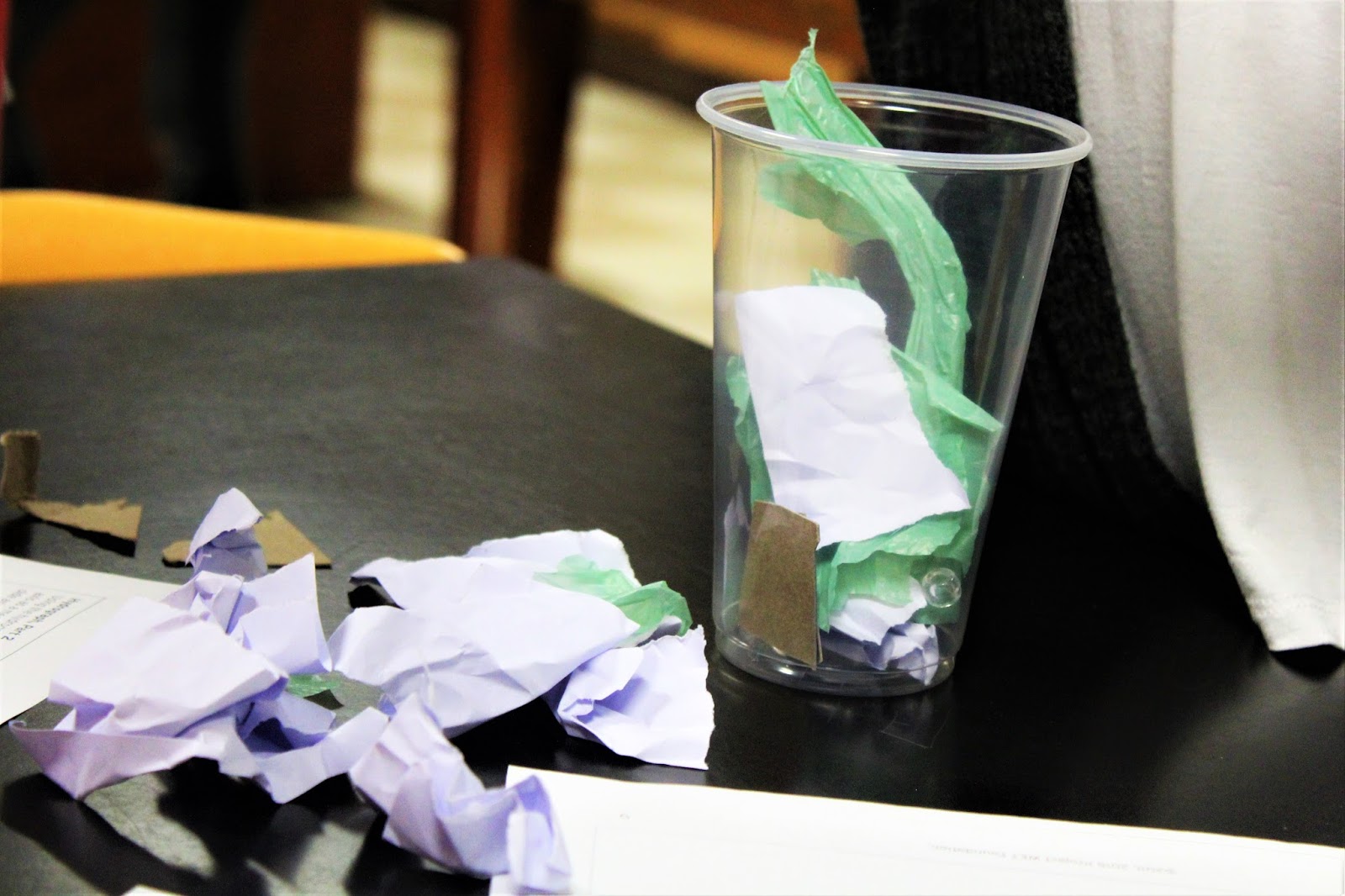
     Then Kyra modified the game. She gave one headwater and one tributary pieces of trash to pass along with the beads. "It's getting disgusting..." said the girl holding the Pacific Ocean, as the trash collected in her bucket. Notice how only a few parts were polluted, but it polluted everything downstream, Kyra said. Then the girls were given cards with pictures of aquatic invasive species. These included mussels and a weed. These also spread quickly through the watershed, overwhelming the girls. This demonstrated how easily invasive species can colonize an entire watershed from one entry point.


    After each round, the girls did the math to see how many beads, trash pieces, and invasive species ended up in the “ocean” and compared these numbers graphically. The numbers differed drastically depending on the flow of beads.


     What struck me as these activities went on was how interested and participatory these girls were, and that they voluntarily signed up for a STEM after-school program. This indicates that girls are interested in science and math. Either we are catching them at an age before they feel discouraged by STEM, or girls in the community are starting to get the message that STEM is for them too, both of which are good outcomes.

     I felt proud that we were able to provide so many female science role models for them, as we had 4 WEN staff and interns present, including myself. I think it helped that the biology teacher (and WEN board member) who hosted us in her classroom was also a woman, so her classroom was filled with animal artifacts like it was its own natural history museum. On one wall were poster assignments by some of her students, depicting genetics and heredity of dragons. This caught the attention of one girl, who said she couldn't wait to take biology and draw dragons. "Dragons are more fun than peas," the teacher told me.

     All we have to do to make kids - and adults - interested in science and technology is make the content fun and interesting! If that means applying real world concepts to fantasy animals, I'm all for it. I think we did a pretty good job keeping the lesson interesting, even though it was simple. "Who knew counting beads could be so fun?" the Girl Scout coordinator said.

     I also realized how many women work and volunteer for WEN in general – we had 8 women in the office at one time one day! We didn't have to try hard to rally up female volunteers to represent WEN for the girls in the after-school program because WEN is already full of women. Not to mention that WEN was started by a woman - our lovely Director, Deb. I was also proud of Kyra for taking charge of teaching the lesson and organizing the girls, while Natalie, Taylor and I engaged the girls in small conversations about the activities. Teaching was new to her, and while I am also uncomfortable leading lessons, Kyra seemed a natural.

     Exposure to women who already are or have been involved in science helps them realize that such a path is possible, and they can be successful in it. This gives me hope for the future of female-driven science innovation.

-Cassie Sevigny
AmeriCorps Volunteer
Media Coordinator

Thursday, February 15, 2018

How Many Mussels is Too Many? - Aquatic Invasive Species

     As the Willard students learned, mussels can clog up pipes, reducing water access, and use the resources that native species rely on, edging them out of the ecosystem. How do we know if the mussel population is large enough to be a concern?

     Heidi asked the students to image a nuclear power plant. Nuclear power plants rely heavily on the functioning of cooling systems. If mussels were introduced to the cooling system, the water flow would slow and heat up, rendering critical cooling processes ineffective. A small number of mussels would be disastrous.

     More likely, mussels would affect hydroelectric power.

     "Montana has some of the cheapest power in the US" because the Columbia Watershed has so many dams, Heidi pointed out. Mussels would slow the rate at which dams produce electricity, increasing power prices for all the residents receiving power from the Northwest.

     The problem lies in the rapid reproduction rates of mussels. Mussel populations do not stay small for long, as the students recalled on my first visit. Mussels' ability to thrive in most any water body contributes to their designation as "invasive," and means that any number of mussels where they are not supposed to be is too many.

Bar graph of ml of water filtered by
mussels in 1, 3, 8 hours
Chart of ml of water filtered by
mussels in 1, 3, 8 hours


   Heidi assisted the students in performing a small demonstration on the impact mussels have on water, aside from their physical presence. One student put a scoop of rich dirt into a plastic soda bottle to simulate the detritus that many water species extract nutrients from.

Photo courtesy of Bailey Roseveare

     "Mussels filter how much water per day?" she asked.
     "One liter [each]," a student answered. The student poured one liter of water into the bottle to represent the water column. Then Heidi held up a contraption with a small canister attached to a screw cap.

     "Specialized gills are what these cotton balls are going to represent," Heidi explained as she stuffed two cotton balls into the canister. After attaching it to the bottle, Heidi set out a clear glass jar and began to squeeze the bottle. The water was forced into the contraption and filtered by the cotton ball gills.

     "What do you notice about the water in the jar?" she asked.
     "It's clear."
     "It's pretty clean."
     "Is that a good thing or a bad thing?" Heidi followed up.
     "Bad," the students agree. One clarified that it was bad because the water had no nutrients left in it.
     "What's happening to the gills?" Heidi took the cotton balls out, now brown from collected soil.
     "They're getting dirty," a student replied.
     "They're filtering nutrients," Heidi reminded them.


     This realization that clear water was unhealthy contrasted the students' initial expectations from the week prior. They wrote that clear water was cleaner, which is good for our drinking water. They figured cleaner, clearer water was less likely to make humans and animals sick. Now, however, they understood that the detritus that makes water unappealing to us is actually an important food source. It also maintains ecosystem balance, as they would learn next.

     "The mussels create an environment unsuitable for living," a student concluded.
"Or we could call it sterile," Heidi elaborated.

     In addition to removing helpful material floating in the water, mussels can increase water toxicity. Mussels produce pseudofeces, or "fake poop".
If there's anything they don't want, the dump it out," Heidi explained. This means "they spit out the toxic stuff."

     The clear water column expands the literal zone of bodies of water. The litoral zone is the area where sunlight can reach the bottom of the water column. This is the section where plants can grow, as they utilize the sunlight for photosynthesis. A larger litoral zone allows more plants to flourish.

     "What happens [with plants] at the end of the growing cycle?" Heidi asked.
     "They die."
     "They die and release phosphorus, perfect conditions for algae blooms," Heidi confirmed. If there is a larger litoral zone, more plants grow, and more plants die, releasing more phosphorus. Algae blooms make water anaerobic, depleting the oxygen available and thus making it difficult for creatures that need oxygen, such as fish and certain bacteria, to survive. This anaerobic state is conducive to the growth of botulism, a toxic bacteria.

     The class read over an article in The Oakland Press about bird deaths that Heidi had passed out. What do mussels have to do with birds? I wondered. Botulism contaminates the food that loons and other waterfowl eat, entering their nervous systems and shutting down their bodies. The article went on to list the numbers of loons, ducks, gulls, and other birds found dead on the shores of water infested with mussels. It provided a stark image of the chain of effects mussels have on an ecosystem.

     Heidi connected the article back to Montana, noting the Montana has the largest loon population west of the Mississippi. If mussels made it to the Columbia Watershed, it would devastate this valued population.

     We revisited the pros and cons of having clear water in aquatic ecosystems, again emphasizing how our assumptions of human needs do not always match with the needs of other organisms.

     "Wow, and they're only this big, they're tiny!" a student expressed amazement at the damage that can be caused by a creature the size of a fingernail.

     Watching the students grasp the interconnectedness of ecosystem elements and the impacts small changes can have gave me hope that early education like AIS will lead to better environmentally-informed citizens in the future.

-Cassie Sevigny
AmeriCorps Team Member
Media Coordinator 

Thursday, February 8, 2018

Those are Some Gravelly Mussels - Aquatic Invasive Species-

     They're in our lakes, they're in our pipes, they're on our boats. They're in every major watershed in the US except the Columbia, which is ours.

     Mussels.

     Mussels are bivalve mollusks. They have two shell halves that protect the mussel's soft body. Mussels can attach to many surfaces, including the outsides of boats, which enables them to travel between bodies of water. Such mobility is the reason for careful boat-cleaning requirements. Female zebra mussels can produce 500,000 eggs per year, with mature mussels sometimes reaching a million eggs per year, resulting in rapid reproduction and establishment in an ecosystem where there was no prior mussel population. This kind of population growth can threaten the ability of native species to survive. Originally from Eurasia and now thriving across North America, mussels provide the perfect example of an aquatic invasive species for WEN's Aquatic Invasive Species (AIS) curriculum, called Columbia Headwaters Education Kit 4.

     Heidi Sedivy leads AIS lessons once a week at Willard Alternative High School, where small class sizes enable intimate engagement with the imminent threat and application of science to relevant local issues. On January 30th I joined Heidi and Bailey, AIS Assistant, on my first classroom program.

    Bailey began by asking the students to think about how mussel invasion might affect human activities. As mussels settle down in the pipe that will become their home, they reduce the water flow rate exponentially. Given their proclivity for clogging up pipes, mussels could prevent the efficient transport of water for agricultural irrigation or hydrating cattle. This increases the difficulty of raising crops and animals, which would increase prices for consumers and decrease profits for companies.

     With human implications in mind, the class set up a lab to examine the physical effects of mussel populations on water flow. Heidi and Bailey demonstrated how to use the equipment. A translucent funnel (aka the top cut off of a plastic soda bottle) sat on top of a clear tube, about an inch in diameter. At the bottom was a filter before the rubber output. This tube simulates a pipe. White gravel would serve as our mussels (though they reminded me of the barnacles that grow on submerged posts and rocks in the Puget Sound).

   Split into two groups, the students poured 2 liters of water through the funnel and timed how long it took to travel through the tube and empty out into a bucket below. After a test-run of an empty tube, they added 5cm of gravel and timed the water again.


     "Mm, look at that dirty water," one girl remarked on the dirt washing off the tiny rocks.
     "You're cleaning our rocks for us!" Bailey replied.

     Even at this lowest increment of "mussels" the water took significantly longer to fully filter through.

     The students noticed that the tubes had slightly different rates, even without the rocks slowing the water.

     "Maybe one team is pouring faster," someone suggested.

     After several rounds of adding "mussels" and pouring water through, the data was ready for analysis. The students noticed that the water did filter through more slowly the more gravel they added to the tube. However, the times from each team did not quite match up...


     "I think those rates are really weird," one student commented.

     Indeed, the average time for 20 cm of gravel was .4 seconds faster than for 15 cm! How could this be?

     "The tube might be haunted," someone else said. While this counts as a hypothesis, we could not test it, so the conversation moved on. What else could cause variation in the experiment, or how could real mussel pipe-clogging differ from the model?

     "I think the rate would fluctuate because the mussels stick to the sides [of pipes] and not just the bottom." This could allow many more mussels to congregate before problematic water flow indicates their presence.

     The class wrapped up with some brief art: creating diagrams, or visual models, of the experiment. This way, when they created graphs the next week they would have a handy reference of what they did.

Mussel experiment diagram


-Cassie Sevigny
AmeriCorps Team Member
Media Coordinator