Showing posts with label art. Show all posts

Monday, November 16, 2020

My Summer as a Writer in Residence at Rattlesnake Creek Dam


By Cassie Sevigny


A glint of white, a shine of running water ahead. The water is seeping in from the corner of the drained reservoir, opposite the headgates, already braiding through the ditches left by the trucks. The new trickle of stream already washes away the drying, damp, and cracking clay below my feet, the clear water flaunting the muted rainbow of glacial stones. These revealed rivulets of rainbow rocks are their own kind of slow, mini excavation alongside the deconstruction of the dam.
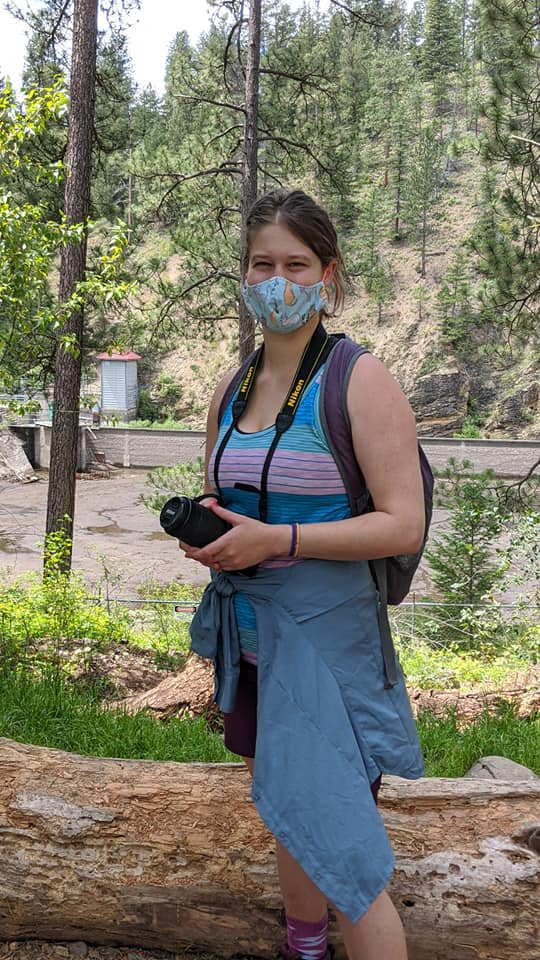

This is a note I wrote while exploring the drained Rattlesnake Creek reservoir as an artist in residence for Trout Unlimited. I was finishing my Master’s in Economics at University of Montana (UM) when I found Open AIR Montana’s artist residency program. Eager to work on a creative project after plunging into statistical econometric analysis, I applied. My excitement heightened upon seeing Rattlesnake Creek dam as a site option because of my prior experience in the creek with the Watershed Education Network (WEN) as a college student. I have participated in citizen science with WEN’s Stream Team and taught local students about river science on WEN field trips. The citizen-led efforts and success of initiating the defunct dam's removal inspired me on a civic level. I was not part of the initial process to approve the removal of the dam, so this was my chance to be involved! 


Since so much of my writing depends on what I see and feel, I did not know exactly where my writing would take me with this project. I wanted to express the importance of this body of water to Missoulians and beyond, the science behind the effects of dams on river ecology, the politics and history of its installation, abandonment, and removal, and the sheer subjective experience of this human-environment interaction. During the residency I spent many days hiking up to the dam overlook, or to the site itself when the construction workers had the day off. I wandered around, connecting pieces of historical and ecological information with aspects of the site itself.


To inform myself, I attended public talks, tours, and virtual lectures by Rob Roberts and Ladd Knotek. I read about bull trout and the importance of the Rattlesnake Creek to local native societies. I helped dig out items from a garbage-and-dirt heap when a local historian came to inspect its trash and treasure. I took pictures of the plants I found along the creek and learned about them with the iNaturalist app. I reviewed the plan for the dam’s deconstruction, and the reconstruction of a semblance of what the original creek might’ve looked like. And of course I ran into WEN staff members along the trail examining the dam removal’s progress.


WEN gave me experience in applied science outdoors with a local stream that connected me to my Montana environment in the first place. Trout Unlimited and Open AIR Montana gave me just the opportunity I needed and desired to explore creative writing and my relationship with an ecosystem that has a soft spot in my heart. 
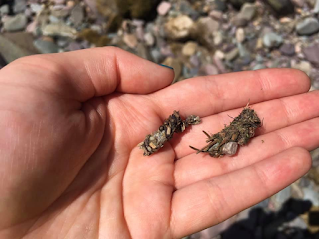

woody caddisfly cases in open hand

Friday, September 21, 2018

Rattlesnake Creek Discovery

WEN's First Summer Camp: A Reflection


     The 2018 Rattlesnake Creek Discovery Summer Camp, in partnership with the Missoula International School, was a full week of fun, play, and learning. Six children attended Monday-Friday 9 a.m.-3 p.m. On the first day, the Rattlesnake Creek explorers collected macro-invertebrates from two different locations, then learned how to identify and draw these aquatic insects.


    Tuesday was introduction to bug anatomy, and more exploration north of the Pavilion. The explorers ventured off into the riparian area along Rattlesnake Creek and discovered interesting critters. The day ended with a cool down in the creek!

     On day three, we mapped Rattlesnake Creek and created our own maps of Greenough Park. We also measured the velocity of the Creek with our sticks and painted rocks with Pam Ward (our guest instructor from Sussex School). Lastly, we rounded out the day with Bull trout game fun!


    Thursday we did a water cycle game and journaled about being a water drop. Cas Smith (our hydro-geologist guest presenter) taught a lesson on groundwater, which included exploring various wells in Greenough Park. The afternoon concluded with watercolor painting and Lego building.

     On our last day, the children collected sticks as we hiked and explored through Greenough, and then we used those sticks to construct “dreamboats”. Afterwards, we launched our boats down the Creek. Finally, we celebrated this special week-long summer camp with a macro-invertebrate mayhem game, and said farewell to the Rattlesnake Creek.


     As the partner of an ex-river guide, I've heard (and fallen in love with) a phrase that seems to capture the spirit of this camp, "Let's just read and run." Read the river, then run it accordingly. While developing the Rattlesnake Creek Explorations Camp, we built a structured schedule which we followed every morning. I was an afternoon volunteer and witnessed firsthand how the overall mood vacillated in the full-belly, post-lunch afternoon heat. The children would either rally energetically after a quick dip in the creek, or feel lethargic. 
     
     It seemed that they fed off of each other's energy, without any verbal communication. It was so fun to read them, and then help steer the afternoon schedule according to their wants and needs. We had so much fun every afternoon. Whether we were taking a break from the heat and painting rocks inside an MIS classroom, focusing on a groundwater lesson, or playing with spray-bottles at the Greenough playground- this camp was totally kid-centric. It was so fulfilling to help facilitate the creation of positive summer memories for these six, very awesome kids. 


This camp couldn't have happened without the leaders from the Missoula International School and Watershed Education Network: John Walker and Deb Fassnacht. Special thanks to our guest instructors Pam Ward and Cas Smith! Shout-out to our volunteers: Madeline Wilber, Cassie Sevigny, Markus Boyer, and Eli Santos.

I look back on this summer camp fondly, and consider it a huge success. We at WEN are looking forward to Summer 2019, and the possibility of offering more camps like this. 

Thanks for reading, and happy first day of Fall!
Katrina Thorness
Watershed Education Network
Communications Coordinator
802 East Front St.
Missoula, MT. 59802
Ph (406) 541-9287
Check us out on facebook for updates. 

Katrina is a part-time Communications Coordinator who is focusing on becoming a 'Jane of All Trades' in life, and for WEN. She assists with program development, and has worked on projects for YCC, AIS, and School Stream Monitoring. One of Katrina's life goals is to continue nurturing a community of outdoor learning in the region.

Tuesday, May 3, 2016

Swimming Down Higgins in the Wild Walk Parade

    Sunday morning Becca summoned me (well, politely requested) to help walk the fish up Higgins to the starting point of the parade. It was propped up over a bike and trailer, which made it easier to carry. As we dragged this mostly-completed fish downtown, we got many stares and smiles, and several compliments. The fabric had been spray-painted with a shimmery turquoise, and red and yellow spots added to make it look more realistic. Upon reaching the red X's we hastily attached the dorsal fin to its support (a yard stick found lounging at the WEN office).

     Several interns volunteered to operate the fish, including myself, Lauren, Maizie, and Joanna, along with Becca. Becca was responsible for the gills, Lauren and Maizie held up the spine and fin, and Joanna (in the tail) moved the whole thing side to side. I got to open and close the mouth. The head did not have specific handles to hold onto, so we added a duct-tape handle onto the lower half, and covered this with Becca's stonefly wings from last year to hide it. This also had the effect of making the fish look like it was eating a bug. My other hand held onto the red tubing that served as the spine.

     The plan was simple. I would look through the "nose" gap and through the open mouth to follow Al, dressed up in her caddisfly case costume, as if trying to eat her. She would guide the fish down the street so we avoided hitting other parade-goers. For the most part this worked, except when the parade slowed down and I ran into her a couple times. When we could tell early on the parade was slowing, the fish did tricks. Al zigzagged across the street, with the trout chasing the tasty snack she was, and several times she led the trout in a full circle! We stayed toward the back of the parade to minimize collisions and ensure we had room to make the trout truly come to life.
Chasing Al (courtesy of Mike Lessard)
Photo courtesy of Kurt Wilson (The Missoulian)

     The cardboard of the head shaded me nicely, keeping the heat and burning rays of the sun off me. Those under the fabric middle complained of the heat, as it seeped through more easily there. My arms did tire, as predicted, even with alternating which held the top of the head and which opened the mouth. At times I rested the top on my head to take some of the weight, but this made it harder to see and follow Al. Partway through the parade the hinge holding the jaw to the head dislodged, so Becca and I worked as a team to keep it together. She held the jaw in her mouth while I moved it with one hand, and when she needed a break I rested the top on my head and used both arms to move the jaw. In addition to this, the joints of the gills came apart too, but Becca held them together. Even with Frankenstein Fish falling apart at the seams, WEN folks kept it swimming!

     As we made our way toward Caras Park, we heard many shouts and exclamations about our fish, though we could not see who made them. "It's a shark!" adults would call, and some more generally and only slightly more accurately, "Look at the fish!" It was the children who corrected their parents, calling out, "Trout!" We were told a photographer followed us the whole way too.

The Fish Operators! (courtesy Mike Lessard)

     Our trout was a hit, and much thanks is due to all the volunteers who helped put it together (Al and Becca put in some loooong hours the day before the parade!) and carry it down Higgins for the public to see. Those of us who were inside the trout took it, slightly broken apart, back to WEN and celebrated the day with some Big Dipper ice cream afterwards.

-Cassie Sevigny
WEN Intern

Frankenstein's Fish

     The Roxy's Wild Walk Parade came back in full swing this year, with a warm sun overhead and upbeat music leading the way! WEN got straight to work to create the best costume of this year's parade. The students dressed as water-bugs last year had commented that it would have been more fun to swim alongside a trout.

     First, there was a gathering of great minds at the WEN office to determine how to construct such a thing. How large should it be? Should it move? Should we carry it or wear it? What material should we make it out of? Becca was inspired by the design of Chinese dragons, with the creature carried along by several people. We would have a fish puppet of sorts, with a mouth that opened and shut, and a tail that swished side to side.

     The fish needed to be lightweight enough to carry, given its large size, so Becca made a trip to Home Resources, a local hardware store. She found some red plumbing tubing we would use to hold the fish's shape.
"How far can I bend this? What can I use to cut it?" she asked.
"You know this is for plumbing, right?" the man behind the counter replied after answering.
Of course she knew, but creativity is famous for re-purposing items.

     Some of the tubing was bent into a U shape to form the outline of the lips, and held taut by wire. A longer piece connected to the upper lip and stretched back to form the spine, which everything else would connect to. At this point, I drew a smattering of design possibilities on the whiteboard as we brainstormed the rest of the fish's configuration. These drawings were rife with disproportionate stick people to indicate where a person should fit inside the fish. (I had to dramatically discard several non-dry erase markers before I could take on this task.)

     Al, a long-time WEN volunteer, disassembled some cardboard boxes and we arched them between the spine and lip to give shape to the head. Becca thought it would be cool to have movable gills, so the next task was to connect tubing to the "spine" in such a way that it would move but not fall off. Our initial version used the assistance of duct tape. We did not have many hours this first day, so we ended with the basic skeleton of the trout.


     I came into the office later in the month and Becca told me about the costumes the kids from the Sussex and Community School were designing. Some made bug costumes like last year, and another class decided to be ducks. Becca really wanted to borrow some ducklings from local people, but... "turns out people aren't fond of you borrowing their ducks - and bringing them to a preschool." So without the visual aid, they turned paper plates into duck bills to wear on their heads.

     When I returned to WEN the week before the parade, a volunteer was applying a second coat of paint to the paper skin others had started previously. A volunteer named Karen showed me her process for mixing white, black, blue and green so they approximated the same color of grey that was already dried onto the paper and we tag-teamed the rest of the painting. Al arrived soon after and we tackled the problem of how to lay the skin over the fish so there wouldn't be any strange gaps. Al attached hangars and wire to the end of the tail (which had been structured while I was gone) to support the tail fin. Becca had given me keys to the basement to retrieve this tail fin, which was painted gorgeously onto paper like the rest of the skin by another volunteer named Nicole. Unfortunately, it was slightly too short! We decided to address the rest of the skin first, and deal with extending the tail fin later.

     Several other interns had arrived by this point, and since we could not proceed without some sort of sticky substance, one of them kindly went out to buy rubber cement for us. Al and I used the time the intern was away to cut one of the sheets of paper skin so it would most efficiently cover the fish's head, without creating oddly-shaped strips we couldn't use. One sheet perfectly covered the head when we cut and rearranged it, saving the last three for the tail. (We held up the tail and laid them over it to ensure it was enough.) The intern returned and we excitedly glued the skin down, ducking under tables to access both sides, and attaching binder clips to hold the frame and skin together while it dried.

     Becca arrived again soon after with some blue-grey fabric, dyed herself, which covered the middle section of the fish that would allow it to bend and swim. We had some difficulty determining how to drape it over and still see the gills, but the fabric was long enough we could cut it in half and fully cover each side. (I'm not quite sure how this problem was solved, but that's what happens when you leave a project in someone else's hands for a day.)

     Just as I was about to leave for the afternoon, Nicole showed up, saving us the difficulty of attempting to recreate her tail design and coloration for the other side of the fin. Having her finish it kept the style consistent.

     It took a total of 7 volunteers and four afternoons to design and assemble our Frankenstein's Fish. All that was left was to see if it would swim....

-Cassie Sevigny
WEN Intern

Friday, April 10, 2015

Waterbugs Emerge from their Lairs for Upcoming Wildwalk


WEN is participating in the Wild Walk this year, put on by the Roxy Theater as part of their International Wildlife Film Festival. The parade will feature many different creatures from organizations around town. Since we love rivers, WEN has asked volunteers to root around in the waters of their imaginations to find costume ideas in their bug-catching nets!

At each costume building day, books full of detailed bug pictures were provided to assist the inspiration process (and so costumes could be accurate, if one so chose). Deb and I gathered materials that could be useful, and I left out some preliminary drawings of costume parts that could be built with these materials in case people had trouble. After waving their bug nets around all this, volunteers made like caddisflies and brought together their preferred materials into a cohesive bug costume.


Here are some examples of the costume-building process:


I chose to be dragonfly (then I get to wear pretty, colorful wings).


Sean, another WEN volunteer, made some wings as an extra costume for anyone who wanted to participate in the parade but couldn't make it to a costume-building day.

Below are some pictures of volunteer Sara making her water beetle costume and, speaking of caddisflies, Al creating her caddisfly nymph costume.

 Some mini bugs from Sussex Elementary School will be crawling out to join us on the day of the parade, as well as our volunteers' own little waterbugs!


Al making paper sticks.


We've got a couple more sessions left to finish up! Saturday (April 11) we will once again be in the conference center, and will start working on our representation of the river and decorating a small wagon.

Saturday, April 18th is our last day to work on projects, and then the parade is April 19th!

-Cassie, WEN volunteer


Two Sussex students working on their costumes