Tuesday, February 23, 2021

Playing in the Woods

By Brook Bauer
12/15/2020

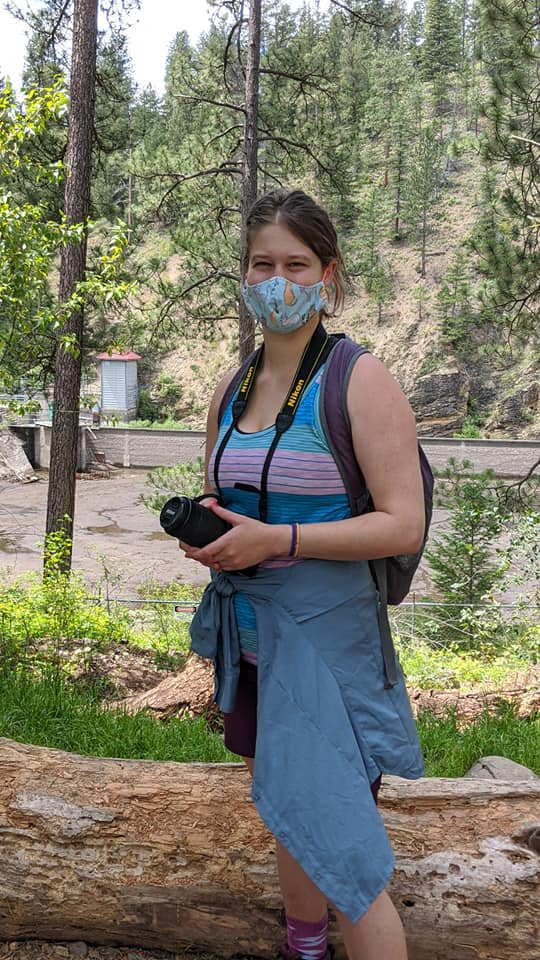
Our adventure started on a crisp morning as Deb and I vigorously prepared for the wonders that awaited us off the Bitterroot River, nested among the wilderness area surrounding McCauley Butte. And, of course, Stephie lent a helping hand in getting everything together. I found myself thinking, “It's a good thing that I brought a big bag today,” because we brought kits to test for pH, O2, as well as macroinvertebrate collection kits. I was not sure what we would need in order to learn as much as we could about this hidden wilderness area. 


From what I had researched and what Deb had told me, we would be venturing out to a wilderness area (approx. 140 acres) that is owned by a lovely school known as Aspire. Aspire is an experiential learning school, playing around with new innovative ways to engage K-12 kiddos in all sorts of academic curriculum. Today Deb and I would be meeting with a few high schoolers to talk about water (hence the variety of water testing kits) and to  check out what was going on in this remarkable hidden gem of a landscape. 


I followed Deb out to the campus and we then followed the instructions left by the Aspire teacher, Elana. Eventually we found ourselves amidst the fresh new snow surrounded by a beautiful wetland ecosystem. Gearing up, we discussed whether or not we would need the sled to haul our gear out, but ultimately decided we would manage. Following Elana’s detailed instructions we started on our way. Going one way, then realizing it was the wrong way, then finding a bridge, following a long fence line, and finding ourselves at the most amazing cluster of cottonwoods. Deb and I, for the life of us, could not remember what a cluster of cottonwoods is called... Maybe Populus? I don’t know if we actually found out, but a girl can hypothesize. Nested within these trees were tons of nests which Deb said were probably magpies. 


Moving along (well, actually we backtracked a little bit due to finding those majestic cottonwoods), we eventually found our way to a frozen lake, then to a larger stretch of cottonwoods, and eventually found the Bitterroot River. Following it until we found our Aspire friends, we were thrilled because there was a huge warm fire to welcome us. 


We spent the next few hours lending a hand to Elana in any way we could. Mainly, we assisted her and two of her students in understanding the ins and outs of how the body of water we found ourselves by worked - and how to test for indicators of water health. The students collected data on turbidity, macroinvertebrates, and pH. They would blaze their own trail by forming their own opinions on the current state of the Bitterroot, a hypothesis of sorts informed by the data that was collected. 


While assisting in the pH testing we got a consistent number of 7.2 out of all of our tests, and found a bunch of little macroinvertebrate friends! (That indicates a healthy water system.)


I learned so much about this wilderness area, and was absolutely in awe of the amount of rich biodiversity that blankets it. What a spectacular place to play! Both Deb and I walked away feeling very grateful that Aspire shared this space and time with us. We hope to be back learning with them soon! Hopefully, next time we will luck out in seeing a beaver!! 

Monday, February 8, 2021

Living in a Caddisfly Case: Part Seven

 By Cassie Sevigny

Moving to Montana was my first foray into full-scale independence. Responsible for feeding myself. No family, no friends. When the people and city were unfamiliar, I met the details of Montana’s landscape. The mountains and evergreen forests reminded me of Washington. Montana huckleberries used to feel foreign and wild, a reminder of how far from home I was, but knowing this little sour red huckleberry existed in the place I had left made me feel like a rhizome that had tunneled from the Puget Sound to Missoula, sprouting and growing in a new direction.
Like a caddisfly in a stream or my child self on the beach, I built a home from pieces of the world around me – the mica-rich rocks, swathes of color-changing larch, fire-forged morels and huckleberries, even a red crayfish who eyed me from a stone dropped long ago by a valley-carving glacier. And like caddisflies and huckleberries, I can make my home in both Washington and Montana.

Monday, February 1, 2021

Living in a Caddisfly Case: Part Six

 By Cassie Sevigny

The “Montana huckleberry” isn’t the only variety. There’s another that I found on a visit home, hiking up Wallace Falls with my family. It takes root along streamsides and in rainy forests of western Washington, fanning its leaves over nurse logs, stems tipped with delicate pink berries.
The trail to Wallace Falls starts below buzzing power lines, but as you walk farther into the forest all human noise fades away. Moss and underbrush muffle sound, the rush of the river filtering through the foliage even when you can’t see it. We stopped at a bench near an informational sign. My siblings and I sang the information to each other, creating its story for ourselves in a joyous lingering moment.

My parents identified the red huckleberry plant. Eating one releases a crisp burst of cool tartness, none of the silky blueberry tones that bother me in the Montana variety. I imagined other creatures that met here, birds and chipmunks, all taking a piece for their needs and carrying on. My stepsister could not get enough. Each berry gave a brighter gleeful gleam to her eyes.
“Save some for the bears,” we told her finally. Bears might not come to this particular bush on the trail, but plenty of other bushes in the state park likely see regular bear visitors. In less human-touched areas, bears even fight over huckleberry territory.

Monday, January 25, 2021

Living in a Caddisfly Case: Part Five

 By Cassie Sevigny

Later in 2018 I joined a WEN field trip with students in Ronan, northeast of Missoula. Near Flathead Lake, I added it to my mental map. On the drive we admired the Mission Mountains through thin haze of smoke. Wildfire season had started somewhere. I thought of the trees burning, the morels and foliage that would sprout afterward. We passed through Arlee, where the freeway splits around the town. “Huckleberry pies and shakes!” a sign announced.
“Oh, I love huckleberries,” Deb said. “Have you ever been huckleberry picking?”
“No,” I said. I don’t like huckleberries. They taste too much like blueberries. I don’t like to reveal this in Montana, just as I keep my dislike of seafood quiet when I’m in Seattle.
“We have to pick huckleberries from nature,” Deb continued. “We can’t grow them. No one’s figured out how to farm them yet. People have tried all sorts of things – planting seeds, transplanting bushes from the wild, changing soil chemistry, burning the area first – nothing works.”
One possible reason for this difficulty is that huckleberries can grow via rhizomes, which are underground, root-like stems that extend from the original structure. Sprouts grow off these sideways stems, appearing to be a new plant. Since they aren’t real roots, a cut and transplanted piece of rhizome won’t sprout, disconnected from its main plant body. In addition to proper planting from root or seed, huckleberries require a unique combination of pH, moisture, nutrients and climate provided naturally in mountainous regions prone to wildfires. Once a bush is established, it takes several years to produce the berries. All of these difficulties don’t mean it’s impossible to grow huckleberries commercially someday, but for now they remain wild.
Until then, we must collect all of our huckleberries from the woods, filling buckets like technologically advanced bears. Some people harvest with rakes to reduce the time and tedium. This method gathers more berries faster than handpicking one by one, but the bushes are left damaged.
“I don’t know why anyone would want to damage the bushes, we only have so many and just have to hope they grow back the next year,” Deb complained. She got so caught up in talking about huckleberries, we forgot to stop for shakes.

Monday, January 18, 2021

Living in a Caddisfly Case: Part Four

 By Cassie Sevigny

In the spring of 2018, I heard word of a tree-planting operation in Lolo to reforest a woman’s property affected by fires. How do trees get planted? I wondered. Do we use seeds and hope for sprouts? Wait for saplings to reach several feet before planting them? I needed to return to Lolo to find out how to restore trees to the land that protects the water.
Going alone this time, I realized that Lolo was not in some far away, abstract part of Montana. I only had to point my compass south of Missoula and drive for half an hour. I found the woman’s house hidden from the road by trees. The lawn and trees were green, but as I hiked up the property, the lush undergrowth gave way to black spindly trunks erupting from the tawny ground. Volunteers who arrived before me were balanced on steep slopes among these trunks. Some jammed shovels into dry, rocky soil. The shovelers prepared the way for others who walked along with buckets of baby native trees, less than a foot high, to insert into the holes. The tiny needled fronds of larch and pine stuck out of the ground like decorative feathers.
“My land was hit hard by the fires. I bought up all the saplings available from the restoration companies,” the landowner told me. “So if anyone else wants them, they’ll have to wait ‘til next year.”
On the hillsides I could see many areas with small dabs of white poking out of the ground. These were the mesh grazing guards, stretched over the newly planted treelings like tiny fences to prevent animal nibbling while they were vulnerable. Deer would think any unguarded trees were a buffet planted just for them. The mesh breaks and disintegrates over time. As the tree grows taller and more resilient to grazing, it doesn’t need protection anymore, and the mesh would hinder its growth.
 I collected some of the biodegradable mesh from a pile on the trail and embarked on a scavenger hunt for treelings missing protection. The landowner directed me to a mess of wood bits on a hillside. Logs and branches littered the ground, leaving the sky wide open. Remnants of a slide. A previous group had already planted there, but finding the living wood of exposed treelings among the scattered dead wood was challenging. While the wood debris protected the baby trees from the sun, it hid them from my gaze, too.
Once I was certain I had found all the trees in the woodslide, I moved to the blackened trunks and trees that survived. Here the needles of the treelings stood out against the smooth dirt. I didn’t find very many, but I did find mushrooms. They were brown with vertical wrinkles, shaped like a shriveled nose sniffing the air. Were these the morels I had heard about? I glanced at my charcoal-smudged palms and clothes. Of course. Morels grow in burn sites. The fire stresses the underground organism, called mycelium, triggering mushroom sprouts. Beneath the morels, the soil glinted.
I caught up with the landowner when we finished scouting for missed trees.
“Why are the rocks and dirt sparkly here?” I asked her. Quartz is a crystal common in Washington’s grey granite, but it doesn’t have such gleaming intensity as the Lolo rocks.
“Mica,” she said.
Mica! Why didn’t I think of that?
I felt like a mystery had been answered, a mystery that had driven so much exploration of beauty that I was let down. If I understood the answer, maybe it wasn’t special. Yet, I am delighted to scoop up caddisflies from mulch or watch them cluster on the shore like dropped beads no matter how many times I’ve seen them before, no matter I am not an expert on their lives. I can marvel at a sparkling stream bed or glinting burn site for its beauty, and the sheer shock that such beauty can exist.


Monday, January 11, 2021

Living in a Caddisfly Case: Part Three

 By Cassie Sevigny

We were measuring rocks (and water chemistry, and the width of the river) because Stream Team was tasked with collecting data on how the 2014 Lolo fires affected the watershed. The size of rocks in pebble count matters because it tells us the overall composition of the streambed. Are they mostly large, easy for critters to live under? Or does the river bed consist of small, ground down, powdery material? Fine grain sand contributes to turbidity, or cloudiness.
Turbidity has serious implications for aquatic creatures. Fish and insects breathe the same form of oxygen we do, O2. They pass water over their gills and filter out the oxygen dissolved in it. This oxygen enters the water from the air as the river burbles over rocks and moves through the landscape. After a fire, wind and rain loosen soil that tree roots and foliage previously protected. This loose soil, along with ash particles, washes into the river. These particles dissolve into the spaces between water molecules that would normally hold oxygen. The fish struggle to breathe the suspended soil underwater as we struggle on land to breathe the smoke.
Some insects, like caddisflies, are particularly sensitive to these changes. When picking up rocks for Pebble Count, or wading in a stream, finding caddisfly nymphs clinging to the underneaths of things indicates that the stream is relatively healthy.
When a caddisfly nymph hatches on a streambed, its instincts tell it all the ways a predator could crush its soft body. As a nymph, only its head, thorax, and legs have a protective exoskeleton, while its squishy abdomen stretches out behind it. Some species spin spider-like web-lairs for safety. Some choose to do nothing, content with their river maggot appearance. A few are gem-green, more akin to an aqueous inchworm. My favorite ones are like the hermit crabs of the river world: case-building caddisflies.
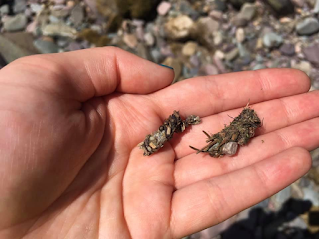
“Look for walking rocks,” I tell kids on WEN field trips, when we have emptied out a net of bugs into a tub of water. A case-building nymph uses its saliva-silk to bind pebbles together around its body. It uses whatever it can find to create its portable house. It might use grains of sand, pebbles of varying size artfully arranged, or perhaps even bits of twigs and stems for a boxy, striped look. Every so often I find lighter toned cases with glimmering rocks, as if the caddisflies were as enraptured with the sparkle as I was. If you don’t have pockets, incorporate the sparkle into your house!
The sparkly cases remind me of the French artist, Hubert Duprat, who kept caddisflies in captivity. He gave them only pearls, gold flakes, and turquoise. Those were the caddisflies of high fashion, crawling around with precious stone adornments.
Once the case is made, only the head and legs stick out, like black eyelashes, so it can crawl around and snag food. The caddisfly eats bits of plant and animal debris that collect on the bottom of the stream, like dust in our houses. Because of the black bodies, you can easily spot the half-inch-long caddisflies in a white tub. It’s the tiny ones that are tricky. That’s when my advice comes in handy. If you are patient enough to let the water settle, only the live insects will move. If you see tiny pebbles or grains of sand moving independently along the bottom, you’ve found a caddisfly!
When the caddisfly is old enough, they grow wings and move out, leaving the case behind. If you find one of these empty cases, you’ll see a tiny air hole on the back end. This tiny air hole is a perfect spot to string up the case on a bracelet or necklace. One WEN volunteer, Al, works at an insect taxonomy lab and brings us leftover cases to do just that.
“Where are these caddisfly cases from?” Deb asked during one of our jewelry-making sessions.
“King County,” Al said.
Seattle is in King County. They were from home.

Monday, January 4, 2021

Living in a Caddisfly Case: Part Two

By Cassie Sevigny

My first trip, we had to leave Missoula to reach our stream site. My mental orientation at this point lacked a compass rose. I biked to the office, crammed myself into Becca's car like another piece of gear, and sat quietly for an hour while we drove off the map into the Wilds of Montana. That is, we went to Lolo.
We lost cell phone service. We passed driveways with signs and side roads without. Rusty pickup trucks guarded the paint-peeling houses. We parked on a dirt shoulder near the day’s assigned stream spot. Popped the trunk, loaded our arms with waders, measuring tools, and clipboards.
Riverside, we untied our shoes, stowed them on the bank, and pulled on the waders. I glanced enviously at the boot-waders the rest of our small team wore. With small feet, my only option were the child-sized, overall-style waders. The waterproofed camo fabric of the legs hugged me so snugly that I had a slight penguin-like waddle. But my waders had pockets.

We had several sets of data to gather, and one of those was called Pebble Count. That sounded pretty boring at first – just gonna start counting pebbles, we’ll be here all day folks. But during Pebble Count we do not actually do any counting of pebbles. We measure rocks.
I reached into the water, hand stinging from the sudden cold, picked up a rock in front of my foot, and pulled a lime green ruler from the pocket of my waders. Daylight reflected off the wet rock. Wait, no, those shimmering striations were embedded in the piece of granite! I tilted the rock back and forth in my hands.
I held the ruler to the rock along its B axis – not its height or length, but width – to find its mediumest measurement.
“50 millimeters!” I yelled to my partner with a clipboard.
I pocketed the rock. When else was I going to find such a glittery rock? I took a step forward deeper into the river. My hand made the polar plunge again to retrieve a second rock. It too, sparkled. Looking up from my Pebble Count, the entire streambed was composed of these sparkle-ridden rocks, a river of treasure flowing through the mountains underneath the crystal clear waters.


Monday, November 16, 2020

My Summer as a Writer in Residence at Rattlesnake Creek Dam


By Cassie Sevigny


A glint of white, a shine of running water ahead. The water is seeping in from the corner of the drained reservoir, opposite the headgates, already braiding through the ditches left by the trucks. The new trickle of stream already washes away the drying, damp, and cracking clay below my feet, the clear water flaunting the muted rainbow of glacial stones. These revealed rivulets of rainbow rocks are their own kind of slow, mini excavation alongside the deconstruction of the dam.


This is a note I wrote while exploring the drained Rattlesnake Creek reservoir as an artist in residence for Trout Unlimited. I was finishing my Master’s in Economics at University of Montana (UM) when I found Open AIR Montana’s artist residency program. Eager to work on a creative project after plunging into statistical econometric analysis, I applied. My excitement heightened upon seeing Rattlesnake Creek dam as a site option because of my prior experience in the creek with the Watershed Education Network (WEN) as a college student. I have participated in citizen science with WEN’s Stream Team and taught local students about river science on WEN field trips. The citizen-led efforts and success of initiating the defunct dam's removal inspired me on a civic level. I was not part of the initial process to approve the removal of the dam, so this was my chance to be involved! 


Since so much of my writing depends on what I see and feel, I did not know exactly where my writing would take me with this project. I wanted to express the importance of this body of water to Missoulians and beyond, the science behind the effects of dams on river ecology, the politics and history of its installation, abandonment, and removal, and the sheer subjective experience of this human-environment interaction. During the residency I spent many days hiking up to the dam overlook, or to the site itself when the construction workers had the day off. I wandered around, connecting pieces of historical and ecological information with aspects of the site itself.


To inform myself, I attended public talks, tours, and virtual lectures by Rob Roberts and Ladd Knotek. I read about bull trout and the importance of the Rattlesnake Creek to local native societies. I helped dig out items from a garbage-and-dirt heap when a local historian came to inspect its trash and treasure. I took pictures of the plants I found along the creek and learned about them with the iNaturalist app. I reviewed the plan for the dam’s deconstruction, and the reconstruction of a semblance of what the original creek might’ve looked like. And of course I ran into WEN staff members along the trail examining the dam removal’s progress.


WEN gave me experience in applied science outdoors with a local stream that connected me to my Montana environment in the first place. Trout Unlimited and Open AIR Montana gave me just the opportunity I needed and desired to explore creative writing and my relationship with an ecosystem that has a soft spot in my heart. 


woody caddisfly cases in open hand

Wednesday, November 4, 2020

Cassie's First Bear!

 By Cassie Sevigny


One Tuesday I dropped in on Level 2 Stream Team. I had to go to the bridge crossing Rattlesnake Creek but not cross it myself. Instead I stayed left, barely found the narrow overgrown trail along the bank, and followed it upstream. “Don’t forget to make noise to alert bears since you’re walking alone,” Deb had warned me. Aissa found me before I’d gotten far and showed me to the site.


I stood on mossy rocks and watched Aissa, Stephie, Reyna, and Joe wrangling insect samples from a special collecting net into a jar. It was a process that required all four sets of hands. Out of the corner of my eye I saw a dark figure leaning over a fallen branch in the woods across the stream. Weird spot for someone to be wandering, I briefly thought, but people are weird. A few minutes later I saw the black shape stretch up, and up, and up into a tree. It was no person. I couldn’t even form words in my excitement and surprise. I just pointed. “A bear!” Aissa told everyone. “It’s eating berries from the mountain ash.” 


The bear lounged for a while, ignoring us. Or perhaps not noticing us, for ten minutes later it lumbered toward the creek and suddenly stopped. There were people in the creek! I wondered if it had intended to come down for a drink or a splash. Likely bears do not usually encounter people in their creek so far upstream, away from main trail access. The bear paused for a bit, contemplating what to do, and eventually retreated into the woods. I wondered if it was going to find another spot.


Deb arrived later with Joe Glassy, WEN board member, who she ran into on the trail. I find this a common occurrence with Deb, who seems to know everyone. Joe had brought his dog Lucy and his camera. How unfortunate he had missed the chance to photograph the bear! But as we talked and the team returned to collecting the fatal insect sample, the bear re-emerged from the trees a ways upstream! It lay down at the edge of the water. If not for the slight movement, it could’ve been mistake for a large black boulder among the rocks. 


I’ve lived in Missoula six years now and seen plenty of deer, birds, insects and squirrels. I know bears frequent the Rattlesnake, and I’ve even been at Greenough during reports of bears in the creek. But this was the first one I’ve seen. I felt part elation and part realization that I couldn’t remember how you were supposed to respond to a bear’s presence. Stream Team had bear spray of course, and we didn’t need to use it. But the fact that I was in the bear’s territory and came face to face with one reminded me how wild the land is, and how easily we can ignore that when we build houses and ranches and roads and trails and bring our urban selves so close to the edge of a wilderness.


Tuesday, November 3, 2020

Resplendent Stream Team

By Cassie Sevigny

Returning to WEN as a staff member has felt a bit like a homecoming. Stream Team days pull me out of my apartment isolation and into the woods, resplendent with yellow and red leaves and striped with tree trunks among the dry blond underbrush. I see Rattlesnake creek, which is not cutting through the forest but embedded as part of it, and I realize sometimes we forget about things that make us happy.

The cool fall weather indicates Stream Team season is ending, so I’ve been lucky to go out several times in the past few weeks. One trip brought me to a location between Greenough and the dam site that I had not been to before. A family was leaving the area around the tilted narrow stone table and bench when we arrived. Upon the table we spread out our gear around a little fall fairy house someone had made. Red berries perched in the shelves of pinecones, and leaves and pine needles stuck out like flags from a mossy wood-and-bark house. That day ended with wine and a light plum cake made with Deb’s recipe and Aissa’s plums. The immediate feeling of being among family and working to a common goal makes me happy.


I also helped with a special Stream Team day with University of Montana’s Water Policy class, taught by Ada Montague, this time at a familiar site by the Duncan trailhead bridge. Clouds clung thickly to the sky and the thin conifers swung about in the wind. It was hard to find insects in our tubs with all the leaves and other fall debris. They needed someone “solid on bugs” to teach the volunteers what to look for and how to identify the insects we were counting. I wasn’t sure how much I would remember but trusted in my ability to recognize and relearn. Turns out even after a few years’ absence from leading any stations, I still know my aquatic insects! Pointing out the tiny wiggling ones reminded me of when I was a new volunteer, delightedly soaking up every bit of Al’s professional expertise that I could. 

Working with WEN has taught me to take the lead with whatever they throw at me. I’ve also been reminded that I have plenty of skills and knowledge from years of working with WEN. That expertise makes me comfortable teaching and leading stations, even if I’m initially hesitant, so that others can learn the excitement of their watersheds too.


Friday, June 26, 2020

Washington Middle School Flagship Water Explorers: Part Four

Introducing the Watershed Education Network’s Washington Middle School Flagship Water Explorers 2020 

By Deb Fassnacht and Jenna Rolle

Week Four: Marsh Soup


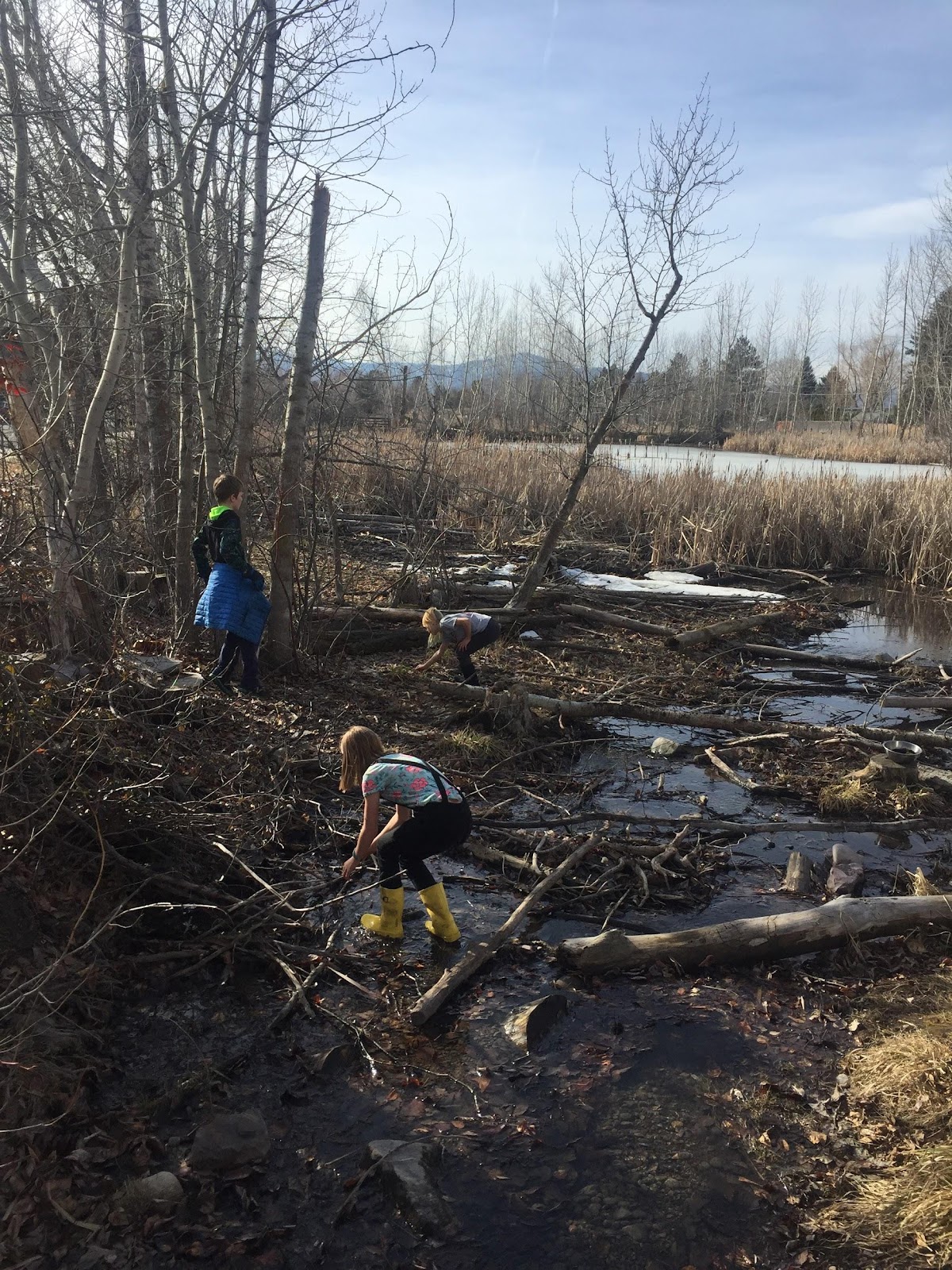
Our fourth week of Water Explorers I was really excited to try out a lesson I had found in a curriculum book in the WEN office: Marsh Soup! The goal of this lesson is to familiarize the students with the marshy area that surrounds Bancroft pond. The marshy areas may not be as classically beautiful or fresh as a flowing stream or an idyllic pond, but they support the bulk of riparian habitat for important plants, animals, and insects. Luckily, this batch of Water Explorers was more than happy to muck around in the marsh, regardless of stinky smells or unappetizing squishing sounds underfoot. 

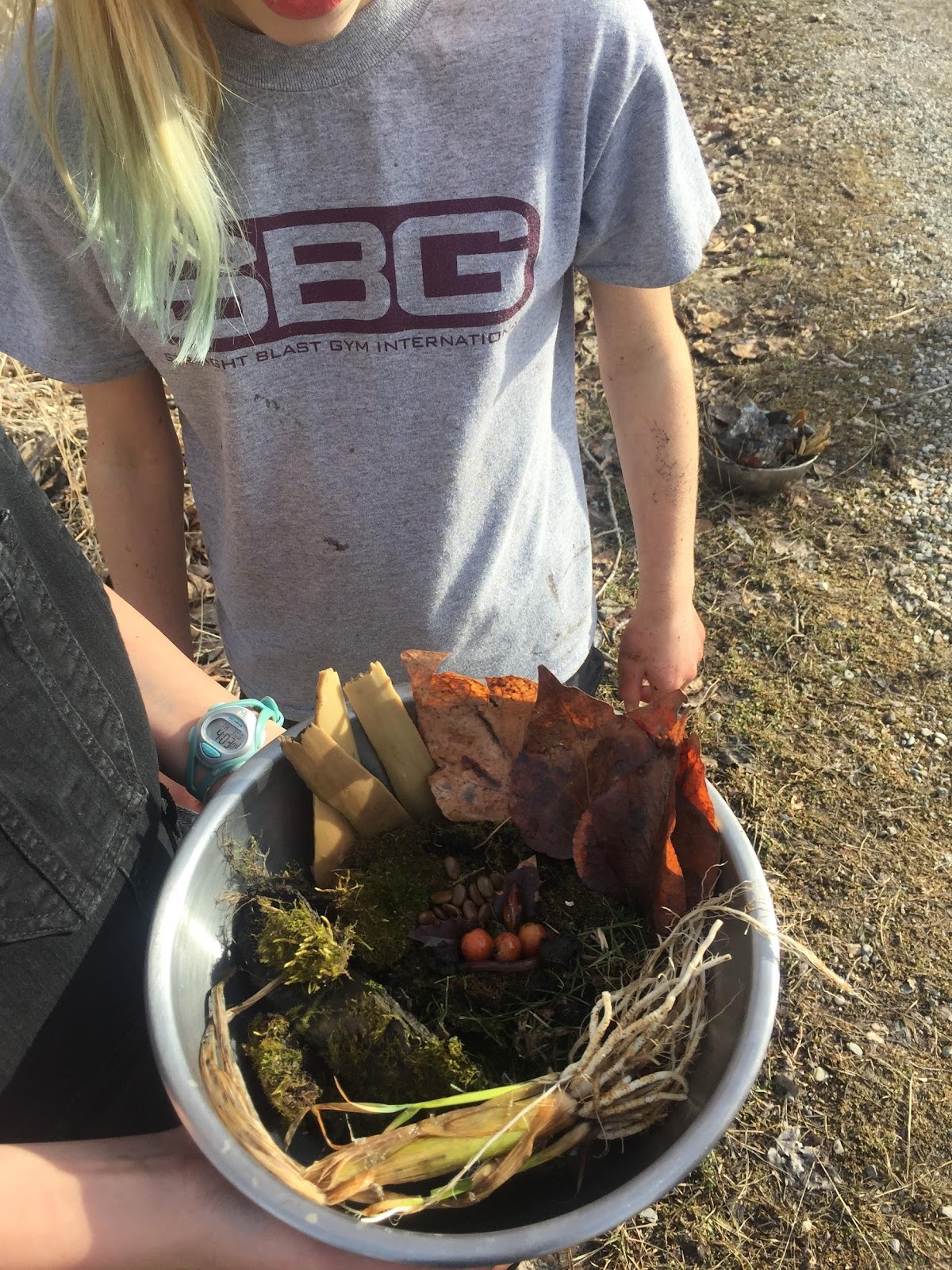
To make marsh soup (or salad, or casserole, or whatever the students want it to be) each team was given a bowl and instructed to build a meal from the marsh. The teams were then to be scored on two criteria: quantity of ingredients and presentation. Both teams took different approaches. Team one opted for quantity, and ended up with 15 different plants, 6 different types of mud, and ice, stream water, and pond water. Team two created a beautiful presentation of seeds, moss and leaves, and still fit quite a few different ingredients in there.


It was really wonderful to see the whole team of explorers out there hunting for marsh treasures and mucking about in an area of the hydrologic cycle that most people ignore. We returned to Washington covered in mud and still chattering about all the cool stuff we found in the marsh. After a quick apology to the parents for the state of their clothes, I sent the students off for their Spring Break.

Friday, June 19, 2020

Washington Middle School Flagship Water Explorers: Part Three

Introducing the Watershed Education Network’s Washington Middle School Flagship Water Explorers 2020 

By Deb Fassnacht and Jenna Rolle

Week Three: More Cattails and Bugs!

Our numbers were cut in half for the third week of Water Explorers, with two of the team in band practice. But the weather was semi-decent so we packed our clipboards and colored pencils and walked down to Bancroft Pond. After seeing the students’ interest in cattails, I had thought to do a miniature plant lesson. Each student found two plants around Bancroft Pond and sketched them, and wrote down two things that they thought made that plant stand out from the others. We then looked in a Wetland Plant Identification book to try and identify the plants they sketched. Finding the dichotomous key to be a bit over even my head, we ended up looking up the plant names and comparing the page to the sketches. They had done a really awesome job identifying the key features of their plants and what set those apart from the others for easy identification.


Once the plant lesson was finished, we still had another 20 minutes before we had to head back to Washington, so the students had free ‘wander and explore’ time. During this time we encountered a gigantic bug, at least 2 inches long, crawling around on a log in the ice of the pond. Much shrieking and excitement ensued. Once we had safely escorted the bug back to its habitat, we packed our bags up once again and headed back to the school. 

Friday, June 12, 2020

Washington Middle School Flagship Water Explorers: Part Two

Introducing the Watershed Education Network’s Washington Middle School Flagship Water Explorers 2020 

By Deb Fassnacht and Jenna Rolle

Week Two: Meeting all the Water Explorers and Exploring Bancroft Pond

The second week of Water Explorers at Washington Middle School was the first time the troupe of water-lovers was all together. All four 6th graders were able to attend, Deb joined for the first part of the lesson, and I was excited to lead a group outing to Bancroft Pond. After introducing ourselves to each other and setting some ground rules for the program, we grabbed our best outdoorsy shoes, jackets, and gloves and headed down to the pond.

The aim of the first week was to get the students oriented to Bancroft Pond, a beautiful park just down the road from their school, and get a feel for their interests in the water-sphere. To prompt this, I had each student write down two observations and two questions they had after a day of exploring the area. The hope was to use these questions and observations as guides to help plan curriculum. I quickly noticed that what the students seemed most interested in were the cattails, which had recently begun to seed out and could be ripped apart and thrown like confetti. All in all, the students seemed to be incredibly happy to be outside, in spite of cold temperatures, and I was excited to have such an energetic and engaged group.


Friday, June 5, 2020

Washington Middle School Flagship Water Explorers: Part One

Introducing the Watershed Education Network’s Washington Middle School Flagship Water Explorers 2020 

By Deb Fassnacht and Jenna Rolle


In January of 2020, Watershed Education Network’s team reached out to Washington Middle School to see about expanding citizen science with students there. We were encouraged to consider the after school program, Flagship. In the winter, we met with Flagship leader, Kristian Stipe to learn about how we could work with the afterschool program and lead students in grades 6-8 on water observations, explorations, and record change over time as citizen scientists. Lucky for us, Jenna Rolle, a winter volunteer and former hydrologic technician, wanted to join the afterschool explorations. Deb and Jenna kicked off this spring’s program.

Week One: Meeting the Flagship Explorers and heading out to discover Pattee Creek and Bancroft Pond

On the first day, Deb met with a few interested students at the school. We met in the cafeteria room with the big cafeteria tables. All the Flagship programs had a table and sign directing kids to their activities. There were crafts, dungeons and dragons, robotics, and some martial arts. I went for one more trip from my car for art supplies and when I returned, I saw one young girl at our table. I asked if she was there for Water Explorers and she replied with a big smile, “Yes.” Then she quickly blurted out, “I LOVE water” and we both laughed. And I said, “I do too, it is one of my favorite places.” We decided to wait for others before going out the back door for a recess. One student came by and said he would be there next week. 

We played ‘Ga-ga-ball,’ a form of dodge ball in a fenced area where the goal is to bounce the ball twice (saying "ga-ga") trying to hit the other person with the bouncing ball. I was the one trying to avoid the ball. The ball pit was filled with ice, water and mud, so soon we were a bit wet and muddy. Since it was a March day with sun shining and the smell of melted snow was in the air, we both wanted to go explore! We decided to go follow Pattee Creek to Bancroft Pond and do some observing and scouting for the rest of the group the following week. 

Such a beautiful day! We enjoyed the sun, the feel of spring, melting snow and a breeze on our faces. Bancroft Pond was frozen and still, sun and shadows with a few birds overhead. We looked for geese and ducks that would be coming back as the weather warmed. Old snow, feathers, and cattails from the year before were bending near the icy trails. My student explorer checked out the ice along the edge of the pond and in the puddles we came across on the trail…snap, crackle, and crunch. We hurried back to the school so we could be on time. I was impressed that my young explorer wanted to pick up garbage we found along the storm drain and beside the sidewalk as we went. We timed our walk for the following weeks. It took 20 minutes from the door of the school to Bancroft Pond. We knew we could explore and have students back each week.

Wednesday, May 20, 2020

Hellgate Elementary Exploration

October 15, 2019
By Bailey Bartell

Hey everyone! I felt incredibly lucky to go with Deb, the Executive Director of WEN, to the classroom as well as the field on this recent project that we accomplished. The WEN team and about 20 volunteers took the entirety of Hellgate Elementary’s second grade class to the Rocky Mountain Elk Foundation (RMEF) for a field trip. With support from the Hellgate PTA, WEN was able to reach close to 180 students in order to expose them to the river ecosystem. 
While in the classroom, Deb began the lesson connecting the students to the river by thinking about things they already know. We talked about what allows us to know that a river is healthy and what we wonder about rivers. We drew pictures of what a healthy river looks like and we collected some wonderful curiosities from the kids like: how far does the river go? Where does it come from? How do we know if it is clean? How do the bugs get there? In addition to introducing musings about the Clark Fork River, we played games and sang songs to help us learn how to identify a mayfly, stonefly and caddisfly. These were the same aquatic macroinvertebrates that we searched for during our field trip at Grant Creek.

On the mornings of our five field trip days, volunteers arrived to the RMEF early to collect insects from the creek for the students to search for in tubs and identify. I was able to guide the experience for students as they found and sorted these various aquatic macroinvertebrates. The level of excitement that was derived from each insect was contagious. Each time a student found a new insect, they would exclaim and treat it like a prize they won. This reaction came from all the students. It was really fun to watch the students who were hesitant in the beginning become excited and involved in the process of searching through the tubs of cold water, insects and detritus. The energy was palpable and helped to create an engaging and positive learning environment.

In addition to finding macroinvertebrates, the students wandered through the property on their riparian walk. They were introduced to the concept of what makes up a riparian area and the benefits of maintaining the natural spaces next to our water sources. We talked about what animals live there, what plants and space help to create a healthy riparian area and took time to connect to the place. We accomplished this by taking interactive walks around RMEF’s property. We listened to the creek sounds, made observations about the downed trees and tall grasses and became young scientists by drawing in our field journals to document our findings.


We ended our afternoons with an active game, Macroinvertebrate Mayhem, that models what happens to our rivers when heat and sediment are introduced to the cold mountain streams. The students were a caddisfly, stonefly, or mayfly and moved down a cold, clear river. As heat and sediment moved into the river as well, the cold water insects changed to warm water compatible insects. At the end, we discussed how the river goes through yearly cycles and why it is important to maintain healthy conditions of cold, clear rivers as much as possible.

I feel incredibly lucky to have witnessed the relationships built with WEN from introductions to waving goodbye after being told one thing that they learned while being with us.

Wednesday, May 13, 2020

My Stream Team Introduction

My Stream Team Introduction 
October 15, 2019
By Bailey Bartell

These past few weeks I have been part of two different groups who go out to collect data on watersheds with the downstream idea of positive impact. I have been part of two different citizen science Stream Teams collecting data on Rattlesnake Creek.
During my time with Stream Team Level Two, we took two different cross sections of the creek in order to measure the creek bed depth. We did this so in the following years we can measure the changes after the dam is removed upstream. David, Aissa and I waded across the creek and setting up a tape for measurement and using a fancy scope (hand level) in order to get a level reading. It took us a good few hours to do so, all the while slipping and sliding under the grey clouds that rolled around the valley. 

My second experience with Stream Team Level Two involved taking longitudinal profiles of Rattlesnake Creek beginning about 100 feet downstream from the currently existing dam. David, Joe and I were essentially measuring the gradient of the creek by taking measurements every forty feet. This required us to run a measuring line forty feet from each reading that we took, we measured the depth at the bankfull, the wetted edge and the thalweg. The bankfull is where the water would rest if the creek bed were full, the wetted edge is where the water is currently sitting in the bed and the thalweg is where most of the downstream current is going. So we took each of these measurements and one additional backsight, every forty feet down this creek until we got to our original cross sections. It was slow moving, but it was incredibly beautiful and humbling to witness the experimental process of new research.


My third experience with Stream Team was with Level One. This group is a group of young adults that go to Rattlesnake Creek every Sunday in order to take varying sets of data. This past Sunday we went to a spot 100 feet below the dam in order to collect physical (cross-section, pebble count, velocity, and photo points), chemical (temperature, pH, and dissolved oxygen), and bug diversity from the creek. We had eight people and lots of work to accomplish. This time, everyone was stationed in one location with no intention to move. It was so powerful to witness so many people dedicating their free time to citizen science! We rallied on getting things done quickly and sharing responsibilities so we collected all of the data for the day in just around three hours. We were lucky to spend the day in dappled sunshine and a light breeze.


It is really rewarding to be part of a process that is paving the way for citizen science in our country and gain so much experience in the process. It is really easy to sign up to be part of the research. All you have to do is email Aissa Wise who is WEN’s Stream Team Coordinator and come to a training. There will be several trainings over the next season and it is a great way to give back to the community.


Wednesday, December 12, 2018

Living in a Caddisfly Case: Part One

By Cassie Sevigny

The wind carries the sharp, salty smell of dead seaweed, thick and dark, strewn across the grey stones. Most things are grey on the Puget Sound beach – the salted and sundried driftwood above the tide line, the clouds that hang overhead, the seagulls picking at picnic scraps, the puddles of rain… I relish the quiet, contemplative mood required to enjoy this grey but textured landscape. My siblings and I would spend hours collecting logs to build forts to withstand the tides and wind coming off the water, as if we were marooned and in need of shelter. This piece of ocean was my main connection to water for almost a decade. Then I moved to Montana.
Montana is landlocked. There is no ocean, not even a protected piece of one like Puget Sound. Nowhere to stand on a beach and imagine how far out the horizon expands. There were mountains and forest though, so with them as the structure of my new home, I sought out inland waters to nourish it.
The Watershed Education Network found me at a volunteer fair. They teach youth (and adults) about what makes a healthy watershed, at least for Missoula County. A woman named Becca gave me the basics of understanding water chemistry, insects, and measuring physical characteristics. She had bright, peppy eyes, frizzy hair in a perpetual ponytail, and an adoration for bugs.
I wanted peaceful moments to experience and learn about rivers myself before I taught watershed science to local kids, so I joined WEN’s citizen science program called Stream Team. Volunteers went out in the fall and spring to gather data from streams, as if we were doctors conducting check-ups. Each trip consisted of four hours of freezing our hands, checking the sky and our waders for leaks, estimating the river’s depth at full flows, and taking its temperature. I ate up the information, and the snacks packed by Deb, the Director. Like any other animal, I knew these people feeding me would be my friends.

Friday, September 21, 2018

Rattlesnake Creek Discovery

WEN's First Summer Camp: A Reflection


     The 2018 Rattlesnake Creek Discovery Summer Camp, in partnership with the Missoula International School, was a full week of fun, play, and learning. Six children attended Monday-Friday 9 a.m.-3 p.m. On the first day, the Rattlesnake Creek explorers collected macro-invertebrates from two different locations, then learned how to identify and draw these aquatic insects.


    Tuesday was introduction to bug anatomy, and more exploration north of the Pavilion. The explorers ventured off into the riparian area along Rattlesnake Creek and discovered interesting critters. The day ended with a cool down in the creek!

     On day three, we mapped Rattlesnake Creek and created our own maps of Greenough Park. We also measured the velocity of the Creek with our sticks and painted rocks with Pam Ward (our guest instructor from Sussex School). Lastly, we rounded out the day with Bull trout game fun!


    Thursday we did a water cycle game and journaled about being a water drop. Cas Smith (our hydro-geologist guest presenter) taught a lesson on groundwater, which included exploring various wells in Greenough Park. The afternoon concluded with watercolor painting and Lego building.

     On our last day, the children collected sticks as we hiked and explored through Greenough, and then we used those sticks to construct “dreamboats”. Afterwards, we launched our boats down the Creek. Finally, we celebrated this special week-long summer camp with a macro-invertebrate mayhem game, and said farewell to the Rattlesnake Creek.


     As the partner of an ex-river guide, I've heard (and fallen in love with) a phrase that seems to capture the spirit of this camp, "Let's just read and run." Read the river, then run it accordingly. While developing the Rattlesnake Creek Explorations Camp, we built a structured schedule which we followed every morning. I was an afternoon volunteer and witnessed firsthand how the overall mood vacillated in the full-belly, post-lunch afternoon heat. The children would either rally energetically after a quick dip in the creek, or feel lethargic. 
     
     It seemed that they fed off of each other's energy, without any verbal communication. It was so fun to read them, and then help steer the afternoon schedule according to their wants and needs. We had so much fun every afternoon. Whether we were taking a break from the heat and painting rocks inside an MIS classroom, focusing on a groundwater lesson, or playing with spray-bottles at the Greenough playground- this camp was totally kid-centric. It was so fulfilling to help facilitate the creation of positive summer memories for these six, very awesome kids. 


This camp couldn't have happened without the leaders from the Missoula International School and Watershed Education Network: John Walker and Deb Fassnacht. Special thanks to our guest instructors Pam Ward and Cas Smith! Shout-out to our volunteers: Madeline Wilber, Cassie Sevigny, Markus Boyer, and Eli Santos.

I look back on this summer camp fondly, and consider it a huge success. We at WEN are looking forward to Summer 2019, and the possibility of offering more camps like this. 

Thanks for reading, and happy first day of Fall!
Katrina Thorness
Watershed Education Network
Communications Coordinator
802 East Front St.
Missoula, MT. 59802
Ph (406) 541-9287
Check us out on facebook for updates. 

Katrina is a part-time Communications Coordinator who is focusing on becoming a 'Jane of All Trades' in life, and for WEN. She assists with program development, and has worked on projects for YCC, AIS, and School Stream Monitoring. One of Katrina's life goals is to continue nurturing a community of outdoor learning in the region.