Tuesday, March 13, 2018

Shade and Oxygen - Sentinel Floating Islands

Pattee Creek Retaining Pond in February
     "Cold and short" is what students recalled about their visit to the floating islands in Pattee Creek retaining pond. These students have been studying wetland health in science classes at Sentinel High School through a Floating Islands watershed health curriculum taught by Sylvia Doyle.


     A healthy wetland, defined by the students, depends on vegetation. Plants have roots which "hold the bank in," "slow the current," and "shade the algae, so less grows." The plants need light, of course. There should be animals, whose feces and dead bodies provide fertilizer for the soil. Decomposers must be around to break down the dead plants and animals. The habitat type is important, too: "It's gotta have a rocky bottom for fish to lay their eggs, and for bugs."


     Another key aspect of healthy wetlands is dissolved oxygen.

     "Our fishermen and fisherwomen know dissolved oxygen is important, like for trout. Our fish are cold water species, not just because they need cold water but because it means there's more dissolved oxygen." Colder water can hold more oxygen than warmer water.

     "So it's really good to have shade on water," a student observed.

     I thought of Stream Team expeditions I'd gone on in the past, where I dunked my hands again and again into freezing water. My hands would turn pink and then white, but I knew the cold was necessary for the river's health.

     "When you see a white cap in a river or lake, that means the water is completely saturated, over 100%, so the bubbles can't mix in," Sylvia pointed out. The water already has so much oxygen dissolved that it can't take any more. She was referring to river rapids or waves formed by wind, but the image of ocean waves crashing on the shore sprang to my mind.

     Shade not only cools the water but prevents the overgrowth of algae. Too much algae limits the amount of oxygen that the water can contain, and encourages bacterial growth.

     "Bacteria can turn nitrogen gas into soluble form," Sylvia said. Some amount of nitrogen enters the water from gas exchange with the air, but bacteria facilitate this process. The students knew nitrogen is important for the ecosystem and that it can come from decomposing matter, but too much nitrogen makes it hard for organisms to breathe. This is also why fertilizer in runoff can be a problem for wetlands, as it adds more nitrogen than the system is accustomed to.

     Even though Sylvia only brings her lessons to the class once per month, the students remember many bits and pieces of what wetlands need to stay healthy and work together to put the big picture together.


-Cassie Sevigny
AmeriCorps Team Member
Media Coordinator

Thursday, February 15, 2018

How Many Mussels is Too Many? - Aquatic Invasive Species

     As the Willard students learned, mussels can clog up pipes, reducing water access, and use the resources that native species rely on, edging them out of the ecosystem. How do we know if the mussel population is large enough to be a concern?

     Heidi asked the students to image a nuclear power plant. Nuclear power plants rely heavily on the functioning of cooling systems. If mussels were introduced to the cooling system, the water flow would slow and heat up, rendering critical cooling processes ineffective. A small number of mussels would be disastrous.

     More likely, mussels would affect hydroelectric power.

     "Montana has some of the cheapest power in the US" because the Columbia Watershed has so many dams, Heidi pointed out. Mussels would slow the rate at which dams produce electricity, increasing power prices for all the residents receiving power from the Northwest.

     The problem lies in the rapid reproduction rates of mussels. Mussel populations do not stay small for long, as the students recalled on my first visit. Mussels' ability to thrive in most any water body contributes to their designation as "invasive," and means that any number of mussels where they are not supposed to be is too many.

Bar graph of ml of water filtered by
mussels in 1, 3, 8 hours
Chart of ml of water filtered by
mussels in 1, 3, 8 hours


   Heidi assisted the students in performing a small demonstration on the impact mussels have on water, aside from their physical presence. One student put a scoop of rich dirt into a plastic soda bottle to simulate the detritus that many water species extract nutrients from.

Photo courtesy of Bailey Roseveare

     "Mussels filter how much water per day?" she asked.
     "One liter [each]," a student answered. The student poured one liter of water into the bottle to represent the water column. Then Heidi held up a contraption with a small canister attached to a screw cap.

     "Specialized gills are what these cotton balls are going to represent," Heidi explained as she stuffed two cotton balls into the canister. After attaching it to the bottle, Heidi set out a clear glass jar and began to squeeze the bottle. The water was forced into the contraption and filtered by the cotton ball gills.

     "What do you notice about the water in the jar?" she asked.
     "It's clear."
     "It's pretty clean."
     "Is that a good thing or a bad thing?" Heidi followed up.
     "Bad," the students agree. One clarified that it was bad because the water had no nutrients left in it.
     "What's happening to the gills?" Heidi took the cotton balls out, now brown from collected soil.
     "They're getting dirty," a student replied.
     "They're filtering nutrients," Heidi reminded them.


     This realization that clear water was unhealthy contrasted the students' initial expectations from the week prior. They wrote that clear water was cleaner, which is good for our drinking water. They figured cleaner, clearer water was less likely to make humans and animals sick. Now, however, they understood that the detritus that makes water unappealing to us is actually an important food source. It also maintains ecosystem balance, as they would learn next.

     "The mussels create an environment unsuitable for living," a student concluded.
"Or we could call it sterile," Heidi elaborated.

     In addition to removing helpful material floating in the water, mussels can increase water toxicity. Mussels produce pseudofeces, or "fake poop".
If there's anything they don't want, the dump it out," Heidi explained. This means "they spit out the toxic stuff."

     The clear water column expands the literal zone of bodies of water. The litoral zone is the area where sunlight can reach the bottom of the water column. This is the section where plants can grow, as they utilize the sunlight for photosynthesis. A larger litoral zone allows more plants to flourish.

     "What happens [with plants] at the end of the growing cycle?" Heidi asked.
     "They die."
     "They die and release phosphorus, perfect conditions for algae blooms," Heidi confirmed. If there is a larger litoral zone, more plants grow, and more plants die, releasing more phosphorus. Algae blooms make water anaerobic, depleting the oxygen available and thus making it difficult for creatures that need oxygen, such as fish and certain bacteria, to survive. This anaerobic state is conducive to the growth of botulism, a toxic bacteria.

     The class read over an article in The Oakland Press about bird deaths that Heidi had passed out. What do mussels have to do with birds? I wondered. Botulism contaminates the food that loons and other waterfowl eat, entering their nervous systems and shutting down their bodies. The article went on to list the numbers of loons, ducks, gulls, and other birds found dead on the shores of water infested with mussels. It provided a stark image of the chain of effects mussels have on an ecosystem.

     Heidi connected the article back to Montana, noting the Montana has the largest loon population west of the Mississippi. If mussels made it to the Columbia Watershed, it would devastate this valued population.

     We revisited the pros and cons of having clear water in aquatic ecosystems, again emphasizing how our assumptions of human needs do not always match with the needs of other organisms.

     "Wow, and they're only this big, they're tiny!" a student expressed amazement at the damage that can be caused by a creature the size of a fingernail.

     Watching the students grasp the interconnectedness of ecosystem elements and the impacts small changes can have gave me hope that early education like AIS will lead to better environmentally-informed citizens in the future.

-Cassie Sevigny
AmeriCorps Team Member
Media Coordinator 

Thursday, February 8, 2018

Those are Some Gravelly Mussels - Aquatic Invasive Species-

     They're in our lakes, they're in our pipes, they're on our boats. They're in every major watershed in the US except the Columbia, which is ours.

     Mussels.

     Mussels are bivalve mollusks. They have two shell halves that protect the mussel's soft body. Mussels can attach to many surfaces, including the outsides of boats, which enables them to travel between bodies of water. Such mobility is the reason for careful boat-cleaning requirements. Female zebra mussels can produce 500,000 eggs per year, with mature mussels sometimes reaching a million eggs per year, resulting in rapid reproduction and establishment in an ecosystem where there was no prior mussel population. This kind of population growth can threaten the ability of native species to survive. Originally from Eurasia and now thriving across North America, mussels provide the perfect example of an aquatic invasive species for WEN's Aquatic Invasive Species (AIS) curriculum, called Columbia Headwaters Education Kit 4.

     Heidi Sedivy leads AIS lessons once a week at Willard Alternative High School, where small class sizes enable intimate engagement with the imminent threat and application of science to relevant local issues. On January 30th I joined Heidi and Bailey, AIS Assistant, on my first classroom program.

    Bailey began by asking the students to think about how mussel invasion might affect human activities. As mussels settle down in the pipe that will become their home, they reduce the water flow rate exponentially. Given their proclivity for clogging up pipes, mussels could prevent the efficient transport of water for agricultural irrigation or hydrating cattle. This increases the difficulty of raising crops and animals, which would increase prices for consumers and decrease profits for companies.

     With human implications in mind, the class set up a lab to examine the physical effects of mussel populations on water flow. Heidi and Bailey demonstrated how to use the equipment. A translucent funnel (aka the top cut off of a plastic soda bottle) sat on top of a clear tube, about an inch in diameter. At the bottom was a filter before the rubber output. This tube simulates a pipe. White gravel would serve as our mussels (though they reminded me of the barnacles that grow on submerged posts and rocks in the Puget Sound).

   Split into two groups, the students poured 2 liters of water through the funnel and timed how long it took to travel through the tube and empty out into a bucket below. After a test-run of an empty tube, they added 5cm of gravel and timed the water again.


     "Mm, look at that dirty water," one girl remarked on the dirt washing off the tiny rocks.
     "You're cleaning our rocks for us!" Bailey replied.

     Even at this lowest increment of "mussels" the water took significantly longer to fully filter through.

     The students noticed that the tubes had slightly different rates, even without the rocks slowing the water.

     "Maybe one team is pouring faster," someone suggested.

     After several rounds of adding "mussels" and pouring water through, the data was ready for analysis. The students noticed that the water did filter through more slowly the more gravel they added to the tube. However, the times from each team did not quite match up...


     "I think those rates are really weird," one student commented.

     Indeed, the average time for 20 cm of gravel was .4 seconds faster than for 15 cm! How could this be?

     "The tube might be haunted," someone else said. While this counts as a hypothesis, we could not test it, so the conversation moved on. What else could cause variation in the experiment, or how could real mussel pipe-clogging differ from the model?

     "I think the rate would fluctuate because the mussels stick to the sides [of pipes] and not just the bottom." This could allow many more mussels to congregate before problematic water flow indicates their presence.

     The class wrapped up with some brief art: creating diagrams, or visual models, of the experiment. This way, when they created graphs the next week they would have a handy reference of what they did.

Mussel experiment diagram


-Cassie Sevigny
AmeriCorps Team Member
Media Coordinator


Tuesday, May 3, 2016

Swimming Down Higgins in the Wild Walk Parade

    Sunday morning Becca summoned me (well, politely requested) to help walk the fish up Higgins to the starting point of the parade. It was propped up over a bike and trailer, which made it easier to carry. As we dragged this mostly-completed fish downtown, we got many stares and smiles, and several compliments. The fabric had been spray-painted with a shimmery turquoise, and red and yellow spots added to make it look more realistic. Upon reaching the red X's we hastily attached the dorsal fin to its support (a yard stick found lounging at the WEN office).

     Several interns volunteered to operate the fish, including myself, Lauren, Maizie, and Joanna, along with Becca. Becca was responsible for the gills, Lauren and Maizie held up the spine and fin, and Joanna (in the tail) moved the whole thing side to side. I got to open and close the mouth. The head did not have specific handles to hold onto, so we added a duct-tape handle onto the lower half, and covered this with Becca's stonefly wings from last year to hide it. This also had the effect of making the fish look like it was eating a bug. My other hand held onto the red tubing that served as the spine.

     The plan was simple. I would look through the "nose" gap and through the open mouth to follow Al, dressed up in her caddisfly case costume, as if trying to eat her. She would guide the fish down the street so we avoided hitting other parade-goers. For the most part this worked, except when the parade slowed down and I ran into her a couple times. When we could tell early on the parade was slowing, the fish did tricks. Al zigzagged across the street, with the trout chasing the tasty snack she was, and several times she led the trout in a full circle! We stayed toward the back of the parade to minimize collisions and ensure we had room to make the trout truly come to life.
Chasing Al (courtesy of Mike Lessard)
Photo courtesy of Kurt Wilson (The Missoulian)

     The cardboard of the head shaded me nicely, keeping the heat and burning rays of the sun off me. Those under the fabric middle complained of the heat, as it seeped through more easily there. My arms did tire, as predicted, even with alternating which held the top of the head and which opened the mouth. At times I rested the top on my head to take some of the weight, but this made it harder to see and follow Al. Partway through the parade the hinge holding the jaw to the head dislodged, so Becca and I worked as a team to keep it together. She held the jaw in her mouth while I moved it with one hand, and when she needed a break I rested the top on my head and used both arms to move the jaw. In addition to this, the joints of the gills came apart too, but Becca held them together. Even with Frankenstein Fish falling apart at the seams, WEN folks kept it swimming!

     As we made our way toward Caras Park, we heard many shouts and exclamations about our fish, though we could not see who made them. "It's a shark!" adults would call, and some more generally and only slightly more accurately, "Look at the fish!" It was the children who corrected their parents, calling out, "Trout!" We were told a photographer followed us the whole way too.

The Fish Operators! (courtesy Mike Lessard)

     Our trout was a hit, and much thanks is due to all the volunteers who helped put it together (Al and Becca put in some loooong hours the day before the parade!) and carry it down Higgins for the public to see. Those of us who were inside the trout took it, slightly broken apart, back to WEN and celebrated the day with some Big Dipper ice cream afterwards.

-Cassie Sevigny
WEN Intern

Frankenstein's Fish

     The Roxy's Wild Walk Parade came back in full swing this year, with a warm sun overhead and upbeat music leading the way! WEN got straight to work to create the best costume of this year's parade. The students dressed as water-bugs last year had commented that it would have been more fun to swim alongside a trout.

     First, there was a gathering of great minds at the WEN office to determine how to construct such a thing. How large should it be? Should it move? Should we carry it or wear it? What material should we make it out of? Becca was inspired by the design of Chinese dragons, with the creature carried along by several people. We would have a fish puppet of sorts, with a mouth that opened and shut, and a tail that swished side to side.

     The fish needed to be lightweight enough to carry, given its large size, so Becca made a trip to Home Resources, a local hardware store. She found some red plumbing tubing we would use to hold the fish's shape.
"How far can I bend this? What can I use to cut it?" she asked.
"You know this is for plumbing, right?" the man behind the counter replied after answering.
Of course she knew, but creativity is famous for re-purposing items.

     Some of the tubing was bent into a U shape to form the outline of the lips, and held taut by wire. A longer piece connected to the upper lip and stretched back to form the spine, which everything else would connect to. At this point, I drew a smattering of design possibilities on the whiteboard as we brainstormed the rest of the fish's configuration. These drawings were rife with disproportionate stick people to indicate where a person should fit inside the fish. (I had to dramatically discard several non-dry erase markers before I could take on this task.)

     Al, a long-time WEN volunteer, disassembled some cardboard boxes and we arched them between the spine and lip to give shape to the head. Becca thought it would be cool to have movable gills, so the next task was to connect tubing to the "spine" in such a way that it would move but not fall off. Our initial version used the assistance of duct tape. We did not have many hours this first day, so we ended with the basic skeleton of the trout.


     I came into the office later in the month and Becca told me about the costumes the kids from the Sussex and Community School were designing. Some made bug costumes like last year, and another class decided to be ducks. Becca really wanted to borrow some ducklings from local people, but... "turns out people aren't fond of you borrowing their ducks - and bringing them to a preschool." So without the visual aid, they turned paper plates into duck bills to wear on their heads.

     When I returned to WEN the week before the parade, a volunteer was applying a second coat of paint to the paper skin others had started previously. A volunteer named Karen showed me her process for mixing white, black, blue and green so they approximated the same color of grey that was already dried onto the paper and we tag-teamed the rest of the painting. Al arrived soon after and we tackled the problem of how to lay the skin over the fish so there wouldn't be any strange gaps. Al attached hangars and wire to the end of the tail (which had been structured while I was gone) to support the tail fin. Becca had given me keys to the basement to retrieve this tail fin, which was painted gorgeously onto paper like the rest of the skin by another volunteer named Nicole. Unfortunately, it was slightly too short! We decided to address the rest of the skin first, and deal with extending the tail fin later.

     Several other interns had arrived by this point, and since we could not proceed without some sort of sticky substance, one of them kindly went out to buy rubber cement for us. Al and I used the time the intern was away to cut one of the sheets of paper skin so it would most efficiently cover the fish's head, without creating oddly-shaped strips we couldn't use. One sheet perfectly covered the head when we cut and rearranged it, saving the last three for the tail. (We held up the tail and laid them over it to ensure it was enough.) The intern returned and we excitedly glued the skin down, ducking under tables to access both sides, and attaching binder clips to hold the frame and skin together while it dried.

     Becca arrived again soon after with some blue-grey fabric, dyed herself, which covered the middle section of the fish that would allow it to bend and swim. We had some difficulty determining how to drape it over and still see the gills, but the fabric was long enough we could cut it in half and fully cover each side. (I'm not quite sure how this problem was solved, but that's what happens when you leave a project in someone else's hands for a day.)

     Just as I was about to leave for the afternoon, Nicole showed up, saving us the difficulty of attempting to recreate her tail design and coloration for the other side of the fin. Having her finish it kept the style consistent.

     It took a total of 7 volunteers and four afternoons to design and assemble our Frankenstein's Fish. All that was left was to see if it would swim....

-Cassie Sevigny
WEN Intern

Thursday, March 10, 2016

Sussex Snow Cheetahs Learn about Water

On a February afternoon, the sun warmed the air, but left the dirt beneath the grass a tad damp. In a line along the path by the river, the Snow Cheetahs (a Sussex Kindergarten class) were asked what they thought they'd be learning on their field trip to the WEN office.
     "About the underground water thingy," one of them suggested. The watershed!
     Becca strode down the bank to the water's edge, performed a couple tricky contortions to reach her hand into the water without falling in, and lifted up a pile of leaves tied together with a red ribbon. This was one of the students' leaf packs, carefully assembled and weighed two months before to measure how much the macro-invertebrates were eating.
     "They're almost gone!" one of the girls exclaimed.
     A fallen log lay across the bank near their leaf packs. Some gouge marks were gnawed into its surface. "What are these?" Becca asked. Several kids mumbled hesitantly and then confidently about beavers, excited by Becca's confirmation: "They're beaver marks!"


After checking on their leaf packs, we all gathered in a circle on the grass outside the Swift Building. We warmed up for the lesson with a water cycle song. One of the boys sat next to me, holding my hand tightly, which made it difficult to act out the song's gestures. At each step of the cycle mentioned in the song, the students yelled "STOP!" Then Becca paused the song to explore the new concept.
     "Does anyone know what evaporation is?" Several hands shot up. One boy explained, "It's when water goes up. You might think water can only go down but it can go up."
      Another boy considered a scenario. Evaporation happens "when a puddle gets hot." On that note, Becca gave the example of steam coming off boiling water when you make spaghetti. The Snow Cheetahs agreed they'd made spaghetti before and liked it. Halfway through the song, the child ended up in my lap.
     When the song finished the Snow Cheetahs got out their journals so they could draw what they thought the watershed looked like. Many drew rivers flowing under the soil.
     "I'm going to draw it going to somebody's house," said one boy, presumably thinking of a well or plumbing with access to the watershed.


Sadly, I had to leave to attend my own class at this point, so I did not get to watch the Snow Cheetahs act as water droplets in the cycle, going from station to station, mimicking how water moves from rivers to clouds to the ocean to animals. After this game they filed (well, "filed" is perhaps too orderly a word) into the Swift building and up the stairs to the WEN office to watch Becca demonstrate how the watershed works with our flow model. I can only imagine they found this exciting.

The Snow Cheetahs' teacher sent us these two pictures from the field trip:


-Cassie Sevigny
WEN Intern

Monday, February 22, 2016

Bonner Science Fair!


On Friday, February 19, 2016, many Watershed Education Network Interns judged the science fair at Bonner School.  The judges decided who will go on to the state science fair which is happening at the UM March 21 and 22, 2016. The top three students with the highest score will go to the state science fair from the sixth, seventh, and eighth grade.  The UM still might be looking for judges for the state science fair if you are available.

There were many projects ranging from ones that involved coins, food, animals, and many more interesting topics.  One that stuck out was a student that was doing research that will affect his future. This student's family works with farm animals and this student was seeing how much weight a pig would gain in a month with controls on many aspects.  Some of the controls the student set were how much food the pig got, what type of food the pig got, and how many times it was fed in a day.  This project helped the student understand how much effort it takes to own farm animals.

All the 6th to 8th graders at Bonner School had to do a science fair project.  A science fair project is a tool that helps students understand the scientific process and has the kids apply the scientific process to a real-world example. The students had freedom to choose the topic their project covered.  All the students got to present their project to a volunteer judge and did a great job.


Monday, October 5, 2015

Washington Middle School’s flagship program is underway!

Washington Middle School on Thursday October 1st kicked off its first flagship program event and WEN was able to participate! This week’s lesson was based on the different types of aquatic macro invertebrates that inhabit our local streams and rivers.  Students were not only taught the general importance of macros as indicator species of pollutants but students also received an in depth lesson on the different feeding groups within our local macro invertebrate community.

                Students were informed of two ways to categorize macroinvertebrates: how the food is obtained and or the type of food that is consumed.  While both are proven to be accurate, macros are omnivores and may feed on different food sources seasonally. Therefore we focus on how food is obtained by macros as means for categorizing. Macro invertebrates are divided into five primary categories.  Scrapers, shredders, collectors, engulf- predators and piercers.

                As a way to test the ability of macros to break down and consume detritus, students in pairs collected leaves and created leaf packs. Leaf packs are roughly softball sized and are contained by netting with small holes to allow macros to freely move in and out of leaf packs.


                The leaf packs are currently submerged at student chosen locations in ponds near Washington Middle School. We will revisit Washington Middle School’s flagship program this week after having collected the leaf packs. In class students will weigh their leaf packs and compare them to the pre-pond submersion weight that was obtained last Thursday.  After comparing the two weights, students will consider the influence that macros had on the total weight changes and rate of consumption.

                Thanks to all of our students, Washington Middle School’s flagship program coordinator Mike Lessard and the faculty that helps keep applied science in the classroom! 

Friday, May 8, 2015

Trickles and Sparkles : An April Stream Team Excursion

     Last weekend Becca and three brave volunteers headed out to a stream in Lolo on a chilly, overcast Saturday. Halfway along the drive, cell phone service slipped away, and soon after we turned off the main road, so did the pavement. Becca gritted her teeth and clutched the steering wheel, trying to convince the car to drive steady and straight, rather than slide off in the mud. However, the mud could've been thicker, the grooves in the road deeper, and the pellets of rain harder, and we made it safely to our destination.

      The infrequently used trail to the river led through a patch of woods, full of plants soaking up the remnants of the recent April rainfall. The colors brightened with the moisture. The trail stopped abruptly at the water's edge, and we skirted carefully under some low hanging branches of pine to the small clearing (pictured left) where we set our supplies.

     The small trees stretched their brilliant burgundy new growth out to us, each branchlet tipped with a soft yellow-green bud. The floor was scattered with white trilliums, reminding me of home. (In Washington, 5th grade camp took us to the Olympic Peninsula, where they were everywhere.)
The stream was quite gorgeous, frothy and glittery. I put on the waders I had found in the basement (an adult pair this time, so I wouldn't have to cram into the kid overall-waders! They were patched up in places, but that means the holes were all sealed off, right?)


     While setting up the transect I noticed a gradually cold trickle on the back of my leg. It was just the water rushing past running off with my body heat, I thought at first. The waders don't have much insulation. But the cold feeling persisted, and dominated one leg more than the other... I turned my head for the fifth or sixth time and noticed a large rip down the back of the wader. To my great disappointment, the waders I had put my faith and excitement in had let me down. As long as I faced upstream, the front of my leg would mostly block the current from seeping in until we finished measuring the stream's width. Then I could put on the back-up, slightly-too-big waders I had brought just in case.
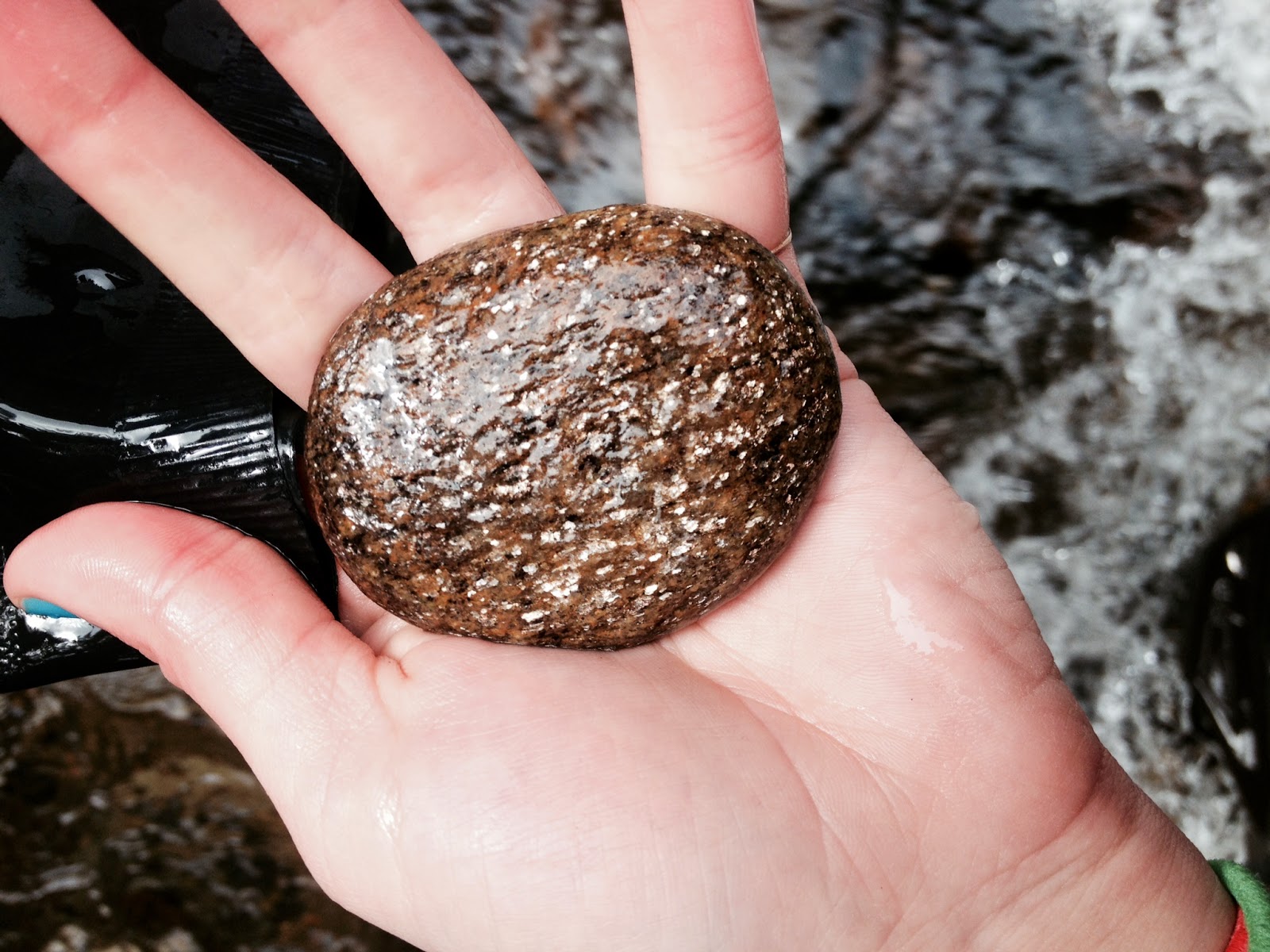
     When Becca and I reached the center of the stream I noticed some strange lights on a boulder resting on the riverbed. They weren't flickering with the current, so it wasn't just sunlight reflecting off the surface of the water. Next to the boulder was a smaller stone, riddled with tinier lights. I made note of the location in my head so I could return later.
    I made it to shore, not too soaked, and only on one leg, and walked over to the pile of waders. I picked one up, and set it aside. It was the left boot and I needed the right boot. I picked up the other one and.... it was a left boot too! Since it was too big for my foot, I decided I could probably wear it on the wrong foot and it wouldn't be too uncomfortable. It would fit, at least, and was better than having a leak. Becca graciously let me borrow her spare wool socks.


    I went back into the river and found the rock I had kept in mind. It did indeed sparkle.


   By this point the next task was pebble count. Becca had brought gloves for us this time, hoping to spare our hands the frozen, numb experience of Stream Teams past. I went to put a pair on and I had the opposite problem as the waders. I had two right hand gloves! The gloves turned out to be ineffective anyway, as the water was deeper than they were long, and just poured in through the top. Also like the waders, the rubber was not very insulating. Becca and Jeremy gave up on the gloves, while I stayed near the shore where it was shallow and only dipped my right hand in to pick up rocks. During this procedure we found that the stream was littered with glittering rocks.


    We concluded the expedition as always, with thermoses of hot water, little cups, and packets of instant hot chocolate. Despite unexpected gear malfunctions, we got the information we came for (plus a little fun), making this another successful, if extra interesting, Stream Team.

-Cassie Sevigny, WEN volunteer

Friday, May 1, 2015

Crawling and Flying through the Wild Walk Parade

     WEN volunteers collected at the Red X's April 19th for the Wild Walk Parade in downtown Missoula. Everyone was abuzz with excitement, including our Sussex Elementary School bugs and parents. Our painted river glistened and sparkled in the sun pouring down, thanks to the last minute addition of colorful mesh (the same used for my dragonfly wings).WEN's "float" was right behind the lively band, ready to lead the winding river of a parade through the streets lined with locals. A local reporter for the Missoulian even made rounds to speak with various WEN folks.

Photo courtesy of Jennie Pak


     On the left, the band is pictured preparing their musical instruments. On the right volunteers Sean and Cassie (myself) dance to the band's music while marching the WEN banner down the street.

     The parade flowed from the X's down Higgins, making a slight curve to stream down to the Pavilion next to the Clark Fork. The festivities did not stop upon arrival though, as there were booths with wildlife information, live music, and hot food. Even Big Dipper ice cream made an appearance to refresh the festival-goers.

     Below are volunteer Al Pak and director Deb  modeling their completed costumes -- a caddisfly and dragonfly, respectively -- and the sunlight shining through Becca's stonefly wings onto the sidewalk.

Photo courtesy of Jennie Pak


As the first real project I've organized with WEN, I consider our Wild Walk experience a splashing success!
-Cassie Sevigny

Friday, April 10, 2015

Waterbugs Emerge from their Lairs for Upcoming Wildwalk


WEN is participating in the Wild Walk this year, put on by the Roxy Theater as part of their International Wildlife Film Festival. The parade will feature many different creatures from organizations around town. Since we love rivers, WEN has asked volunteers to root around in the waters of their imaginations to find costume ideas in their bug-catching nets!

At each costume building day, books full of detailed bug pictures were provided to assist the inspiration process (and so costumes could be accurate, if one so chose). Deb and I gathered materials that could be useful, and I left out some preliminary drawings of costume parts that could be built with these materials in case people had trouble. After waving their bug nets around all this, volunteers made like caddisflies and brought together their preferred materials into a cohesive bug costume.


Here are some examples of the costume-building process:


I chose to be dragonfly (then I get to wear pretty, colorful wings).


Sean, another WEN volunteer, made some wings as an extra costume for anyone who wanted to participate in the parade but couldn't make it to a costume-building day.

Below are some pictures of volunteer Sara making her water beetle costume and, speaking of caddisflies, Al creating her caddisfly nymph costume.

 Some mini bugs from Sussex Elementary School will be crawling out to join us on the day of the parade, as well as our volunteers' own little waterbugs!


Al making paper sticks.


We've got a couple more sessions left to finish up! Saturday (April 11) we will once again be in the conference center, and will start working on our representation of the river and decorating a small wagon.

Saturday, April 18th is our last day to work on projects, and then the parade is April 19th!

-Cassie, WEN volunteer


Two Sussex students working on their costumes