Friday, May 8, 2015

Trickles and Sparkles : An April Stream Team Excursion

     Last weekend Becca and three brave volunteers headed out to a stream in Lolo on a chilly, overcast Saturday. Halfway along the drive, cell phone service slipped away, and soon after we turned off the main road, so did the pavement. Becca gritted her teeth and clutched the steering wheel, trying to convince the car to drive steady and straight, rather than slide off in the mud. However, the mud could've been thicker, the grooves in the road deeper, and the pellets of rain harder, and we made it safely to our destination.

      The infrequently used trail to the river led through a patch of woods, full of plants soaking up the remnants of the recent April rainfall. The colors brightened with the moisture. The trail stopped abruptly at the water's edge, and we skirted carefully under some low hanging branches of pine to the small clearing (pictured left) where we set our supplies.

     The small trees stretched their brilliant burgundy new growth out to us, each branchlet tipped with a soft yellow-green bud. The floor was scattered with white trilliums, reminding me of home. (In Washington, 5th grade camp took us to the Olympic Peninsula, where they were everywhere.)
The stream was quite gorgeous, frothy and glittery. I put on the waders I had found in the basement (an adult pair this time, so I wouldn't have to cram into the kid overall-waders! They were patched up in places, but that means the holes were all sealed off, right?)


     While setting up the transect I noticed a gradually cold trickle on the back of my leg. It was just the water rushing past running off with my body heat, I thought at first. The waders don't have much insulation. But the cold feeling persisted, and dominated one leg more than the other... I turned my head for the fifth or sixth time and noticed a large rip down the back of the wader. To my great disappointment, the waders I had put my faith and excitement in had let me down. As long as I faced upstream, the front of my leg would mostly block the current from seeping in until we finished measuring the stream's width. Then I could put on the back-up, slightly-too-big waders I had brought just in case.
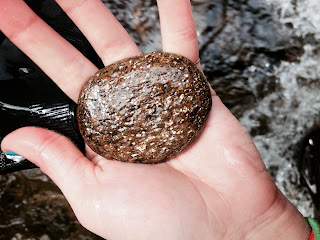
     When Becca and I reached the center of the stream I noticed some strange lights on a boulder resting on the riverbed. They weren't flickering with the current, so it wasn't just sunlight reflecting off the surface of the water. Next to the boulder was a smaller stone, riddled with tinier lights. I made note of the location in my head so I could return later.
    I made it to shore, not too soaked, and only on one leg, and walked over to the pile of waders. I picked one up, and set it aside. It was the left boot and I needed the right boot. I picked up the other one and.... it was a left boot too! Since it was too big for my foot, I decided I could probably wear it on the wrong foot and it wouldn't be too uncomfortable. It would fit, at least, and was better than having a leak. Becca graciously let me borrow her spare wool socks.


    I went back into the river and found the rock I had kept in mind. It did indeed sparkle.
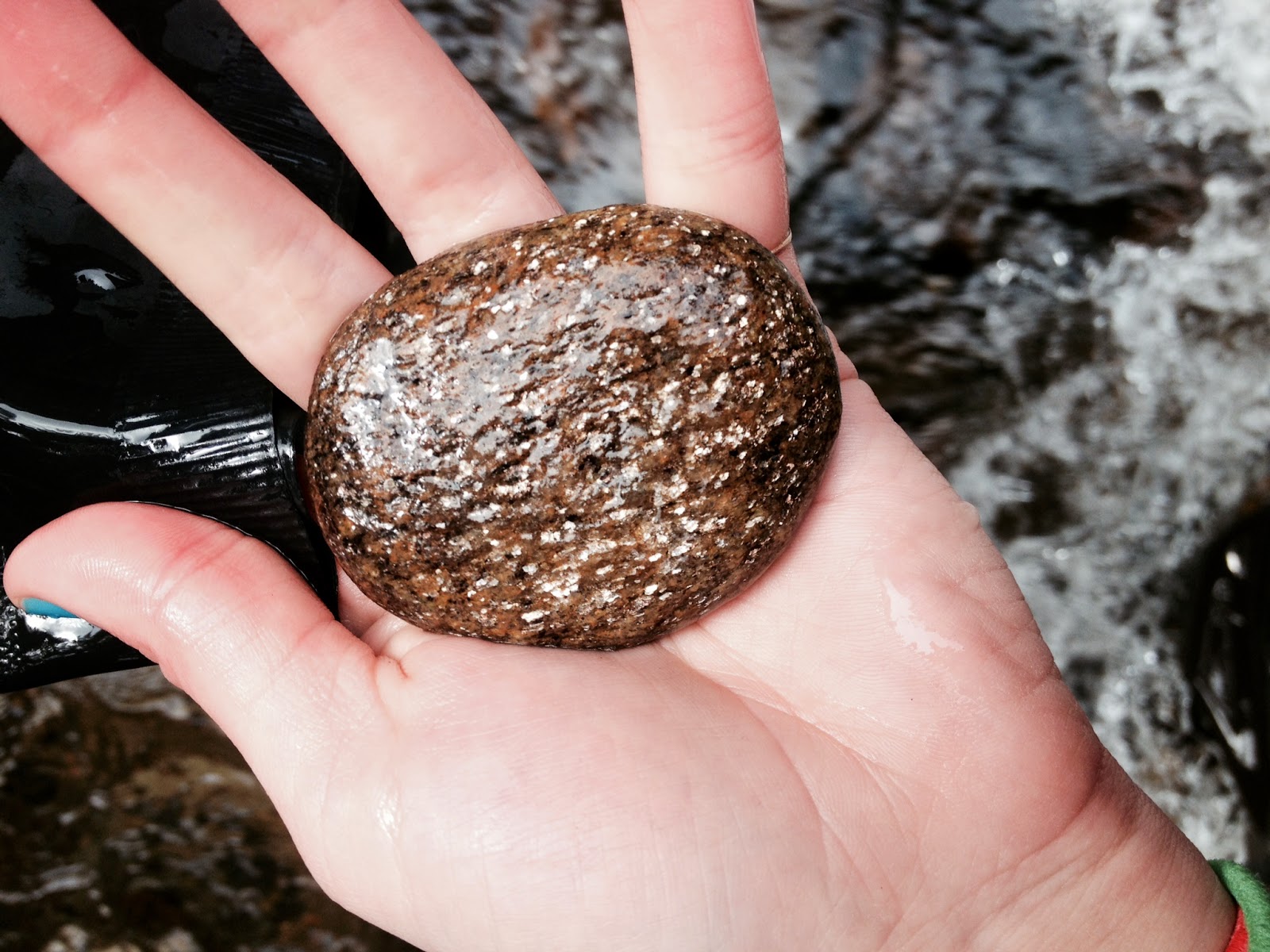

   By this point the next task was pebble count. Becca had brought gloves for us this time, hoping to spare our hands the frozen, numb experience of Stream Teams past. I went to put a pair on and I had the opposite problem as the waders. I had two right hand gloves! The gloves turned out to be ineffective anyway, as the water was deeper than they were long, and just poured in through the top. Also like the waders, the rubber was not very insulating. Becca and Jeremy gave up on the gloves, while I stayed near the shore where it was shallow and only dipped my right hand in to pick up rocks. During this procedure we found that the stream was littered with glittering rocks.


    We concluded the expedition as always, with thermoses of hot water, little cups, and packets of instant hot chocolate. Despite unexpected gear malfunctions, we got the information we came for (plus a little fun), making this another successful, if extra interesting, Stream Team.

-Cassie Sevigny, WEN volunteer

Friday, May 1, 2015

Crawling and Flying through the Wild Walk Parade

     WEN volunteers collected at the Red X's April 19th for the Wild Walk Parade in downtown Missoula. Everyone was abuzz with excitement, including our Sussex Elementary School bugs and parents. Our painted river glistened and sparkled in the sun pouring down, thanks to the last minute addition of colorful mesh (the same used for my dragonfly wings).WEN's "float" was right behind the lively band, ready to lead the winding river of a parade through the streets lined with locals. A local reporter for the Missoulian even made rounds to speak with various WEN folks.

Photo courtesy of Jennie Pak


     On the left, the band is pictured preparing their musical instruments. On the right volunteers Sean and Cassie (myself) dance to the band's music while marching the WEN banner down the street.

     The parade flowed from the X's down Higgins, making a slight curve to stream down to the Pavilion next to the Clark Fork. The festivities did not stop upon arrival though, as there were booths with wildlife information, live music, and hot food. Even Big Dipper ice cream made an appearance to refresh the festival-goers.

     Below are volunteer Al Pak and director Deb  modeling their completed costumes -- a caddisfly and dragonfly, respectively -- and the sunlight shining through Becca's stonefly wings onto the sidewalk.

Photo courtesy of Jennie Pak


As the first real project I've organized with WEN, I consider our Wild Walk experience a splashing success!
-Cassie Sevigny

Friday, April 10, 2015

Waterbugs Emerge from their Lairs for Upcoming Wildwalk


WEN is participating in the Wild Walk this year, put on by the Roxy Theater as part of their International Wildlife Film Festival. The parade will feature many different creatures from organizations around town. Since we love rivers, WEN has asked volunteers to root around in the waters of their imaginations to find costume ideas in their bug-catching nets!

At each costume building day, books full of detailed bug pictures were provided to assist the inspiration process (and so costumes could be accurate, if one so chose). Deb and I gathered materials that could be useful, and I left out some preliminary drawings of costume parts that could be built with these materials in case people had trouble. After waving their bug nets around all this, volunteers made like caddisflies and brought together their preferred materials into a cohesive bug costume.


Here are some examples of the costume-building process:


I chose to be dragonfly (then I get to wear pretty, colorful wings).


Sean, another WEN volunteer, made some wings as an extra costume for anyone who wanted to participate in the parade but couldn't make it to a costume-building day.

Below are some pictures of volunteer Sara making her water beetle costume and, speaking of caddisflies, Al creating her caddisfly nymph costume.

 Some mini bugs from Sussex Elementary School will be crawling out to join us on the day of the parade, as well as our volunteers' own little waterbugs!


Al making paper sticks.


We've got a couple more sessions left to finish up! Saturday (April 11) we will once again be in the conference center, and will start working on our representation of the river and decorating a small wagon.

Saturday, April 18th is our last day to work on projects, and then the parade is April 19th!

-Cassie, WEN volunteer


Two Sussex students working on their costumes

Wednesday, March 18, 2015

Chief Charlo Get Excited at Rattlesnake Creek

With our gear carefully situated, listening to the quiet of the Rattlesnake Creek, we awaited the students of Chief Charlo Elementary. The school bus entered the parking lot of Greenough Park and the 5th graders rambled out, talking excitedly among themselves. The volunteers' anticipation mounted as the teacher, Kevin Cashman, lead the students across the bridge of the creek towards the workstations. And with a rush of joy and squeals of delight the kids were upon us, eager to dive into the world of macro-invertebrates. 

First, a little context. To conduct a biological assessment of the Rattlesnake Creek, 300 macro-invertebrates are gathered to determine if a stream is polluted. Macro-invertebrates are animals that do not have backbones, but are visible to the naked eye. Certain macro-invertebrates are sensitive to pollution in the streams, such as mayfly and stonefly nymphs, and their presence or absence can indicate the overall health of a stream. The Watershed Education Network collects this data to keep community members aware of the quality of the water, and to empower students to understand the importance of our watershed.

The students rushed over to the tables, bubbling with enthusiasm as Mr. Cashman directed the kids into their groups. "Tanagers, and Western Meadowlarks will go into the creek! The Clark's Nutcrackers and the Pileated Wodpeckers will collect the bugs!" And with that the 5th graders scrambled about to their respective stations.

The Tanagers, about six kids, pulled on waders and armed themselves with nets, then went to the waters edge where I told them about the crab walk. "First thing is safety", I call out, "and to be safe in the creek we will be doing the crab walk whenever we are walking in it". With exaggerated movements, I demonstrate the crab walk, where you walk sideways down the river so as to avoid slipping. The kids head into the water and I take them down to riffles where the macro-invertebrates hang out. Three of the 5th graders eagerly hold the nets, while three others stand a few feet in front and start the shimmy. The shimmying disrupts the insects, and are directed by the current of the creek into the awaiting nets. Giggles echo out of the cool afternoon as the kids trade places, the former getting ready to shimmy, and the latter taking the nets. With the nets full of bugs and debris, the Tanagers head up to tubs full of water waiting on the bank where the nets are upended. With the task of netting the bugs finished, the children take the waders off and get ready to start collecting the macro-invertebrates.

Spoons and ice cube trays have taken the place of nets and waders, as I tell the 5th graders to search for the bugs like a stork, calm and unhurried. The Tanagers set about with quite a many "oohs" and "ahs" as the macro-invertebrates that they worked so hard to collect flit about the tub, diving for the leaves and other debris. With steady hands, the kids dip the spoons in, carefully uncovering and lifting the bugs out of the tubs and into the ice cube trays. "One macro-invertebrate per cube", I tell the Tanagers, as spoons laden with treasures appear out of the tub. Once a few fine specimens are found I take out the dichotomous key, an identification tool that consist of a series of choices that lead the user to the correct name and picture of an the macro-invertebrates that we are searching for. First, we look to see if the creatures have shells or not. "No shells!", the kids cry out. Second, we look to whether legs are involved with our little friends. "Legs!", the 5th graders say, and we continue down the key to the majority of the macro-invertebrates found in the stream being mayfly nymphs. After the Tanagers enthusiastically identify the creatures they are set free back into the Rattlesnake Creek.

Today was an exciting day for me. Experiencing the joy and vigor that a child greets its world with is uplifting to say the least. Moments of a persons existence are made when introduced early to the wonders of life. I feel very proud to hopefully be a part of something so significant. Being shown the beauty and life thriving silently in the river can be sometimes all it takes for a person to become acquainted with a sense of wonder that quietly guides them through life. Perhaps this placement of wonder actually took place, or perhaps a group of 25 children just had an absolute blast. Either one I will take. One thing for sure is that I look forward to more outdoor adventures with the Watershed Education Network, where we teach kids of the unseen world bustling in our streams.

-WEN Volunteer


Tuesday, November 4, 2014

Stream Team in Late October

Late fall turns out not to be the most comfortable season to begin one's experience with stream monitoring, but I was determined to finally get my hands wet (and keep my feet dry).

The drive up to the selected stream passed with discussions about ladybugs eating aphids and grizzly bears swarming to eat ladybugs in the mountains. On one side of the car stood thousands of larch trees, green and yellow stripes blanketing the mountainside. Larches, I learned are one of the only deciduous conifers. On the other side, sprinkled in with the evergreens were what appeared to be birch, with dark branches bearing suspended sprays of yellow leaves.
The sky alternated dropping pellets of water and  letting the occasional sunbeam peek through the clouds as we drove.

After a few moments of uncertainty we came upon our section of stream.

       The team unloaded the equipment from the trunk and we tugged on our waders. My waders required a bit more tugging than everyone else's, as I, with my smallish feet, had to use the kid size waders, which happen to come with attached waterproof overalls. My feet fit very comfortably but my legs were slightly too long and my thighs squeezed (very) snugly inside. The difficulty of bending my knees made for some interesting walking strides. Conveniently, however, a pocket was situated on the front where I stowed my camera.

       The bank closest to the roadside was steep, composed of  large black boulders. The strongest current ran along this same bank, forcing us to step into the deepest part of the river, the water trying to pull us along downstream. Resisting the current and carefully treading over the slippery rocks, all three trans-sections were successfully strung across and staked down.
Downstream

Upstream
       Perhaps the easiest measurements to take consisted of measuring the current water and bank-full depths of the stream, as this did not require us to get our hands wet, and slush was not yet falling from the sky. Some hail had formed high in the atmosphere and partially melted before gracing us with its presence. Fortunately the precipitation ceased (for the most part) before the tossing of the grid and counting of "pebbles".

     The grid toss measurement counts the number of patches of fine sediment. We came up with low numbers, as the stream bed was mostly covered in rocks. Plunging our hands into the water to retrieve the grid was our first encounter with the frigidity of the stream, as our waders (and wader-overalls) protected our bodies nicely. In my pairing, grid toss was followed by pebble count, which required hands to be dipped into the water 100 times total to pick up and measure rocks. My partner and I, in sympathy, took turns with this. Our hands quickly flushed red and numbed. We could barely hold the pencil and clipboard, let alone write numbers into a tiny set of boxes. Our results for this measurement came out looking like the scratchings of a child just learning that numbers each have their own shapes. (The warm pocket of my wader-overalls came quite in handy at this point for my hands.) However, this produced some interesting finds.

       Several rocks we picked up had small, squishy, translucent green globules attached to their undersides. Upon investigation (asking Rebecca) my partner and I learned that these were actually a type of algae. While dreading reaching my whole forearm into the deepest section of the stream I saw, sitting in the shallow water over one of the boulders on the bank, what I assumed was a red crayfish. Through the water distortion it appeared to be about three inches. It swam away moments after realizing I had noticed it, just as I was fumbling to get to my camera. (Not being familiar with the area, I looked up what types of crustaceans lived in Montana and found several pictures of crayfish which appeared much like the one I saw, but not anywhere near as red.)


        As we were finishing up our tests and unstaking the trans-sections the sun came out, brightening the larches in the distance. Rebecca pointed out two tall thermoses of hot water, which we poured into mugs and used to warm our hands. The hot water doubled to provide well-deserved hot chocolate for the ride back, which we paired with homemade chocolate chip pumpkin cookies. Talk was lighthearted, about plans for Halloween, and I contemplated that freezing in a stream together with other people creates a sort of camaraderie despite the fact they were strangers just hours before.

-Cassie Sevigny, new WEN volunteer

View on the way back to WEN office.

Sunday, August 24, 2014

Crew Number Two! WEN Leads 21st Century CSC

After a successful 6 week crew, WEN got together with a new group of 8 local high school students, this time working with the 21st Century Conservation Service Corps. The crew spent 2 weeks hard at work deep in the Montana forests.

It was straight to business for this bunch, and Road Surveys were the name of the game. Miles of dirt roads were covered, boulders moved, and data collected. Here is a picture of some of the crew hard at work... although when you're in such a gorgeous place as that, how can it really be work?!

Wait... Are we doing all those roads?!

Moving from road surveys, the crew moved onto the water, measuring Flow, taking pebble counts, and documenting their work through photographs and recording more data. Look close, and you'll see Deb even got to go out for the fun!

It's water time

While still on the rivers and creeks, the 21st Century CSC crew spend some time with the bugs, as any good watershed steward would. This group loved checking out what was swimming around!

I spy - a Mayfly!

On a couple of occasions at Dunham Creek near Seeley Lake, the crew spent time identifying plants. This gave them the expertise to pull the noxious weeds and water the natives we want to see thrive.

Transporting water to those that need it - the plants.

It was a great two weeks with this crew, and for such a short amount of time, it is truly amazing what they were able to accomplish! Thanks so much Landon, Abby, Clara, Finn, Shane, Georgia, Ian, and Mark - lets do it again next summer!


CSC Crew Crushing weeds!

Also, a huge thanks to Becca and Peter - our YCC and 21st CSC crew leaders extraordinaire!

Don't worry - this was staged!


Wednesday, August 20, 2014

WEN and YCC - A perfect combination!

This summer, WEN partnered with the Lolo National Forest to run a Youth Conservation Crew (YCC) program. The 6 week program brought together 8 Missoula area high school students to work on a variety of projects for the Forest Service.

The YCC Crew deep in the Montana woods.

Data collection was a big theme of the summer, and the crew drove and hiked many miles through old and decommissioned Forest Service Roads. Along the way, they were collecting measurements, tracking GPS data, and determining use. Not to mention, there were the occasional boulder that needed to be moved out of the way!

Hiking along old Forest Service roads to get to the next data collection spot.

Off the dry roads and into the wet streams, the crew spent time in the water completing Pebble Counts, measuring flow, and checking out bugs!

BUGS!

The crew learned the difference between Native Plants and Noxious Weeds, spending in the Ninemile getting rid of the invasive species to help the natives thrive. It might not be a pretty task, but they sure did make it look good!

Crew member getting after the weeding project

It wasn't all work and no play, as the teaching moments turned out to be a lot of fun. The group got to spend time Birding at the MPG Ranch, and also went on a hunt for Grizzly Bears, working with experts using radio collars to track them.

Birding at the MPG Ranch

At the end, the crew gave a presentation to members of the US Forest Service about what they accomplished and what they learned. A report of all the data collected was also submitted which will help the Forest Service determine their next steps in these areas.

It was great to work with this crew - one that bonded so well and so quickly, all while getting great data in needed areas. The summer seemed to go by far too quickly, but we gained so many great memories! Thanks  for all the hard work Andrei, Ava, Claire, Dylan, Jackie, Josh, and Noah!

Monday, May 12, 2014

Wow! We've been busy!

Welcoming Becca Paquette - New Program Coordinator


We know, we know - it's been quite some time since new words made their way onto the blog. This fine blog seemed to have been swept away in a strong current, and we've finally found it washed up on shore. In the hiatus, so many fantastic things have happened! From field trips for all ages to the numerous WEN Talks (formally Advanced Training sessions) to the Stream Team collecting great samples, there hasn't been a dull moment.


We've also had the great pleasure to welcome new members to our team, the latest being Program Coordinator Becca Paquette. Becca comes to us from over the river and through the woods, across the plains and over some hills - all the way from the East Coast! She studied Zoology at the University of New Hampshire, and has recently moved to Missoula for new experiences.


Becca brings a wealth of knowledge and high energy to the position, and in a few short weeks has already settled into place. Be sure to say Hi when you see her at our next event!

Speaking of our next event - keep your eyes peeled for our Facebook and email updates - Our next WEN Talks event is on Thursday, May 22 with Pat Saffel of Montana Fish, Wildlife, and Parks! Hope to see you there!

Photos by Mike Lessard