Tuesday, June 1, 2021

Primrose Macroinvertebrate Day!


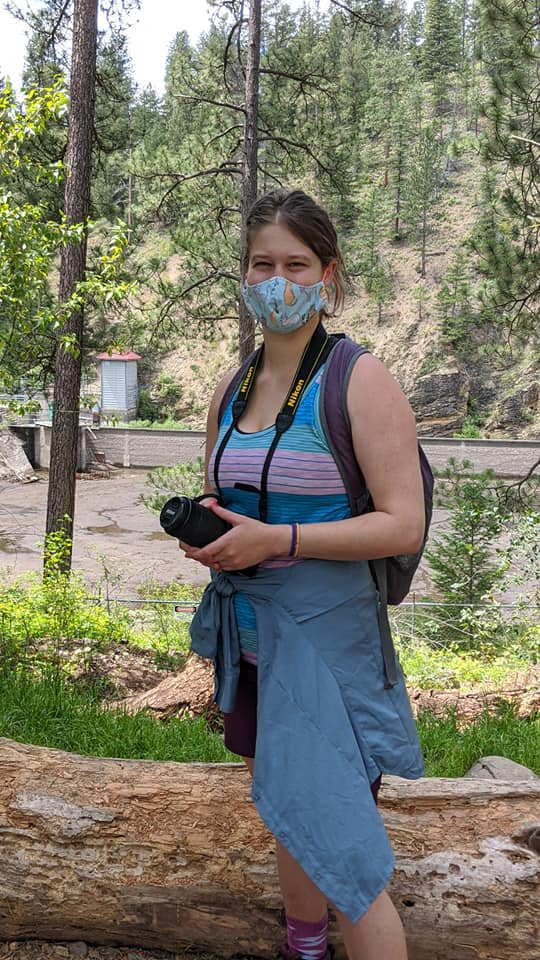
Brook exploring bugs with preschoolers


Just like every day where I go into a new volunteering scenario with WEN I woke up energized and a little bit uncertain about what the rest of the day would behold. I showed up to the office and got a complete rundown of the wonderful lesson plans and various activities that Deb had prepared. As a wise teacher once told me... You always have to have back up activities for the already established back up activities... or something like that.

Al showed up. Macroinvertabrate extraordinaire! Seriously.. He looks at these little buddies for a living and is just a walking wealth of knowledge, and not to mention a super valuable asset for what laid ahead of us.

Stephie and I were sent to the creek to collect bugs. Waders on, nets and hands we were wiggling away in the creek, collecting all sorts of little friends to bring to the school. Once we were satisfied with our sampling we drove to the Primrose Monastery School. At first we were blind on where we were supposed to be going, but then we saw the WEN sign nested on the side of the street next to one of the most spectacular buildings, in my opinion, in Missoula. This school is like Hogwarts for preschoolers, I was in awe.

We walked in, bug jugs in hand and found our wonderful team; Cassie, Deb, and Al. Stephie and I assisted in setting up and then we were all funneled into the building which I so eagerly wanted to explore! And then sitting on the floor were a cluster of kiddos, eager to know who were and what we were doing at their school.

After all the introductions, we took the kids outside. And all of their little heads plunged into the depths of macroinvertebrates and the incredible experience of seeing them so intimately. These kids were so curious, kind, and respectful to the bugs. Asking questions like, “How do they breathe? Where do they live? What is this one? Are they all friends? Do they eat each other? What would it be like to live underwater?” All were beautifully articulated questions and made me (as someone who has a very limited knowledge about macroinvertebrates) really challenged to learn more and be excited and curious just the same as these kids.

Moving along there was lots of giggling, magnifying, running around, dancing, and chatting. In order to diversify the amount of activities Deb and Cassie led a bug lesson where we learned about movement and anatomy that acts as a way to identify the different bug species. We did the dance that went:

Head Thorax Abdomen Six Legs!

Head Thorax Abdomen Six Legs!

Head Antennas Exoskeleton

Head Antennas Exoskeleton

Head Thorax Abdomen Six Legs !


Then we talked about how the different bugs move…

The Mayfly does the Mayfly mambo

The Caddisfly does the Caddisfly thrash

The Stonefly does the Stonefly strut

The kids loved it. I did as well, and honestly I’m bummed that this physical way of learning really didn't show up in my college education. Being able to act a process like this out is so incredibly beneficial.

As the day came to an end there were songs sung, dancing, wiggling, crafting and loads of love and hugs were had. And I can say with a full heart that this school and the kids that make it up are truly a gem nested within Missoula. I hope these kiddos continue to bring their curiosity and kindness in their future exploration in creeks to come.

Thanks for having the WEN team Primrose Montessori Team! I’m so grateful to have had the opportunity to learn with you all!

Rock on,

Brook


Monday, May 3, 2021

Stories from Supporters: Katrina

Leading up to Missoula Gives, the Watershed Education Network brings you reflections from former volunteers, teachers, staff, and long-time friends of the organization. They share the impact WEN's programs have had on them and how our mission matches their values. Here, a wonderful volunteer of ours shares her thoughts and reflections on her time with WEN.

By Katrina Thorness

What first drew you to WEN?

December 14, 2017 was the first day I stepped into WEN’s office. I had won a telescope from a raffle at Montgomery Distillery, which had hosted WEN for a Moscow Monday community night. Walking into WEN’s office sparked joy in my heart. There was so much life, art, color—and the warmest welcome from one bubbly Deb. I recall thinking, “This looks like a good place to work. I want to work in a place like this.” Later that night, I told my partner about my day and mused aloud, “I wonder if WEN would ever need somebody like me.” Fortune followed. That spring, one of my courses required logged volunteer hours, and the Professor had listed WEN as a qualifying option. I took it as a sign. Those spring volunteer hours led to a summer internship, which led to a part-time position. Reflecting on this time, I realize that I’m not sure what first drew me to WEN: a sense of belonging—or fate.

Why is WEN’s mission important to you? 

Ideally, a mission statement should “bestow an aura of being endowed with a sense of purpose—the agency is charged with an important public mission, achieving it responds to urgent needs, and past achievements are known.” Charles Goodsell, Mission Mystique: Belief Systems in Public Agencies (2010). In my mind, WEN’s mission statement checks all of these boxes. Further, WEN’s mission statement endows me with a strong sense of purpose.

Working for WEN, I knew that each task I completed helped children make it to Rattlesnake Creek, the Clark Fork River, or a wetland.  As a child, being outside calmed my heart. As an adult, I now know that these experiences can foster attachment, which provides the secure base needed to explore, learn, and relate. Through WEN’s mission to foster knowledge, understanding, and appreciation of watershed health through citizen science, youth and school engagement, and outreach to our communities, WEN is not only promoting our environment’s health—WEN is building resiliency in our children. This in itself is of vital public health importance.

Ultimately, WEN’s mission is important to me because I want children to feel valued and experience the bountiful benefits of being outside with educators and mentors. I believe that this attachment will motivate children to seek the outdoors and serve as environmental stewards in their adulthood.

Do you find hands-on science or outdoor education more engaging than standard science curriculum or in-class school?

My opinion is that hands-on science—outside—is more engaging than learning inside. Through WEN, I have experienced the difference and witnessed children and adults thrive from outdoor learning labs. 


You can help WEN provide more hands-on outdoor science education for students of all ages by donating to WEN on Missoula Gives, May 6 & 7, 2021:

https://www.missoulagives.org/organizations/the-watershed-education-network 

Monday, April 26, 2021

Stories from Supporters: Vicki Watson

Leading up to Missoula Gives, the Watershed Education Network brings you reflections from former volunteers, teachers, staff, and long-time friends of the organization. They share the impact WEN's programs have had on them and how our mission matches their values.

Vicki Watson in front of the Clark Fork River at Milltown in Fall 2006

Vicki Watson is a Professor of Environmental Studies at the University of Montana. She has been a friend to our director, Deb Fassnacht, and gotten involved with WEN's activities since the organization's beginning, and frequently sends her students our way to volunteer. In reflecting on her relationship with WEN, Vicki shared the following:

"WEN helps people of all ages learn about our streams and share their knowledge with others (another good way to learn). Middle school kids have fun learning stream science -- physics, chemistry and biology. Older students and adults learn how to share their knowledge with younger stream scientists. And some citizen scientists (the Stream Team) conduct useful studies of our streams that help us assess the health of streams and the need for any protective actions.

"I have been grateful for the opportunity WEN has provided to my students to get experience in sharing their knowledge and love of streams with younger folks. And the opportunity to work on citizen science projects -- some of those students have since set up citizen science projects elsewhere.

"I have also helped with some of the class field trips, and it is always a delight to see the kids on the stream -- some run around enjoying the freedom of the outdoors, while others are quite serious and focused on the science exercise. The diversity of responses is part of the magic.

"These learning opportunities have inspired some students to become stream scientists, and have inspired many more to become stream protectors. And our streams certainly need informed stream protectors.

So many thanks to WEN for providing stream access and training and fun."

You can help WEN provide more meaningful outdoor educational experiences for students of all ages by donating to WEN on Missoula Gives May 6 & 7, 2021: https://www.missoulagives.org/organizations/the-watershed-education-network

Monday, April 19, 2021

Stories from Supporters: Jeani Adams

This spring, the Watershed Education Network brings you reflections from former volunteers, teachers, staff, and long-time friends of the organization. They share the impact WEN's programs have had on them and how our mission matches their values.

Clark Fork + Blackfoot confluence. Former site of Milltown dam,
now Milltown State Park. Photo credit: Cassie Sevigny

Jeani Adams found WEN's work incredibly valuable during the removal of the Milltown dam:

"I have always believed that pairing in-class learning with an outdoor experience really works well with many topics. I was fortunate to work with WEN and help with the Milltown Dam removal project. We provided students with some background information in the classroom and then took them on a field trip to the dam overlook, where they could observe the actual destruction/remediation efforts. We then reinforced their learning and investigation of the changes the environment would undergo with the dam removal using a series of fun activities. It was wonderful to see how excited they were to witness history and many of them told of how they brought this information home to share. 

WEN truly focuses on providing students with an experience that they are not able to get in a traditional classroom. I believe it is a very important job that they do and they do an awesome job!"


You can help more local students experience outdoor education by donating to WEN on Missoula Gives May 6 & 7, 2021: https://www.missoulagives.org/organizations/the-watershed-education-network 

Monday, March 22, 2021

Aspire School Rises to the Challenge of Developing a Floodplain

Radley Watkins stands on snow covered grass in a wooded riparian area. His hands are up in front of him, gesturing as he talks.
Photo by Cassie Sevigny

On a sunny winter’s day at McCauley Butte next to the Bitterroot River, I met with staff from the Watershed Education Network (WEN) and students and their educators from Aspire High School. Aspire is an “alternative” school based on experiential education and recently acquired a good portion of land on McCauley Butte and the Flat. Our group was assembled to council with Aspire students as they investigated a community resilience topic for the RISE Challenge Big Sky, hosted by Brightways Learning and WEN. The students were confronted with identifying a real-world environmental issue and developing a solution with an action plan to address this issue. These students chose to address how to use a riparian floodplain as a year-round outdoor classroom. 

I first learned about their project when Deb Fassnacht from WEN contacted the Missoula Conservation District (CD) to ask if we had any insight on what sort of structures could be constructed in the floodplain, and if a representative from the CD could come out and meet with the students. I was happy to oblige. 


The land Aspire school owns is the riparian area between the Butte and the Bitterroot River. The riparian area is beautiful from an ecological standpoint, and I would consider it high-value habitat. The area has beaver ponds and cottonwoods and hosts waterfowl, woodpeckers, and other wildlife.  The challenge for the students is this land is not only in the floodplain, but the floodway. The floodway doesn’t just get standing water covering it occasionally; flood water moves through these areas with a fair bit of velocity, like you-better-watch-out-for-ponderosa-pines-floating-through kind of velocity. Almost all planning and zoning regulations prohibit any development in the floodway.


The students knew they could not build a traditional structure or even a boardwalk in this area, so they were coming up with all sorts of ideas on how to create an attractive educational space on the property. As I covered some of the regulatory challenges the students faced, including a conservation easement that the previous owners put in place with the Five Valleys Land Trust, the students began discussing (more alternatives?) ideas. Their eyes lit up as they discussed solutions such as rope bridges, floating decks, and hanging platforms. While I could speak about zoning, floodplain regulation, and conservation easements generally, the Missoula Conservation District only has regulatory authority over 310 permits based on Montana’s Natural Streambed and land Preservation Act. 


A 310 permit is required to ensure that natural rivers and streams, and the lands and property immediately adjacent to them, are protected and preserved to be available in their natural or existing state. The interesting thing about this particular permit is that there is no automatic definable jurisdictional boundary. Often time the CD generally looks at the riparian buffer within 50 feet of a major navigable river, but any project that degrades environmental life support systems or causes unreasonable depletion and degradation of natural resources in a riparian corridor could come under 310 jurisdiction, and yet… almost no one knows a 310 permit application is needed for work near a river.


Two people standing on snow-covered frozen pond, footprints leading up to them. A brush-covered hill rises from the edge of the pond in the background.
Radley and a student investigate a possible beaver breathing
hole in the ice. (Photo by Cassie Sevigny)

After talking 310 permitting and wandering the land, we headed back to our vehicles. I think I left the students with more questions than answers. I felt bad about that, but that is the nature of science and exploration. It was awesome to see students engaged in place-based education and the excitement of the students as they stood on a frozen beaver pond and talking about beaver ecology will stay with me for a long time. 

What will these students propose to do to make this floodplain a year-round classroom? Will they try to suspend fellow classmates from the trees? Will they float them over a beaver pond? I don’t know, but in any case, they are going to learn a lot about rivers, flood plains, and riparian areas, and how humans interact in these changing riverine environments.


-Radley Watkins

Resource Conservationist

Missoula Conservation District


Monday, March 15, 2021

Snow Hikes, Snow Spiders, Snow Flies, Oh My!

By Cassie Sevigny

Rounded snow banks along the edges of Bear Creek. Trees cast shadows, and sunlight reveals stones beneath the very clear shallow water.
Bear Creek (Photo by Cassie Sevigny)
I went hiking this weekend with a friend who's moving away from Montana. We drove up to Bear Creek trail, expecting mud and a trail-turned-creek, but spring is not so progressed yet. Instead we found a low-traffic, barely-compressed solid snow trail that was much easier to traverse. The snow lay in heaps on rocks like pillows, hid the true edges of the creek, stuck in frozen puffs to the sides of small trees, and reflected the days brilliant cold sunshine back at us. Good thing I wore sunscreen!

As we walked I noticed little black spiders on the trail. Warming up, perhaps? Despite their dark color against the white, they blended in with all the other natural debris flecking the snow. Only their flicking legs caught my attention. I wondered if these spiders just didn't go dormant for winter, or if the sun was waking them up.

boulders on a hill covered with mounds of snow. Trees at top of hill and a patch of blue sky behind.
Snow pillows (Photo by Cassie Sevigny)

Then in an open snowfield I saw another bug crawling - black and winged, crawling uphill away from the creek. Two tails, wings folded neatly over each other on its back, made me guess it could be a stonefly. One fly is just a curiosity, until my friend said he's seen some earlier. And then there was another. And two more. All crawling uphill, crossing the trail a decent ways away from the creek. Perhaps a hatch? Were these the very winter stoneflies WEN featured on Science Friday?

Winter stoneflies are not very strong fliers and instead walk around on the ice and snow looking for a mate, just like the ones I saw. Their dark color may help them better absorb the heat from the sun when emerging in such cold months, though they also have their own internal antifreeze! 

small winter stonefly on top of snow
Snow fly (Photo by Cassie Sevigny)

I was probably seeing the aptly named "small winter stonefly" (capniidae) since these were smaller and more delicate than most stoneflies I have seen around the Clark Fork in the summer. Missoulian Angler confirms that small winter stoneflies emerge in February and March, and have been found around the Bitterroot River, of which Bear Creek is a tributary. Missoulian Angler also informs me that they have a much cooler name, the "snow fly," which I shall use from now on!

I saw more and more spiders as we hiked too, now that I was looking for any black moving speck in our path. Were the spiders emerging too? Were they looking to eat the stoneflies? My search for information pulled up another blog where someone else wondered the same thing, but for streamside spiders catching insects in their webs. I only saw the spiders. I forgot to photograph the spiders I saw so I cannot identify them precisely, but they were small and black, like many of the spiders active during winter. (Most spiders go dormant to survive the cold.) Maybe they are black for the same reason as their potential prey - to stay warm.

While I found no definitive answer to whether the black snow spiders eat the black snow flies, I was delighted I could reasonably speculate! Working with WEN enabled me to guess that I was seeing some kind of stonefly, and also exposed me to the theoretical existence of winter stoneflies. Finding them in the wild and relating them to the environment I found them in made the cool science facts so much more real, tangible, and relevant to me. Finding small details in a landscape and being able to understand them, or hazard a guess as to their role, also enhances my experience outdoors and makes me feel more connected to the environment than if I saw hikes as "just passing through." Chance encounters with tiny wildlife can mean just as much as the sun shining beautifully between the tall thin  evergreens or the companion you talk to on the way, and I'm glad I had all three.

Sunlight filtering through a stand of tall thin evergreen trees. The shadows leave stripes on the snow in the foreground.
Photo by Cassie Sevigny


Monday, March 8, 2021

Best Ways to Preserve Nature while Hiking

By Cendy Moliere, Personal Injury Law

Pair of hiking boots sitting on the floor at the top of a metal staircase, waiting for hiking weather.
Photo by Cassie Sevigny

You have planned a hike to get away from the hustle and bustle of the big city. Good choice, as hiking offers numerous benefits for adventure seekers of all ages. The physical activity alone enhances several body functions, such as the immune system and the strength of your muscles. Hiking is also an eco-friendly way to preserve nature, that is, if you follow five times tested tips for preserving nature while hiking.

Do Not Trash Mother Nature

The first tip on our list might appear to be common sense, but you would be surprised to learn about the number of hikers that do not completely remove all of the trash from a campground or resting area. We are talking about recyclable trash, not materials like plastic that take centuries to degrade. Another element of the remove all trash movement involves leaving human waste. Dig a hole at least six inches deep in an area that is not visited by humans. Even better, hike a trail that provides portable toilets at certain intervals.

Sleep at Established Campsites

If you plan to take a multiple day hike, you need to find spots to call it a day. Many trails have established campgrounds available for hikers to use. Campsites are carefully designed to disturb Mother Nature as little as possible. Many campsites offer shelters that protect hikers against bad weather conditions. Camping in a spot away from established campsites can leave long-term damage for the vegetation you have flatten to sleep.

Keep Water Sources Clean 

We know the timeless adage: “I’ll go when I have to go.” It makes sense, but you should go when you have to go at a spot that is located far away from the nearest water source. A good rule of thumb is to do your thing at least 200 feet away from a creek, a stream, or a river. Use biodegradable soap to prevent tainting delicate water supplies. In addition, avoid washing dishes and clothes next to a body of water.

Smokey the Bear Says Build Small Fires 

Smokey likes to tell people about the importance of putting out fires, but he also has a message for hikers that need to build a fire for cooking and/or for generating warmth on a cold night. Keep every fire you build small to leave less of an impact on the environment. Most trails mention ideal locations for building fires, so check with park and wilderness manuals to locate suggested spots for building a fire.

Buy Eco-Friendly Hiking Clothes

You do not hear much about this tip, but it is an important tip to remember because of the materials used to design and produce hiking clothes. You have to understand the production process to learn about which type of hiking clothes places the least amount of stress on the environment. Every time an article of hiking clothes is made, pollution rises from a factory to negatively impact the fragile ecosystem. You should also look for hiking clothes that use organic materials, such as organic cotton.


This article was provided by www.personalinjury-law.com, an organization dedicated to providing the public with information about personal injury and safety information. Nothing in this article should be construed as legal advice, and it is intended for informational use only. 


Monday, March 1, 2021

A Special Place

By Aissa Wise

 Hiking up the trail, backpack full of chocolate and gear, waders and boots tied together and draped over my shoulders. Finding the right configuration of gear placement on my person while hiking to the stream is a skill; sometimes I get it right, sometimes I don’t. How long can I hike with my clunky wade boots smacking my side? Are my waders dragging in the mud? Are my Stream Team volunteers ready to collapse? We round the bend, and the best view of Rattlesnake Creek is before us. A few volunteers mimic my awestruck gasp. I’ve seen this view a thousand times, but it never gets old. In fact, it looks different every time. Today, the Red Osier Dogwood that frames the creek is the color of ripe raspberry. We set our gear down for a deep breath of fresh autumn air and bask in the presence of the creek. A special place. I point out an American Dipper (Cinclus mexicanus) to the volunteers, a sweet little dark grey bird doing her famous dipper dance on a moss covered boulder in search of insects under the water. 

I continue down the trail to the creek, gear and volunteers in tow. I lead them to a special spot I particularly love to share. This place is off the beaten path, set apart from the daily Missoula recreators hiking and biking the Rattlesnake Creek trail system. A special place. The far side of the creek is framed by a large cliff, elegantly curved from years of the creek rushing by. We share our side with creek loving alders (Alnus incana), cottonwoods (Populus trichocarpa), red osier dogwood (Cornus stolonifera), willows (Salix bebbiana), serviceberry (Amelanchier alnifolia), and mountain ash trees (Sorbus americana). Before we set up, I share with my volunteers that we are on sacred ground of the Salish, Pend d'Oreille, & Kootenai Native American People and we honor the path they have always shown us in caring for the environment. I am sure to thank my volunteers for honoring this special place. 


Waders on and safety talk finished, the volunteers split into three groups. Each group will monitor three different water quality parameters; biological, chemical and physical properties of the creek. Group one will collect and count aquatic macroinvertebrates (insects) which are incredible bioindicators (living organisms that give us an idea of the health of an ecosystem). Group two will collect water samples to measure temperature, pH and dissolved oxygen. The last group will measure the creek from bank to bank, describe rocks and cobbles and measure stream flow to get an idea of the physical shape of the creek. We will continue to collect this data for many years in hopes that it will help us, and others, to better understand how the creek is changing over time due to climate change and an increase of human pressure. In turn, this data will allow for better decisions to be made for the health of Rattlesnake Creek, the fish and insects that swim in it, the American Dippers that dance along it, and all of the plants that rely on it. This is a special place. 

Tuesday, February 23, 2021

Playing in the Woods

By Brook Bauer
12/15/2020

Our adventure started on a crisp morning as Deb and I vigorously prepared for the wonders that awaited us off the Bitterroot River, nested among the wilderness area surrounding McCauley Butte. And, of course, Stephie lent a helping hand in getting everything together. I found myself thinking, “It's a good thing that I brought a big bag today,” because we brought kits to test for pH, O2, as well as macroinvertebrate collection kits. I was not sure what we would need in order to learn as much as we could about this hidden wilderness area. 


From what I had researched and what Deb had told me, we would be venturing out to a wilderness area (approx. 140 acres) that is owned by a lovely school known as Aspire. Aspire is an experiential learning school, playing around with new innovative ways to engage K-12 kiddos in all sorts of academic curriculum. Today Deb and I would be meeting with a few high schoolers to talk about water (hence the variety of water testing kits) and to  check out what was going on in this remarkable hidden gem of a landscape. 


I followed Deb out to the campus and we then followed the instructions left by the Aspire teacher, Elana. Eventually we found ourselves amidst the fresh new snow surrounded by a beautiful wetland ecosystem. Gearing up, we discussed whether or not we would need the sled to haul our gear out, but ultimately decided we would manage. Following Elana’s detailed instructions we started on our way. Going one way, then realizing it was the wrong way, then finding a bridge, following a long fence line, and finding ourselves at the most amazing cluster of cottonwoods. Deb and I, for the life of us, could not remember what a cluster of cottonwoods is called... Maybe Populus? I don’t know if we actually found out, but a girl can hypothesize. Nested within these trees were tons of nests which Deb said were probably magpies. 


Moving along (well, actually we backtracked a little bit due to finding those majestic cottonwoods), we eventually found our way to a frozen lake, then to a larger stretch of cottonwoods, and eventually found the Bitterroot River. Following it until we found our Aspire friends, we were thrilled because there was a huge warm fire to welcome us. 


We spent the next few hours lending a hand to Elana in any way we could. Mainly, we assisted her and two of her students in understanding the ins and outs of how the body of water we found ourselves by worked - and how to test for indicators of water health. The students collected data on turbidity, macroinvertebrates, and pH. They would blaze their own trail by forming their own opinions on the current state of the Bitterroot, a hypothesis of sorts informed by the data that was collected. 


While assisting in the pH testing we got a consistent number of 7.2 out of all of our tests, and found a bunch of little macroinvertebrate friends! (That indicates a healthy water system.)


I learned so much about this wilderness area, and was absolutely in awe of the amount of rich biodiversity that blankets it. What a spectacular place to play! Both Deb and I walked away feeling very grateful that Aspire shared this space and time with us. We hope to be back learning with them soon! Hopefully, next time we will luck out in seeing a beaver!! 

Monday, February 8, 2021

Living in a Caddisfly Case: Part Seven

 By Cassie Sevigny

Moving to Montana was my first foray into full-scale independence. Responsible for feeding myself. No family, no friends. When the people and city were unfamiliar, I met the details of Montana’s landscape. The mountains and evergreen forests reminded me of Washington. Montana huckleberries used to feel foreign and wild, a reminder of how far from home I was, but knowing this little sour red huckleberry existed in the place I had left made me feel like a rhizome that had tunneled from the Puget Sound to Missoula, sprouting and growing in a new direction.
Like a caddisfly in a stream or my child self on the beach, I built a home from pieces of the world around me – the mica-rich rocks, swathes of color-changing larch, fire-forged morels and huckleberries, even a red crayfish who eyed me from a stone dropped long ago by a valley-carving glacier. And like caddisflies and huckleberries, I can make my home in both Washington and Montana.

Monday, February 1, 2021

Living in a Caddisfly Case: Part Six

 By Cassie Sevigny

The “Montana huckleberry” isn’t the only variety. There’s another that I found on a visit home, hiking up Wallace Falls with my family. It takes root along streamsides and in rainy forests of western Washington, fanning its leaves over nurse logs, stems tipped with delicate pink berries.
The trail to Wallace Falls starts below buzzing power lines, but as you walk farther into the forest all human noise fades away. Moss and underbrush muffle sound, the rush of the river filtering through the foliage even when you can’t see it. We stopped at a bench near an informational sign. My siblings and I sang the information to each other, creating its story for ourselves in a joyous lingering moment.

My parents identified the red huckleberry plant. Eating one releases a crisp burst of cool tartness, none of the silky blueberry tones that bother me in the Montana variety. I imagined other creatures that met here, birds and chipmunks, all taking a piece for their needs and carrying on. My stepsister could not get enough. Each berry gave a brighter gleeful gleam to her eyes.
“Save some for the bears,” we told her finally. Bears might not come to this particular bush on the trail, but plenty of other bushes in the state park likely see regular bear visitors. In less human-touched areas, bears even fight over huckleberry territory.

Monday, January 25, 2021

Living in a Caddisfly Case: Part Five

 By Cassie Sevigny

Later in 2018 I joined a WEN field trip with students in Ronan, northeast of Missoula. Near Flathead Lake, I added it to my mental map. On the drive we admired the Mission Mountains through thin haze of smoke. Wildfire season had started somewhere. I thought of the trees burning, the morels and foliage that would sprout afterward. We passed through Arlee, where the freeway splits around the town. “Huckleberry pies and shakes!” a sign announced.
“Oh, I love huckleberries,” Deb said. “Have you ever been huckleberry picking?”
“No,” I said. I don’t like huckleberries. They taste too much like blueberries. I don’t like to reveal this in Montana, just as I keep my dislike of seafood quiet when I’m in Seattle.
“We have to pick huckleberries from nature,” Deb continued. “We can’t grow them. No one’s figured out how to farm them yet. People have tried all sorts of things – planting seeds, transplanting bushes from the wild, changing soil chemistry, burning the area first – nothing works.”
One possible reason for this difficulty is that huckleberries can grow via rhizomes, which are underground, root-like stems that extend from the original structure. Sprouts grow off these sideways stems, appearing to be a new plant. Since they aren’t real roots, a cut and transplanted piece of rhizome won’t sprout, disconnected from its main plant body. In addition to proper planting from root or seed, huckleberries require a unique combination of pH, moisture, nutrients and climate provided naturally in mountainous regions prone to wildfires. Once a bush is established, it takes several years to produce the berries. All of these difficulties don’t mean it’s impossible to grow huckleberries commercially someday, but for now they remain wild.
Until then, we must collect all of our huckleberries from the woods, filling buckets like technologically advanced bears. Some people harvest with rakes to reduce the time and tedium. This method gathers more berries faster than handpicking one by one, but the bushes are left damaged.
“I don’t know why anyone would want to damage the bushes, we only have so many and just have to hope they grow back the next year,” Deb complained. She got so caught up in talking about huckleberries, we forgot to stop for shakes.

Monday, January 18, 2021

Living in a Caddisfly Case: Part Four

 By Cassie Sevigny

In the spring of 2018, I heard word of a tree-planting operation in Lolo to reforest a woman’s property affected by fires. How do trees get planted? I wondered. Do we use seeds and hope for sprouts? Wait for saplings to reach several feet before planting them? I needed to return to Lolo to find out how to restore trees to the land that protects the water.
Going alone this time, I realized that Lolo was not in some far away, abstract part of Montana. I only had to point my compass south of Missoula and drive for half an hour. I found the woman’s house hidden from the road by trees. The lawn and trees were green, but as I hiked up the property, the lush undergrowth gave way to black spindly trunks erupting from the tawny ground. Volunteers who arrived before me were balanced on steep slopes among these trunks. Some jammed shovels into dry, rocky soil. The shovelers prepared the way for others who walked along with buckets of baby native trees, less than a foot high, to insert into the holes. The tiny needled fronds of larch and pine stuck out of the ground like decorative feathers.
“My land was hit hard by the fires. I bought up all the saplings available from the restoration companies,” the landowner told me. “So if anyone else wants them, they’ll have to wait ‘til next year.”
On the hillsides I could see many areas with small dabs of white poking out of the ground. These were the mesh grazing guards, stretched over the newly planted treelings like tiny fences to prevent animal nibbling while they were vulnerable. Deer would think any unguarded trees were a buffet planted just for them. The mesh breaks and disintegrates over time. As the tree grows taller and more resilient to grazing, it doesn’t need protection anymore, and the mesh would hinder its growth.
 I collected some of the biodegradable mesh from a pile on the trail and embarked on a scavenger hunt for treelings missing protection. The landowner directed me to a mess of wood bits on a hillside. Logs and branches littered the ground, leaving the sky wide open. Remnants of a slide. A previous group had already planted there, but finding the living wood of exposed treelings among the scattered dead wood was challenging. While the wood debris protected the baby trees from the sun, it hid them from my gaze, too.
Once I was certain I had found all the trees in the woodslide, I moved to the blackened trunks and trees that survived. Here the needles of the treelings stood out against the smooth dirt. I didn’t find very many, but I did find mushrooms. They were brown with vertical wrinkles, shaped like a shriveled nose sniffing the air. Were these the morels I had heard about? I glanced at my charcoal-smudged palms and clothes. Of course. Morels grow in burn sites. The fire stresses the underground organism, called mycelium, triggering mushroom sprouts. Beneath the morels, the soil glinted.
I caught up with the landowner when we finished scouting for missed trees.
“Why are the rocks and dirt sparkly here?” I asked her. Quartz is a crystal common in Washington’s grey granite, but it doesn’t have such gleaming intensity as the Lolo rocks.
“Mica,” she said.
Mica! Why didn’t I think of that?
I felt like a mystery had been answered, a mystery that had driven so much exploration of beauty that I was let down. If I understood the answer, maybe it wasn’t special. Yet, I am delighted to scoop up caddisflies from mulch or watch them cluster on the shore like dropped beads no matter how many times I’ve seen them before, no matter I am not an expert on their lives. I can marvel at a sparkling stream bed or glinting burn site for its beauty, and the sheer shock that such beauty can exist.


Monday, January 11, 2021

Living in a Caddisfly Case: Part Three

 By Cassie Sevigny

We were measuring rocks (and water chemistry, and the width of the river) because Stream Team was tasked with collecting data on how the 2014 Lolo fires affected the watershed. The size of rocks in pebble count matters because it tells us the overall composition of the streambed. Are they mostly large, easy for critters to live under? Or does the river bed consist of small, ground down, powdery material? Fine grain sand contributes to turbidity, or cloudiness.
Turbidity has serious implications for aquatic creatures. Fish and insects breathe the same form of oxygen we do, O2. They pass water over their gills and filter out the oxygen dissolved in it. This oxygen enters the water from the air as the river burbles over rocks and moves through the landscape. After a fire, wind and rain loosen soil that tree roots and foliage previously protected. This loose soil, along with ash particles, washes into the river. These particles dissolve into the spaces between water molecules that would normally hold oxygen. The fish struggle to breathe the suspended soil underwater as we struggle on land to breathe the smoke.
Some insects, like caddisflies, are particularly sensitive to these changes. When picking up rocks for Pebble Count, or wading in a stream, finding caddisfly nymphs clinging to the underneaths of things indicates that the stream is relatively healthy.
When a caddisfly nymph hatches on a streambed, its instincts tell it all the ways a predator could crush its soft body. As a nymph, only its head, thorax, and legs have a protective exoskeleton, while its squishy abdomen stretches out behind it. Some species spin spider-like web-lairs for safety. Some choose to do nothing, content with their river maggot appearance. A few are gem-green, more akin to an aqueous inchworm. My favorite ones are like the hermit crabs of the river world: case-building caddisflies.
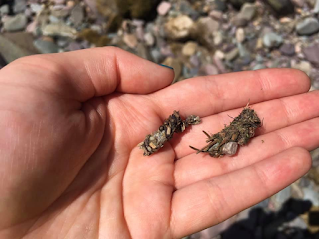
“Look for walking rocks,” I tell kids on WEN field trips, when we have emptied out a net of bugs into a tub of water. A case-building nymph uses its saliva-silk to bind pebbles together around its body. It uses whatever it can find to create its portable house. It might use grains of sand, pebbles of varying size artfully arranged, or perhaps even bits of twigs and stems for a boxy, striped look. Every so often I find lighter toned cases with glimmering rocks, as if the caddisflies were as enraptured with the sparkle as I was. If you don’t have pockets, incorporate the sparkle into your house!
The sparkly cases remind me of the French artist, Hubert Duprat, who kept caddisflies in captivity. He gave them only pearls, gold flakes, and turquoise. Those were the caddisflies of high fashion, crawling around with precious stone adornments.
Once the case is made, only the head and legs stick out, like black eyelashes, so it can crawl around and snag food. The caddisfly eats bits of plant and animal debris that collect on the bottom of the stream, like dust in our houses. Because of the black bodies, you can easily spot the half-inch-long caddisflies in a white tub. It’s the tiny ones that are tricky. That’s when my advice comes in handy. If you are patient enough to let the water settle, only the live insects will move. If you see tiny pebbles or grains of sand moving independently along the bottom, you’ve found a caddisfly!
When the caddisfly is old enough, they grow wings and move out, leaving the case behind. If you find one of these empty cases, you’ll see a tiny air hole on the back end. This tiny air hole is a perfect spot to string up the case on a bracelet or necklace. One WEN volunteer, Al, works at an insect taxonomy lab and brings us leftover cases to do just that.
“Where are these caddisfly cases from?” Deb asked during one of our jewelry-making sessions.
“King County,” Al said.
Seattle is in King County. They were from home.

Monday, January 4, 2021

Living in a Caddisfly Case: Part Two

By Cassie Sevigny

My first trip, we had to leave Missoula to reach our stream site. My mental orientation at this point lacked a compass rose. I biked to the office, crammed myself into Becca's car like another piece of gear, and sat quietly for an hour while we drove off the map into the Wilds of Montana. That is, we went to Lolo.
We lost cell phone service. We passed driveways with signs and side roads without. Rusty pickup trucks guarded the paint-peeling houses. We parked on a dirt shoulder near the day’s assigned stream spot. Popped the trunk, loaded our arms with waders, measuring tools, and clipboards.
Riverside, we untied our shoes, stowed them on the bank, and pulled on the waders. I glanced enviously at the boot-waders the rest of our small team wore. With small feet, my only option were the child-sized, overall-style waders. The waterproofed camo fabric of the legs hugged me so snugly that I had a slight penguin-like waddle. But my waders had pockets.

We had several sets of data to gather, and one of those was called Pebble Count. That sounded pretty boring at first – just gonna start counting pebbles, we’ll be here all day folks. But during Pebble Count we do not actually do any counting of pebbles. We measure rocks.
I reached into the water, hand stinging from the sudden cold, picked up a rock in front of my foot, and pulled a lime green ruler from the pocket of my waders. Daylight reflected off the wet rock. Wait, no, those shimmering striations were embedded in the piece of granite! I tilted the rock back and forth in my hands.
I held the ruler to the rock along its B axis – not its height or length, but width – to find its mediumest measurement.
“50 millimeters!” I yelled to my partner with a clipboard.
I pocketed the rock. When else was I going to find such a glittery rock? I took a step forward deeper into the river. My hand made the polar plunge again to retrieve a second rock. It too, sparkled. Looking up from my Pebble Count, the entire streambed was composed of these sparkle-ridden rocks, a river of treasure flowing through the mountains underneath the crystal clear waters.


Monday, November 16, 2020

My Summer as a Writer in Residence at Rattlesnake Creek Dam


By Cassie Sevigny


A glint of white, a shine of running water ahead. The water is seeping in from the corner of the drained reservoir, opposite the headgates, already braiding through the ditches left by the trucks. The new trickle of stream already washes away the drying, damp, and cracking clay below my feet, the clear water flaunting the muted rainbow of glacial stones. These revealed rivulets of rainbow rocks are their own kind of slow, mini excavation alongside the deconstruction of the dam.


This is a note I wrote while exploring the drained Rattlesnake Creek reservoir as an artist in residence for Trout Unlimited. I was finishing my Master’s in Economics at University of Montana (UM) when I found Open AIR Montana’s artist residency program. Eager to work on a creative project after plunging into statistical econometric analysis, I applied. My excitement heightened upon seeing Rattlesnake Creek dam as a site option because of my prior experience in the creek with the Watershed Education Network (WEN) as a college student. I have participated in citizen science with WEN’s Stream Team and taught local students about river science on WEN field trips. The citizen-led efforts and success of initiating the defunct dam's removal inspired me on a civic level. I was not part of the initial process to approve the removal of the dam, so this was my chance to be involved! 


Since so much of my writing depends on what I see and feel, I did not know exactly where my writing would take me with this project. I wanted to express the importance of this body of water to Missoulians and beyond, the science behind the effects of dams on river ecology, the politics and history of its installation, abandonment, and removal, and the sheer subjective experience of this human-environment interaction. During the residency I spent many days hiking up to the dam overlook, or to the site itself when the construction workers had the day off. I wandered around, connecting pieces of historical and ecological information with aspects of the site itself.


To inform myself, I attended public talks, tours, and virtual lectures by Rob Roberts and Ladd Knotek. I read about bull trout and the importance of the Rattlesnake Creek to local native societies. I helped dig out items from a garbage-and-dirt heap when a local historian came to inspect its trash and treasure. I took pictures of the plants I found along the creek and learned about them with the iNaturalist app. I reviewed the plan for the dam’s deconstruction, and the reconstruction of a semblance of what the original creek might’ve looked like. And of course I ran into WEN staff members along the trail examining the dam removal’s progress.


WEN gave me experience in applied science outdoors with a local stream that connected me to my Montana environment in the first place. Trout Unlimited and Open AIR Montana gave me just the opportunity I needed and desired to explore creative writing and my relationship with an ecosystem that has a soft spot in my heart. 


woody caddisfly cases in open hand

Wednesday, November 4, 2020

Cassie's First Bear!

 By Cassie Sevigny


One Tuesday I dropped in on Level 2 Stream Team. I had to go to the bridge crossing Rattlesnake Creek but not cross it myself. Instead I stayed left, barely found the narrow overgrown trail along the bank, and followed it upstream. “Don’t forget to make noise to alert bears since you’re walking alone,” Deb had warned me. Aissa found me before I’d gotten far and showed me to the site.


I stood on mossy rocks and watched Aissa, Stephie, Reyna, and Joe wrangling insect samples from a special collecting net into a jar. It was a process that required all four sets of hands. Out of the corner of my eye I saw a dark figure leaning over a fallen branch in the woods across the stream. Weird spot for someone to be wandering, I briefly thought, but people are weird. A few minutes later I saw the black shape stretch up, and up, and up into a tree. It was no person. I couldn’t even form words in my excitement and surprise. I just pointed. “A bear!” Aissa told everyone. “It’s eating berries from the mountain ash.” 


The bear lounged for a while, ignoring us. Or perhaps not noticing us, for ten minutes later it lumbered toward the creek and suddenly stopped. There were people in the creek! I wondered if it had intended to come down for a drink or a splash. Likely bears do not usually encounter people in their creek so far upstream, away from main trail access. The bear paused for a bit, contemplating what to do, and eventually retreated into the woods. I wondered if it was going to find another spot.


Deb arrived later with Joe Glassy, WEN board member, who she ran into on the trail. I find this a common occurrence with Deb, who seems to know everyone. Joe had brought his dog Lucy and his camera. How unfortunate he had missed the chance to photograph the bear! But as we talked and the team returned to collecting the fatal insect sample, the bear re-emerged from the trees a ways upstream! It lay down at the edge of the water. If not for the slight movement, it could’ve been mistake for a large black boulder among the rocks. 


I’ve lived in Missoula six years now and seen plenty of deer, birds, insects and squirrels. I know bears frequent the Rattlesnake, and I’ve even been at Greenough during reports of bears in the creek. But this was the first one I’ve seen. I felt part elation and part realization that I couldn’t remember how you were supposed to respond to a bear’s presence. Stream Team had bear spray of course, and we didn’t need to use it. But the fact that I was in the bear’s territory and came face to face with one reminded me how wild the land is, and how easily we can ignore that when we build houses and ranches and roads and trails and bring our urban selves so close to the edge of a wilderness.


Tuesday, November 3, 2020

Resplendent Stream Team

By Cassie Sevigny

Returning to WEN as a staff member has felt a bit like a homecoming. Stream Team days pull me out of my apartment isolation and into the woods, resplendent with yellow and red leaves and striped with tree trunks among the dry blond underbrush. I see Rattlesnake creek, which is not cutting through the forest but embedded as part of it, and I realize sometimes we forget about things that make us happy.

The cool fall weather indicates Stream Team season is ending, so I’ve been lucky to go out several times in the past few weeks. One trip brought me to a location between Greenough and the dam site that I had not been to before. A family was leaving the area around the tilted narrow stone table and bench when we arrived. Upon the table we spread out our gear around a little fall fairy house someone had made. Red berries perched in the shelves of pinecones, and leaves and pine needles stuck out like flags from a mossy wood-and-bark house. That day ended with wine and a light plum cake made with Deb’s recipe and Aissa’s plums. The immediate feeling of being among family and working to a common goal makes me happy.


I also helped with a special Stream Team day with University of Montana’s Water Policy class, taught by Ada Montague, this time at a familiar site by the Duncan trailhead bridge. Clouds clung thickly to the sky and the thin conifers swung about in the wind. It was hard to find insects in our tubs with all the leaves and other fall debris. They needed someone “solid on bugs” to teach the volunteers what to look for and how to identify the insects we were counting. I wasn’t sure how much I would remember but trusted in my ability to recognize and relearn. Turns out even after a few years’ absence from leading any stations, I still know my aquatic insects! Pointing out the tiny wiggling ones reminded me of when I was a new volunteer, delightedly soaking up every bit of Al’s professional expertise that I could. 

Working with WEN has taught me to take the lead with whatever they throw at me. I’ve also been reminded that I have plenty of skills and knowledge from years of working with WEN. That expertise makes me comfortable teaching and leading stations, even if I’m initially hesitant, so that others can learn the excitement of their watersheds too.